Hoax Bomb Threats Hit Flights Across Europe as Police Hunt the Sender

At least seven passenger flights across Europe were searched, diverted or escorted by fighter jets on Tuesday, November 4, 2026, after a wave of hoax bomb threats that authorities later confirmed were false. No explosives were found on any aircraft, all flights landed safely, and no group has claimed responsibility, but the scale of the disruption has left police in several countries hunting for the sender.
The airlines affected included Ryanair, Polish carrier LOT, Scandinavian Airlines and Wizz Air, with flights heading to Warsaw, Rome, Sofia and Murcia among those targeted. Here is what happened flight by flight, what investigators know so far, and why security experts say a single day of threats across six countries is exceptional.
| Quick Fact | Detail |
|---|---|
| What happened | Wave of hoax bomb threats against passenger flights across Europe on November 4, 2026 |
| Flights affected | At least seven flights, plus an Israel-bound cruise ship separately searched |
| Airlines hit | Ryanair, LOT, Scandinavian Airlines and Wizz Air |
| Explosives found | None on any aircraft |
| Worst hit airline | Ryanair, with four flights targeted |
| How threats arrived | By email, where officials have described the method |
| Responsibility claimed | None, and no arrests reported |
| Previous day | November 3: Wizz Air flight escorted to Budapest by a Hungarian fighter jet |
How the Day Unfolded Flight by Flight
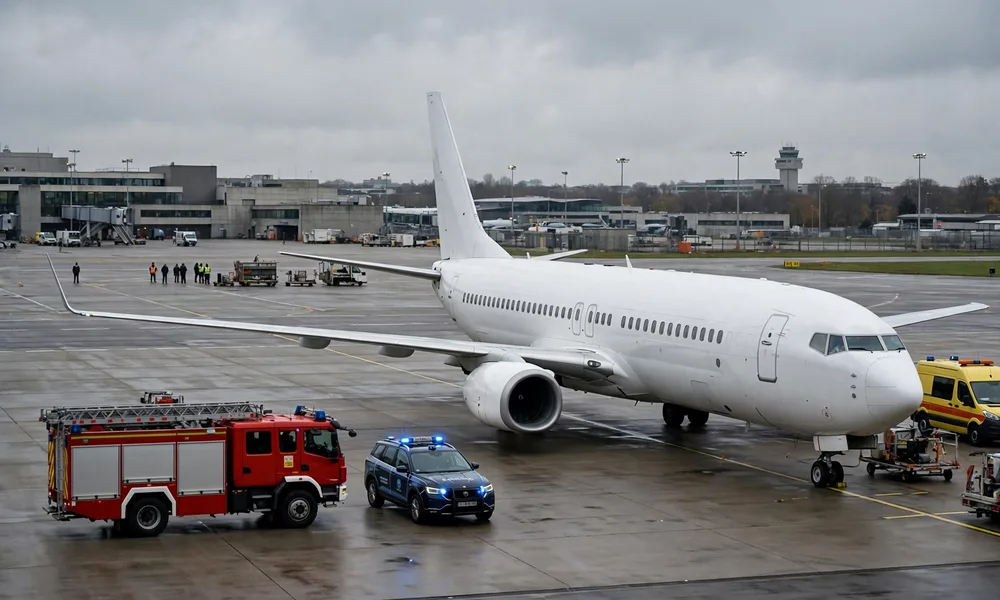
The biggest disruption involved LOT Polish Airlines flight LO286 from London Heathrow to Warsaw. After airport authorities flagged a potential security threat on board, the flight was diverted to Warsaw Modlin Airport with 181 people on board, landing safely at 10:01 a.m. local time. Modlin Airport closed briefly while security teams investigated. The flight had been carrying Jewish schoolchildren from London on a Holocaust education trip, according to reporting on the incident.
In Italy, two Ryanair flights bound for Rome were searched after anonymous threats. Ryanair flight FR9611 from Dublin was escorted into Rome’s Fiumicino Airport by two Italian Air Force Eurofighter jets, landing at 10:45 a.m. local time, while a separate Ryanair flight from Lisbon was also escorted and searched. Police bomb disposal teams checked both aircraft and found nothing.
In Spain, a Ryanair flight from Manchester to Murcia, carrying 114 passengers and seven crew, landed in Spain after receiving a threat. The Guardia Civil searched the aircraft and its baggage, ruled out explosives, and allowed Murcia Airport to resume normal operations. In Poland, a Scandinavian Airlines flight SK751 from Copenhagen landed without incident at Warsaw Chopin Airport, which closed a runway while the plane was inspected. In Bulgaria, two planes arriving in Sofia from Bergamo and Dublin were inspected and found clear, and neither was diverted.
For a closer look at another European disruption story this week, read about hackers hitting supermarket freezers across 10 European countries.
Why Experts Say This Wave Was Exceptional
Seven confirmed bomb threats in a single day affecting flights is exceptional, according to Rhys Jones, analysis output manager at aviation risk advisory firm Osprey Flight Solutions. Matthew Borie, the firm’s co-founder and chief intelligence officer, offered three hypotheses: a single threat triggering copycat incidents, an individual or group making multiple coordinated threats, or operations of hybrid warfare by state actors or their supporters.
Borie noted that the focus on European carriers could indicate a Russian angle, while adding that Iranian hybrid warfare activity in parts of Europe was equally active. Officials have been more careful. No country has pointed fingers, no government has named a suspect, and Moscow and Tehran both deny any such campaign. Bulgarian authorities were still attempting to identify the sender of the threats as of November 4.
The context matters. The wave followed a Wizz Air flight from London Luton to Sofia that was diverted to Budapest the previous day after a bomb threat received mid-air, with a Hungarian Air Force Gripen scrambled to intercept and escort the aircraft. That pattern made the following day’s threats harder to dismiss as coincidence. The same week, unidentified hackers shut down fridges in supermarkets in several European countries, and some experts said hoax bomb threats could be part of a similar pattern of low cost, deniable disruption efforts.
What Happens to Passengers and to the Investigation
For passengers, the immediate effect was delay, diversion and a security search, followed by a safe landing and, in most cases, onward travel. Airlines and airports followed well tested procedures: land or divert, search the aircraft and baggage with police and bomb disposal teams, and only release the plane when it is declared clear. The UK government described the warnings as malicious hoax threats and said the UK has one of the most robust aviation security systems in the world, with well tested processes for responding to potential threats.
For investigators, the work is now about tracing the emails. Where officials have described how the threats arrived, it was by email, and police in several countries are working together to determine whether the incidents were connected. Greek authorities were separately investigating a bomb threat against the Crown Iris, a Panamanian flagged, Israeli run cruise ship carrying 940 passengers and 597 crew in the port of Syros, which was evacuated as a precaution, though no connection between that incident and the flight threats had been established.
Polish Prime Minister Donald Tusk said on Tuesday that security forces had thwarted an attempted overnight provocation near the country’s border with Russia’s Kaliningrad exclave, adding to the sense of a tense week for European security. None of that proves a link to the flight threats, and officials have been careful not to claim one. But it explains why this story is being watched far beyond the airports involved. For more travel disruption coverage, see United Airlines flight UA82 emergency and Iran claims four tankers destroyed near Strait of Hormuz.
Frequently Asked Questions
Were any explosives found on the flights?
No. All of the affected aircraft were searched and no explosives were found. Every threat turned out to be a hoax, and all flights landed safely.
Which airlines and routes were affected?
Ryanair, LOT, Scandinavian Airlines and Wizz Air were affected. Flights included London Heathrow to Warsaw, Manchester to Murcia, Copenhagen to Warsaw, Dublin and Lisbon to Rome, and Bergamo and Dublin to Sofia.
Has anyone claimed responsibility?
No group or individual has claimed responsibility, and no arrests have been reported. Authorities have not attributed the threats to any individual, group or country.
Could this happen again?
Security experts say the pattern is hard to predict, but the wave followed a similar threat the previous day. Airlines and airports say their procedures for malicious hoax threats are well tested, and police in several countries are now working together to trace the sender.
Sources
Reporting for this article drew on coverage citing the Associated Press, BBC News and Reuters, plus aviation security analysis from Osprey Flight Solutions. Readers can check the original reporting here: Insurance Business on Europe’s wave of aviation bomb hoaxes, report on bomb threats disrupting flights across Europe, and Daily Britain on hoax threats hitting six European flights.
Final Thoughts
A hoax is easy to dismiss once everyone is safe, but that would miss the point of this story. Whoever sent these threats managed, at almost no cost, to divert planes, scramble fighter jets, close runways and frighten hundreds of passengers across six countries in a single day. That is disruption on a scale that no single prankster usually achieves, which is why investigators are treating the wave as a serious case even though no bomb existed. Until the sender is found, airlines will keep flying the same routes, passengers will keep boarding, and security teams will keep searching every plane that gets a threat. The system worked this time. The question now is whether it was tested by a copycat, a coordinated group, or something bigger, and the answer will shape how Europe guards its skies in the months ahead.