South Africa Votes in Municipal Elections as ANC Faces Its Toughest Local Test in 30 Years

South Africans voted on Wednesday, November 4, 2026, in municipal elections widely seen as a critical test for the governing African National Congress, the party that led the country out of apartheid in 1994 but has steadily lost support over the past decade. A record 29.2 million people were registered to vote at 23,696 polling stations, and polls suggest the ANC could fall below 40 percent nationally, with control of major cities including Johannesburg up for grabs.
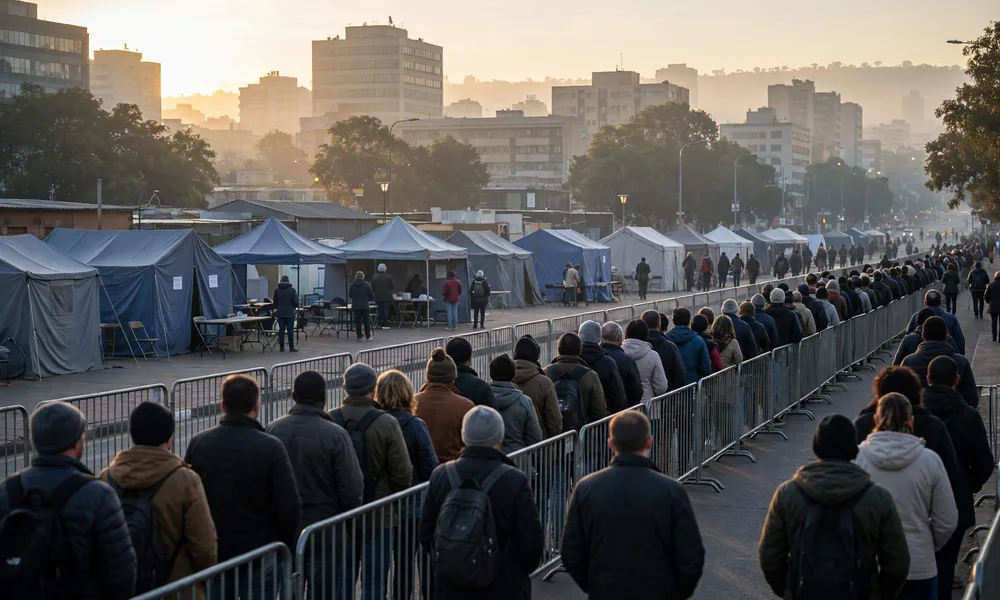
Polling stations opened at 7 a.m. local time and were due to close at 9 p.m., with Wednesday declared a public holiday to encourage turnout. Final results are expected on Sunday. Here is what is at stake, which cities matter most, and what the outcome could mean for South Africa’s politics ahead of the 2029 national elections.
| Quick Fact | Detail |
|---|---|
| What happened | South Africans voted in local government elections on November 4, 2026 |
| Registered voters | Record 29.2 million people at 23,696 voting stations |
| Poll hours | 7 a.m. to 9 p.m. local time, with Wednesday declared a public holiday |
| Special votes | More than 1.4 million cast on Monday and Tuesday, from 2.6 million approved applications |
| Seats contested | 10,526 council seats, contested by 136,790 candidates including independents |
| ANC polling | One Ipsos poll put ANC support at about 30 percent, down from 46 percent in 2021 |
| Key battlegrounds | Johannesburg, Durban and other major metros |
| Results due | Final results expected on Sunday, November 8, 2026 |
Why This Election Matters So Much
The ANC once commanded overwhelming majorities. It won about 70 percent of the vote in the 2004 general election, but its share has fallen in every cycle since. It fell below 50 percent in the 2021 municipal elections for the first time since the end of apartheid, and in the 2024 national and provincial elections it lost its parliamentary majority for the first time since 1994. It now leads a government of national unity with the Democratic Alliance and other parties.
This local election is the first big test since that 2024 setback, and it tests the party where voters feel government most directly: water, electricity, roads, refuse collection and local jobs. A recent auditor general report awarded clean audits, the highest standard of financial management, to only 39 of South Africa’s 257 municipalities for the 2024/25 financial year. That figure has become a shorthand in the campaign for why many voters are angry.
President Cyril Ramaphosa has rejected suggestions that the party is in irreversible decline. At its final campaign rally he told supporters that support was recovering. “What I am seeing here is that the ANC is going higher and higher and on the 4th of November we will show those naysayers,” he said. Wednesday’s vote is the moment that claim gets tested.
For a closer look at another major political story this week, read about Spain transport minister resigns after train crashes.
Johannesburg, Durban and the Battle for the Metros
Voters are electing councils for eight metropolitan municipalities, 44 district councils and 205 local councils, and those councils will then choose mayors. The contest for Johannesburg, South Africa’s commercial centre, is expected to be one of the most closely watched races. The city has had five mayors in four years, a symbol of the instability that has frustrated residents and businesses alike.
The Democratic Alliance is seeking to expand its influence, particularly in Johannesburg, where it has nominated Helen Zille, 75, a former national leader, as its mayoral candidate. A News24 poll put Zille at 36 percent, which would still leave her needing coalition partners, particularly the ANC, to govern. That is the pattern many analysts expect across the big metros: no outright winner, and messy coalition talks afterwards.
In Durban and the wider KwaZulu-Natal province, the uMkhonto weSizwe party led by former president Jacob Zuma is contesting its first local election after becoming the third largest party in Parliament in 2024. Its performance in Durban will show whether its national breakthrough can translate into local power. More than 500 political parties are contesting the elections in total, a sign of how fragmented South African politics has become.
What Voters Are Angry About
Water shortages, electricity failures, crime, unemployment and poor municipal services are the central issues in this election. Residents in many towns deal with regular electricity and water outages, potholed roads and unreliable refuse collection. Just 17 percent of adults recently surveyed by the Human Sciences Research Council said they were satisfied with the country’s democratic trajectory, while 68 percent expressed active dissatisfaction.
An Ipsos survey of 2,533 registered voters found that half of respondents said no party represented their views, while 68 percent said politicians could not be trusted. Those numbers help explain why turnout is such a worry. Turnout in the 2021 municipal elections was about 46 percent of registered voters, the lowest since democracy, against about 59 percent in the 2024 national vote. Wednesday was declared a public holiday precisely to push that figure up.
The special vote numbers suggest enthusiasm is at least higher than in 2021. More than 1.4 million special votes were cast on Monday and Tuesday, part of a record 2.6 million special vote applications approved. That is a sharp increase from the previous local elections, and election officials will be watching whether it translates into higher turnout on the day itself.
What Happens After the Votes Are Counted
The Electoral Commission of South Africa is expected to release results within a few days, with final results due on Sunday. In councils where no party wins a majority, coalition negotiations will begin, and in the big metros those talks could take weeks. South Africa has recent experience of this: unstable coalitions have governed several major cities since 2021, sometimes collapsing and forcing new mayoral votes.
The results will also shape the race to succeed Ramaphosa as ANC leader at the party’s conference in December 2027, and they could reshape local political alliances ahead of the 2029 national elections. A result below 40 percent nationally would deepen questions inside the ANC about its direction. A result that holds up better than the polls suggest would give Ramaphosa room to argue that the recovery he promised is real.
Either way, the governing challenge does not change on Monday morning. Whoever runs Johannesburg, Durban and the other metros will inherit the same broken pipes, the same strained budgets and the same impatient voters. The election decides who gets the chance to fix them. For more international coverage, see Dapo Akande elected ICJ judge for nine year term and global stocks slide after Democratic sweep.
Frequently Asked Questions
When did South Africa’s 2026 municipal elections take place?
South Africans voted on Wednesday, November 4, 2026. Polling stations opened at 7 a.m. and were due to close at 9 p.m. local time, and Wednesday was declared a public holiday to encourage participation.
How many people were registered to vote?
A record 29.2 million people were registered to vote at 23,696 voting stations nationwide. More than 1.4 million special votes had already been cast on Monday and Tuesday before polling day.
Why is the ANC under pressure in this election?
The ANC fell below 50 percent in the 2021 municipal elections for the first time since apartheid ended, then lost its parliamentary majority in 2024. Polls ahead of the 2026 vote suggested its support could fall below 40 percent, with one Ipsos poll putting it at about 30 percent.
When will the results be announced?
Final results are expected on Sunday, November 8, 2026. Where no party wins a majority in a council, coalition talks will follow to choose a mayor.
Sources
Reporting for this article drew on coverage from BusinessDay, Moneyweb and the Sowetan, with polling figures from Ipsos and the Electoral Commission of South Africa. Readers can check the original reporting here: BusinessDay on South Africa voting as ANC decline puts major cities up for grabs, Moneyweb on key things to watch in the municipal elections, and Sowetan on South Africans heading to the polls.
Final Thoughts
South Africa’s municipal elections rarely get the world’s attention, but this one deserves it. The ANC is not just fighting for town halls. It is fighting to prove that the party of Nelson Mandela can still win the trust of voters who live with failing services every day. The record registration and the surge in special votes show that South Africans have not given up on voting, even if many say they trust no party. What they want is simpler than any manifesto: water that runs, lights that stay on, roads that are fixed and councils that account for their money. Whoever wins on Sunday will be judged on exactly that, and the clock will start ticking the next morning.