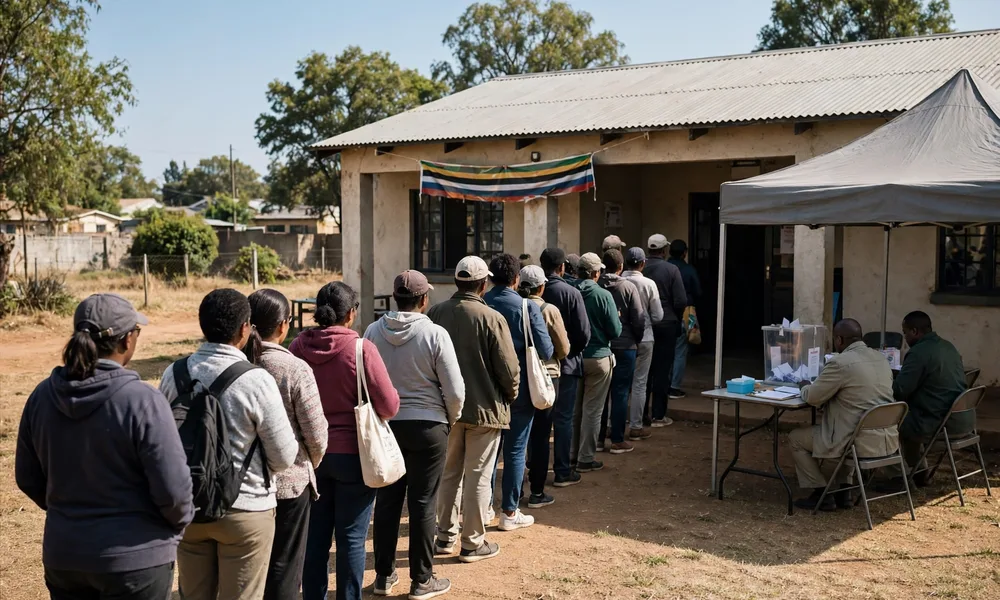
Early results from South Africa’s municipal elections show the governing African National Congress, the ANC, narrowly ahead of the Democratic Alliance, the DA, but the count is still at a very early stage and the picture could change a lot. With about 12 percent of votes counted by 04:24 GMT on Thursday, November 5, 2026, the ANC had about 32 percent of the vote, just ahead of the DA on 31 percent, according to the election commission, the IEC. A later update, with 19 percent of votes counted, put the ANC at about 31.4 percent and the DA at 30.5 percent. South Africans voted on Wednesday, November 4, and the final results are due within seven days.
Quick Facts
| Election | Municipal elections, Wednesday, November 4, 2026 |
| Early leader | ANC, about 32 percent with 12 percent of votes counted |
| Second place | DA, about 31 percent with 12 percent of votes counted |
| Later update | ANC 31.4 percent, DA 30.5 percent, with 19 percent of votes counted |
| CSIR projection | ANC about 32 percent and DA about 26 percent in the final tally |
| Registered voters | About 29.2 million |
| Voting stations | 23,696 |
| Parties contesting | 508 |
| ANC in 2021 municipal elections | 46 percent, down from 62 percent in 2011 |
| Gauteng early results | DA 40.89 percent, ANC 18.48 percent |
| Western Cape early results | DA 59.09 percent |
| South African rand | Strengthened about 0.5 percent to 16.3425 per dollar |
| Final results | Due within seven days, declaration expected on Sunday |
| Coalition talks | Parties have two weeks to negotiate after results |
What the Early Results Show
South Africans went to the polls on Wednesday, November 4, 2026, to vote in municipal elections that were widely seen as a test of the ANC. The early numbers on Thursday morning told a close story. With around 12 percent of votes counted by 04:24 GMT, the ANC had about 32 percent of the vote, narrowly ahead of the DA on 31 percent, according to the IEC.
A projection by the Council for Scientific and Industrial Research, the CSIR, suggested the ANC could finish with about 32 percent in the final tally and the DA about 26 percent. That projection was based on 11.5 percent of voting districts having declared results. It is important to stress that this is a projection, not a final result, and it was made when only a small share of districts had reported.
The early tally may not mirror the final results. Only a small proportion of districts had reported in the populous provinces of Gauteng and KwaZulu-Natal when the early numbers were published. As counting continues in those big provinces, the national picture could move in either direction. Readers who followed our earlier coverage can compare the early results with what was expected before polling day in our election day preview of the ANC test in South Africa.
Gauteng and the Western Cape Tell a Different Story
The national picture hides big differences between provinces. In Gauteng, the province that includes Johannesburg and Pretoria, the DA was leading in the early count with 40.89 percent against the ANC’s 18.48 percent. Gauteng is the most populous province in the country, so its results carry a lot of weight in the national total. In the Western Cape, the DA led with 59.09 percent. The Western Cape is the DA’s stronghold, so a clear lead there was expected.
The reason the national gap is so tight even though the DA leads in Gauteng and the Western Cape is that the ANC still draws strong support in other parts of the country. Early national numbers are shaped by which districts report first, and that order can flatter one party or the other for a few hours. That is why election watchers are waiting for more districts to report in Gauteng and KwaZulu-Natal before drawing firm conclusions. Major municipalities including Johannesburg are not expected to have any clear winner, so coalition talks will matter a great deal once the final results are known.
Why Voters Turned Against the ANC
The November 4 vote was widely predicted to see the ANC lose ground. Voters were expected to punish the party for high crime rates, corruption scandals and failing basic services such as water and electricity. Those are the issues that dominate daily life in many South African towns and cities, and they were at the center of the campaign.
About 29.2 million voters were registered across 23,696 voting stations, with 508 political parties contesting. That is a huge field of parties, and it shows how crowded South African politics has become. Many voters now have local parties and independent candidates to choose from, which spreads the vote more widely than it did when the ANC dominated. The service delivery problems are not abstract for voters. Water cuts, power cuts and crime affect homes and businesses every day, and when a party has governed a municipality for years and the taps still run dry, voters tend to look elsewhere.
The Rand and the Market Reaction
The early signs of a strong DA performance moved the markets. The South African rand strengthened about 0.5 percent to 16.3425 per dollar on the early results. Traders took the close race as a sign that the DA, which is seen by many investors as the more business friendly of the two big parties, could do better than expected.
Elsewhere on the same day, global news was not limited to elections. Our report on the two tankers and tugboat fire in the Strait of Hormuz shows how other major stories were also drawing attention on November 5. Election results moved markets in the United States too, as covered in our report on how the Dow jumped 1100 points on the Democratic sweep and divided government. One early currency move is not proof of a lasting trend, and the final election result could still shift market views in either direction.
What Happens Next: Final Results and Coalitions
Final results and seat allocations are due within seven days of the election, with declaration expected on Sunday. That gives the IEC time to count, check and verify the votes from all 23,696 voting stations.
Once the results are declared, parties have two weeks to negotiate coalition governments. That two week window is where the real power in many municipalities will be decided. In places where no party wins a majority, small parties can become kingmakers, and the deals they strike will decide who runs the city or town. Johannesburg is the biggest example. With no clear winner expected there, the coalition talks for South Africa’s largest city will be watched closely, and the talks can be slow and tense.
For voters, the wait for final results is also a wait for answers about services. Whoever ends up running each municipality will face the same problems that drove the vote: crime, corruption and failing water and electricity. The coalition deals will decide who gets the chance to fix those problems, and voters will judge the new councils on whether the taps run and the lights stay on.
What This Means for 2029 and the ANC Succession
The outcome will help shape the political landscape ahead of the 2029 national election. Municipal elections are often read as a preview of national politics, and a poor ANC result in 2026 would raise questions about the party’s chances in 2029. The ANC has governed South Africa since 1994, but its vote share has fallen at every level, and the 2026 municipal result looks set to continue that trend. The result could also influence the succession battle within the ANC as President Cyril Ramaphosa nears the end of his term as party leader in 2027.
For the DA, the early numbers are encouraging but far from final. The party is leading in Gauteng and the Western Cape in the early count, and it is close behind the ANC nationally. If the final results confirm that picture, the DA will claim that it is now a genuine rival to the ANC across the country, not just in the Western Cape. That claim would shape its strategy for 2029.
For now, though, the only safe conclusion is that the race is close and the count is early. The CSIR projection of about 32 percent for the ANC and about 26 percent for the DA is a guide, not a verdict. The final numbers will only be known when the IEC declares the results, expected on Sunday, and until then every figure in this article should be read as provisional.
Frequently Asked Questions
Who is leading in the early South Africa municipal election results?
The ANC is narrowly ahead in the early results. With about 12 percent of votes counted, the ANC had about 32 percent and the DA had about 31 percent. A later update with 19 percent counted put the ANC at about 31.4 percent and the DA at 30.5 percent. Counting is still at a preliminary stage, so the lead could change.
When will the final South Africa municipal election results be announced?
Final results and seat allocations are due within seven days of the November 4 election, with declaration expected on Sunday. Parties then have two weeks to negotiate coalition governments in municipalities where no party won a majority.
What did the CSIR project for the final results?
The Council for Scientific and Industrial Research projected that the ANC could finish with about 32 percent in the final tally and the DA about 26 percent. The projection was based on 11.5 percent of voting districts having declared results, so it is an early estimate and the final numbers could differ.
Why is the ANC expected to lose support in these elections?
The vote was widely predicted to see the ANC lose ground as voters punished it for high crime rates, corruption scandals and failing basic services such as water and electricity. The ANC won 46 percent in the 2021 municipal elections, down from 62 percent in 2011, and the early 2026 numbers point to a further fall.
Sources
This article is based on reporting from Reuters, KTWB and Cape Town Etc. The Reuters report is available at Reuters, the KTWB report is available at KTWB, and the Cape Town Etc report is available at Cape Town Etc.
Final Thoughts
The early results from South Africa’s municipal elections point to a close race and a weaker ANC, but they are still only early results. With about 12 percent of votes counted the ANC led the DA by about one point, and with 19 percent counted the gap was still under one point. The CSIR projection of about 32 percent for the ANC and about 26 percent for the DA suggests the final result could be a clear step down for the governing party from its 46 percent in 2021. Gauteng and the Western Cape show how different the picture looks from province to province, with the DA ahead in both. The final results, expected on Sunday, will set the stage for two weeks of coalition talks and will shape the road to the 2029 national election and the ANC succession battle in 2027. Until the IEC declares the results, every number in this story should be read as provisional.