Seattle power outages: A powerful autumn windstorm swept across western Washington on Saturday evening, November 7, 2026, and knocked out power to more than 115,000 customers at the peak. Seattle City Light customers were hit hardest inside the city, with about 46,000 without power late on Saturday night. By Sunday morning, November 8, crews had restored power to many homes and businesses, but thousands were still waiting in the dark, and forecasters warned that another storm system due on Monday could bring more trouble.
Table of Contents
Quick Facts
| Fact | Detail |
|---|---|
| Date of storm | Saturday evening, November 7, 2026 |
| Peak outages across western Washington | More than 115,000 customers |
| Seattle City Light peak outages | About 46,000 customers |
| First outage reports | Around 8:44 p.m. in Arbor Heights, West Seattle |
| Strongest wind gusts inland | Up to 50 mph |
| Strongest wind gusts on coastal headlands | Over 69 mph |
| Seattle City Light customers still out at 10 a.m. Sunday | 6,783 in King County |
| Puget Sound Energy customers still out Sunday morning | 7,713 |
| Next storm system expected | Monday |
| Seattle City Light outage line | 206-684-3000 |
Seattle Power Outages: How the Storm Hit Western Washington
The first major storm system of the season arrived on the Pacific Northwest coast with real force on Saturday evening. The first outage reports came around 8:44 p.m. in Arbor Heights, West Seattle. Within about 20 minutes, outages spread fast across the city.
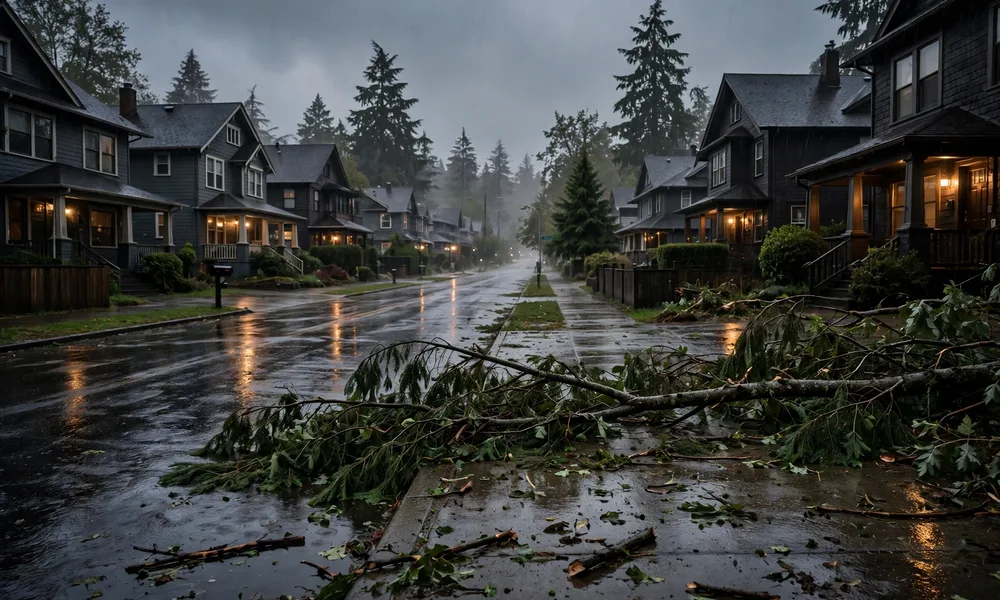
Wind gusts reached up to 50 mph in inland areas. Along coastal headlands, gusts went over 69 mph. That kind of wind can snap branches, topple weakened trees, and bring down power lines. Trees fell onto lines in many places. Wires came down in streets, and roads were blocked by fallen trees and debris.
The storm hit when many people were at home for the evening. Lights went out without warning in one street after another. PowerOutage.com figures reported by local outlets put the total across western Washington at more than 115,000 customers at the peak. The storm also arrived as part of a wider pattern of wild weather, with a cold snap already causing disruption elsewhere, as reported in our story on the polar vortex disruption, the earliest on record, and the winter cold snap on November 7.
Seattle City Light and the Hardest Hit Areas
Seattle City Light bore the heaviest load inside the city. About 46,000 of its customers lost power at the peak late on Saturday evening. At one point, the utility was working on 143 different outages across Seattle at the same time. This was not one broken line. It was damage spread across the city.
The early damage centred on West Seattle. In Burien and White Center, more than 20,582 customers lost power. The largest single outage in that area hit 4,884 customers in Burien alone.
By Sunday morning, the areas still most affected were in Capitol Hill, between Madison and Republican streets. Recovery does not happen evenly. Some streets can be fixed in an hour, while others stay dark for much longer when a tree is tangled in lines. Just before midnight, about 30,000 of its customers in King County were still without power. By 10 a.m. on Sunday, that number had fallen to 6,783. Seattle City Light customers can report outages by calling 206-684-3000.
Outages Across the Region
Seattle was the centre of the story, but the storm reached far beyond the city limits. Puget Sound Energy reported between 27,000 and 30,000 customers out across King, Pierce, Thurston, Skagit and Whatcom counties, with more than 220 outage sites.
To the north, Snohomish County Public Utility District reported more than 12,000 outages around Marysville and Lake Stevens. By Sunday morning, that number had fallen to 449. Peninsula Light Company reported about 6,000 customers out around Gig Harbor and the Key Peninsula. Tacoma Public Utilities reported 1,802 customers out around midnight, down to 13 by Sunday morning.
Taken together, these numbers describe a storm that hit the whole Puget Sound area at once. No single utility was spared. The first priority is safety, which means making downed wires safe and clearing roads. After that, crews work on repairs that will bring back the largest number of customers. The scale of the event puts it in context with other severe weather this weekend, including the earthquake near Hamamatsu in Japan on November 7 and the winter storm that flooded tens of thousands of tents in Gaza on November 7.
Recovery on Sunday Morning
By Sunday morning, November 8, the picture had improved, but it was far from normal. Seattle City Light showed 6,783 customers still out in King County at 10 a.m. Sunday, down from about 30,000 just before midnight. Puget Sound Energy showed 7,713 customers still out, down from 21,656 the night before.
Even so, thousands woke up on Sunday to cold homes and fridges that had been off for hours. For some, the outage had lasted all night. For others, power had come back and gone out again as crews switched lines on and off to make safe repairs.
Capitol Hill remained one of the hardest hit areas on Sunday morning. The pocket between Madison and Republican streets was still waiting for power while other neighbourhoods had already been restored. Roads blocked on Saturday night had to be cleared, and in some places poles and wires needed full replacement rather than a quick fix. People still without power were urged to check updates from their own utility and to follow local officials for live information.
What to Do During a Power Outage
A long outage is more than an inconvenience. It can be a safety risk, especially at night or in cold weather. The advice below is general information only. Always follow the guidance of your own utility and local officials, who will have the latest updates for your area.
Stay away from downed power lines. Treat every fallen wire as live, even if it looks dead or is not sparking. Do not touch it, do not drive over it, and do not try to move it. Keep children and pets away, and report it to your utility.
Use light safely. Candles are a fire risk, especially near curtains or bedding. Battery powered torches and lanterns are safer. Keep a charged phone or power bank ready if you can.
Check on neighbours, especially older people and people who live alone. A short knock on the door or a quick phone call can make a real difference. If someone depends on powered medical equipment, help them contact their utility or local services for advice.
Think about food safety. A fridge that stays closed will keep food cold for several hours. Keep fridge and freezer doors shut as much as possible. If power has been out for a long time, be careful with perishable food, and when in doubt, throw it out.
Never use a generator indoors, in a garage, or close to open windows and doors. Generators produce carbon monoxide, which is colourless and odourless and can kill. The same rule applies to charcoal grills and camp stoves, which should never be used inside a home. If you use a generator, keep it outside and well away from the house. Keep warm, dress in layers, and do not assume power will return at a set time, because repair times can change as crews find new damage.
What Comes Next
The storm that hit on Saturday night was the first major storm system of the season to hit the Pacific Northwest coast and Puget Sound with this force. That fact matters, because it means the season is now under way, and more systems are likely to follow in the weeks ahead.
Forecasters expected showers to linger into the coming week, with another storm system due on Monday. That means more outages were possible, even for customers who had just had their power restored. Wet ground makes trees more likely to fall, because roots lose their grip in soaked soil.
Utilities will be watching the Monday system closely. After a big storm, crews are tired, equipment is already stressed, and some repairs are temporary fixes. A second storm can test those fixes and create new damage. For people across western Washington, the message is simple. Be ready for more disruption. Keep torches, batteries, and a charged phone to hand, and know how to report an outage to your utility.
Frequently Asked Questions
How many customers lost power in the Seattle windstorm?
More than 115,000 customers lost power across western Washington at the peak on Saturday night, November 7, 2026. Seattle City Light accounted for about 46,000 of those customers. Puget Sound Energy reported between 27,000 and 30,000 customers out.
When did the outages start?
The first outage reports came around 8:44 p.m. on Saturday in Arbor Heights, West Seattle. Within about 20 minutes, outages spread fast across the city and into nearby areas, including Burien and White Center.
How many customers were still without power on Sunday morning?
Seattle City Light showed 6,783 customers still out in King County at 10 a.m. Sunday, down from about 30,000 just before midnight. Puget Sound Energy showed 7,713 still out, down from 21,656 the night before. Tacoma was down to 13, and Snohomish County was down to 449.
How can Seattle City Light customers report an outage?
Seattle City Light customers can report outages by calling 206-684-3000. Customers should also check the utility website and outage map for live updates, and follow local officials for safety information.
Sources
Final Thoughts
The Seattle power outages on Saturday night, November 7, 2026, were a sharp reminder of how fast life can change when the weather turns. In less than an hour, more than 115,000 customers across western Washington lost power. In Seattle, about 46,000 City Light customers were hit at the peak, and crews worked through the night on 143 separate outages. By Sunday morning, recovery was well under way, but Capitol Hill was still waiting, and another storm system was due on Monday. The best response now is to stay prepared, check on neighbours, follow utility updates, and treat every downed line with care until crews say it is safe.