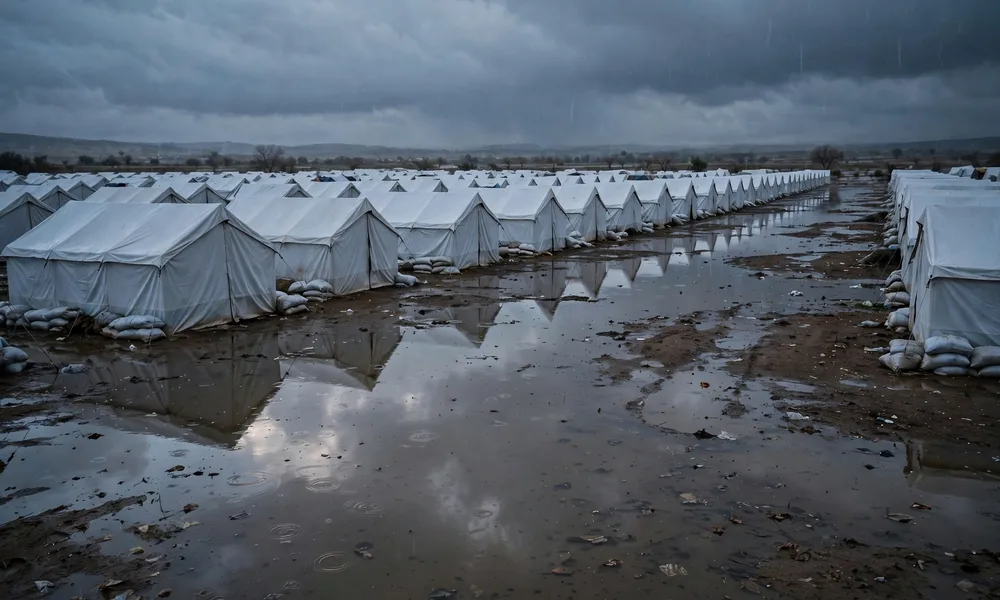
The first winter storm of the season hit the Gaza Strip on Saturday, November 7, 2026, and within twelve hours it had flooded at least 70,000 tents that were sheltering displaced Palestinians. The figure comes from the Hamas-run Gaza government media office, which reported the flooding to the news agency Reuters. Tens of thousands of people were affected across the territory. Some people were injured, but no deaths had been reported by the time the figures were released. The media office put the initial damage at about three million dollars.
Quick Facts
| Detail | What happened |
|---|---|
| Storm date | Saturday, November 7, 2026, the first winter storm of the season |
| Tents flooded | At least 70,000, according to the Hamas-run Gaza government media office |
| People affected | Tens of thousands of displaced people |
| Fatalities reported | None reported at the time of the figures |
| Injuries | Some people were injured |
| Initial losses | About 3 million dollars, according to the media office |
| Distress calls | 1,500 calls in 10 hours, according to Gaza civil defence |
| Water levels | 30 to 40 centimetres (12 to 16 inches) at several shelter sites |
| Areas hit hardest | Gaza City, Khan Younis, and Deir el-Balah |
| Tents urgently needed | About 200,000, according to Gaza’s emergency committee |
How the storm overwhelmed the camps in hours
The rain began on Friday evening and grew heavier through the night. By Saturday morning, water was pooling inside tents across the Gaza Strip. Families in camps in Gaza City, Khan Younis, and Deir el-Balah waded through ankle-deep water as they tried to move their belongings to higher ground. Mattresses and blankets soaked through within minutes. In some places, the fabric of the tents sagged under the weight of the water and collapsed onto the people inside. Dozens of walls at shelter sites also collapsed under the force of the rain and the rising water.
Water levels at several shelter sites rose by 30 to 40 centimetres, which is 12 to 16 inches. That depth is enough to ruin anything stored at ground level, and in a tent there is almost nothing stored above ground level. Food, clothing, medicine, and bedding all sat in the water. For families who had already lost their homes, the storm took away much of what little they had left.
Why the response could not keep up
Municipal and civil defence officials said they were unable to cope with the storm because of fuel shortages and damage to their equipment. Pumps that could have cleared standing water were short of fuel. Trucks and machinery that could have moved sandbags or cleared blocked drains were damaged or out of service. Gaza’s civil defence service said it received 1,500 distress calls from displaced residents in just ten hours. Anadolu reported 2,166 distress calls since the storm began on Friday evening, with crews able to respond to only 218 of them. The gap between the calls and the responses shows how stretched the emergency services were.
Jonathan Veitch, the UNICEF representative for Palestine, said the situation was being made worse by Israeli restrictions on the entry of heavy machinery and supplies such as engine oil. Without that equipment, repair crews cannot keep their vehicles and pumps running. The shortage of machinery has been a running problem for months, and the storm exposed it in a single night.
COGAT, the Israeli military agency that coordinates aid, did not immediately comment on the accusations by Hamas. It said on Friday that it had stepped up efforts to improve sanitary conditions before the rain, which had been expected. Four additional vacuum trucks entered Gaza this week through the International Committee of the Red Cross, joining eight others brought in over the past month.
The mismatch between the need and the response is the story of this storm. The rain was forecast. The shortage of tents, fuel, and equipment was known in advance. The flooding still overwhelmed the system because the system had too little to work with. Families in the camps paid the price in wet bedding, ruined supplies, and a night spent standing in water.
The scale of the shelter crisis before winter
The storm hit a population that was already living in fragile shelter. Gaza’s emergency committee said more than one million displaced people face the dangers of winter and that about 200,000 tents and heating supplies are urgently needed. The Gaza Center for Human Rights warned that about 950,000 Palestinians live in displacement sites exposed to flood hazards. Those numbers describe a crisis that was waiting for the first heavy rain.
A November 5 report by the UN humanitarian office OCHA put the need in concrete terms. Gaza needed about 121,000 tents, 561,000 tarpaulins, 57,000 emergency shelter kits, and 1.7 million mattresses ahead of the cold and rainy season. The report was published just two days before the storm arrived, and the flooding of 70,000 tents on the first night of the season shows how far the supply of shelter falls short of the need.
Tents are not a durable answer to winter weather. They leak, they tear, and they offer almost no insulation against cold wind and rain. A mattress that has soaked through in a flood is no longer a mattress. It becomes a damp, heavy weight that breeds mold and illness. The coming months will bring more storms, and each one will test the same worn-out tents, the same blocked drains, and the same short-staffed emergency services.
What the wider region is watching
The flooding in Gaza comes at a moment when the wider region is in flux, and the international focus on the territory remains intense. The storm is a humanitarian story, but it is also a test of whether the aid system can meet a crisis that was forecast days in advance. The numbers in the OCHA report were public. The vacuum trucks were delivered. The storm was expected. The flooding still happened at a scale that overwhelmed the response. Elsewhere in the region, Egypt reopened its embassy in Tripoli after twelve years, a step toward rebuilding ties across North Africa. You can read the full story here: Egypt Reopens Tripoli Embassy After 12 Years.
At the same time, military action in the Gulf has drawn global attention. The United States confirmed strikes on Qeshm Island air defence systems, a development that raises the stakes for security across the region. You can read the full story here: Trump Confirms US Strikes on Qeshm Island Air Defence.
In Europe, a shooting in Krakow’s Market Square left six people dead, a tragedy that has shaken one of Poland’s most visited public spaces. You can read the full story here: Krakow Market Square Shooting Leaves Six Dead.
The human cost behind the numbers
The figure of 70,000 flooded tents is hard to grasp on its own. It helps to think of it as tens of thousands of households, each with its own small store of food, clothing, and bedding, all damaged in a single night. The media office put the initial losses at about three million dollars, but that figure counts only the material damage. It does not count the illness that follows when children sleep in damp bedding, or the days lost to cleaning up, or the fear that the next storm will be worse.
The health risks are real and immediate. Wet bedding and standing water create the conditions for respiratory illness, skin infections, and waterborne disease. Children and older people are the most vulnerable. In camps where clean water and sanitation are already scarce, a flood that mixes sewage with standing water can turn a bad night into a public health emergency. That is why the OCHA report listed mattresses alongside tents and tarpaulins: a dry place to sleep is not a comfort, it is a basic need. The war behind this crisis followed the October 7, 2023 attacks in which about 1,200 people were killed in southern Israel. Palestinian authorities say more than 74,000 people have been killed in Gaza since then, and the Hamas-run health ministry said 1,580 people have been killed since the ceasefire came into force.
What happens next
The immediate need is clear: dry shelter, dry bedding, and working pumps. The emergency committee’s call for about 200,000 tents and heating supplies is the headline figure, but the OCHA list gives the fuller picture. Tents, tarpaulins, shelter kits, and mattresses all need to arrive in large numbers and reach the camps before the next storm.
The longer question is whether the aid system can move fast enough. The storm was forecast, the needs were documented, and the flooding still overwhelmed the response. That pattern will repeat with each new storm unless the supply of shelter and the capacity of the emergency services grow sharply. Fuel for pumps, engine oil for machinery, and trucks for clearing water are not optional extras. They are the tools that decide whether a storm is a bad night or a disaster. For now, families in the camps are drying what they can save and waiting for the next forecast.
How many tents were flooded in the Gaza winter storm?
At least 70,000 tents were flooded within twelve hours of the storm’s arrival on Saturday, November 7, 2026, according to the Hamas-run Gaza government media office. Tens of thousands of displaced people were affected, and the media office put initial losses at about three million dollars.
Was anyone killed in the flooding?
No fatalities had been reported at the time the figures were released. Some people were injured in the storm, and dozens of walls at shelter sites collapsed. Gaza’s civil defence service received 1,500 distress calls in ten hours, and Anadolu reported 2,166 calls since Friday evening.
Why could the emergency services not cope with the storm?
Municipal and civil defence officials said fuel shortages and damaged equipment left them unable to cope. UNICEF representative Jonathan Veitch said Israeli restrictions on heavy machinery and supplies such as engine oil made the situation worse. Crews could respond to only a fraction of the distress calls they received.
How much shelter does Gaza still need before winter?
Gaza’s emergency committee said about 200,000 tents and heating supplies are urgently needed for more than one million displaced people. A November 5 report by the UN humanitarian office OCHA said Gaza needed about 121,000 tents, 561,000 tarpaulins, 57,000 emergency shelter kits, and 1.7 million mattresses ahead of the cold and rainy season.
Sources
- Reuters: Heavy rain floods tents housing Gaza displaced people as aid shortages hamper response
- SRN News: Heavy rain floods tents housing Gaza displaced people
- Eastleigh Voice: 70,000 displacement tents flooded as winter storm hits Gaza
Final Thoughts
The first winter storm did in twelve hours what months of warnings had described: it flooded 70,000 tents and left tens of thousands of displaced people standing in water. The storm was forecast. The need for tents, tarpaulins, and mattresses was documented two days earlier by the UN. The emergency services still could not keep up: fuel was short, equipment was damaged, and crews answered only a fraction of the calls for help. The flooding is a warning about the months ahead. Each new storm will test the same worn tents and the same stretched services. The time to close the gap between the need and the supply is now, before the next rain arrives.
Image: AI-generated editorial illustration.