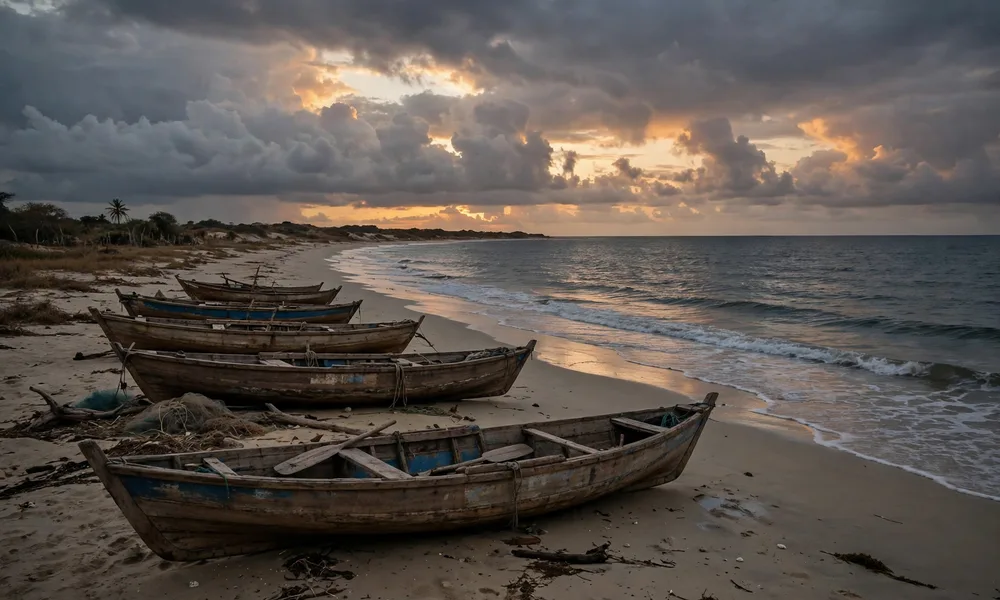
At least 35 people have died after a wooden migrant boat capsized off the coast of northwestern Senegal, and the search for more victims was still under way on Sunday, November 8, 2026. The boat, a traditional flat-bottomed pirogue, went down off the Loumpoul dunes in the Kebemer department of the Louga region, about 180 kilometres north of Dakar. Senegal’s Interior Ministry said rescue teams had recovered 21 bodies by Saturday evening and saved one person. Later updates pushed the provisional toll higher, first to 34 and then to at least 35, with one survivor confirmed. The total number of people on board is still not known, and officials have said the toll may change again as the search continues.
Quick Facts
| Fact | Detail |
|---|---|
| What happened | A wooden pirogue carrying people attempting to migrate irregularly capsized off the Senegalese coast |
| Where | Off the Loumpoul dunes, Kebemer department, Louga region, northwestern Senegal, about 180 km north of Dakar |
| When | Reports differ between Friday, November 6, and Saturday, November 7, 2026 |
| Death toll | At least 35, provisional, as of Sunday, November 8, 2026 |
| Survivor | One person rescued alive |
| People on board | Total number not known |
| Victims’ home area | Most victims reported to come from the Leona and Thieppe districts of Kebemer department |
| Route | Atlantic Ocean route from West Africa toward Spain’s Canary Islands |
| Search status | Still going on, with families of victims being helped |
What Happened Off the Kebemer Coast
The boat was a pirogue, a wooden flat-bottomed vessel used for generations by fishing communities along the West African coast. Pirogues are built for near-shore fishing, not for long ocean crossings, yet they are often used by people trying to reach Europe by sea because they are cheap and easy to obtain. The vessel was carrying people attempting to migrate irregularly when it capsized off the Loumpoul dunes, a stretch of sand dunes on the coast of the Kebemer department in the Louga region.
Kebemer sits in northwestern Senegal, on the coast between the capital, Dakar, and the northern city of Saint-Louis, about 180 kilometres north of Dakar. That distance matters, because it shows how far along the Senegalese coast the departures have spread. People are not only leaving from the capital or the well-known fishing towns, but also from smaller coastal communities where the sea is a part of daily life. The exact moment of the sinking is not settled in the public record. Some reports say the boat capsized on Saturday, November 7. Saliou Diouf, founder of Senegal’s main migrant aid association Boza Fii, told AFP the sinking occurred on Friday, November 6. This is a genuine difference between the reports, not a detail to smooth over, and neither date should be treated as certain.
How the Death Toll Rose Through the Day
The death toll did not arrive as a single number. It rose through the day on Sunday, November 8, as rescue teams kept working and different official sources gave updated figures. That pattern is common after a sinking, and it is why every figure in this story must be treated as provisional until the search is complete.
The first official figure came from Senegal’s Interior Ministry. In a statement issued on Sunday, November 8, 2026, the ministry said that as of Saturday evening, November 7, rescue teams had recovered 21 bodies and saved one person. The ministry called the toll provisional, said the search was still going on, and said the families of victims were being helped.
Later on Sunday morning, Senegal’s public news agency APS reported 34 deaths and one survivor, citing an official source. That update nearly doubled the earlier count, which suggests rescue teams were still finding bodies through the night and into the morning. Then, later on Sunday, firefighters gave AFP a revised provisional toll of at least 35 dead and one survivor. The words matter here: “at least” means the number could still climb. The toll is best understood as a rising provisional figure, 21, then 34, then at least 35, and none of these numbers should be read as final.
The Search and Rescue Effort
Rescue teams were at work from the first hours after the sinking, and the search was still going on when the latest figures were reported on Sunday. The Interior Ministry’s statement confirmed that teams had recovered bodies and saved one person by Saturday evening, and the later updates show that the work continued through the night and into Sunday. Only one survivor has been confirmed so far, pulled from the sea alive. That single rescue is a small piece of good news inside a large tragedy, but it also underlines how few people survived.
The ministry said the families of victims were being helped. That help matters in the days after a sinking, when families need to know whether their relatives were on the boat and what happens next. In coastal communities like Kebemer, a boat departure is rarely a secret, and relatives often wait on the shore for news. The search itself faces the usual problems of the Atlantic coast: rough seas, deep water not far from shore, and bodies that drift with the current. The fact that the toll kept rising through Sunday shows teams were still finding victims hours after the sinking.
Who the Victims Were
Very little is known in public about the people who died, and it is important to be honest about that. No victim names are public. The total number of people on board is not known. The nationalities of all victims have not been confirmed. Any report that claims to know these details is going beyond the public record, and this article will not do that. One fact has been reported about where the victims came from. Le Soleil newspaper reported that most of the victims came from the Leona and Thieppe districts in the same department.
That detail, if correct, means the tragedy struck close to home. The people on the boat were not strangers passing through Kebemer. They were, for the most part, from the area itself. When most of the victims come from nearby districts, the loss is concentrated in a small number of communities, and families in Leona and Thieppe are now waiting for news. The absence of names in the public record is normal at this stage. Officials must confirm identities before releasing names, and families must be told first. Until then, the victims remain unnamed in public, and they should be remembered as people, not as a number.
The Wider Atlantic Route
This sinking is the latest tragedy on the dangerous Atlantic Ocean route from West Africa to Spain’s Canary Islands, where thousands have died in recent years trying to make the crossing. The route has become one of the main paths for people trying to reach Europe by sea, and it is also one of the deadliest. The boats are small, the ocean is vast, and the journey takes days. When something goes wrong far from shore, help is often too far away to arrive in time.
The route from Senegal to the Canary Islands is roughly 1,500 kilometres across open Atlantic water, depending on the departure point. The boats are often wooden pirogues built for fishing, loaded with far more people than they were designed to carry, with little room for food, water, or safety equipment. Engine failure, bad weather, or a simple loss of balance can turn a long voyage into a disaster in minutes. Thousands have died on this route in recent years, and the true toll is almost certainly higher than the official count, because many boats disappear without any trace.
The news also arrives in a week of other heavy stories. In Egypt, a train collision near Giza left seven people dead. In Gaza, a winter storm flooded tens of thousands of tents sheltering displaced people. And in Nigeria, a court voided the presidential candidacy of Atiku Abubakar. Readers can follow the Egypt train collision, our coverage of the Gaza winter storm, and our report on the Nigeria court ruling.
FAQs
How many people died in the Senegal boat sinking?
At least 35 people, according to the latest provisional figure given by firefighters to AFP on Sunday, November 8, 2026. The toll rose through the day, from 21 in the Interior Ministry’s statement to 34 in an APS report, and then to at least 35. The figure is provisional, and the search was still going on.
Where did the boat capsize?
The boat capsized off the Loumpoul dunes in the Kebemer department, Louga region, in northwestern Senegal. The area is about 180 kilometres north of Dakar, on the coast between Dakar and the northern city of Saint-Louis.
When did the sinking happen?
Reports differ. Some say Saturday, November 7, 2026, while Saliou Diouf of the migrant aid association Boza Fii told AFP the sinking occurred on Friday, November 6. The difference has not been resolved, so neither date should be treated as certain.
How many people were on board, and who were they?
The total number on board is not known, and the nationalities of all victims have not been confirmed. No victim names are public. Le Soleil reported that most victims came from the Leona and Thieppe districts. One person was rescued alive.
Sources
Final Thoughts
The sinking off Kebemer will be felt most keenly in the small coastal communities of the Louga region, where families are still waiting for news and the search at sea continues. The toll of at least 35 is provisional, and it may rise again before the search ends. Behind the number are people who set out on a dangerous crossing in hope of a better life and did not survive the journey. Their loss is a reminder of the human cost of the Atlantic route. The victims deserve to be remembered with respect, not as a statistic, and the facts will become clearer as the search ends and officials confirm more details.