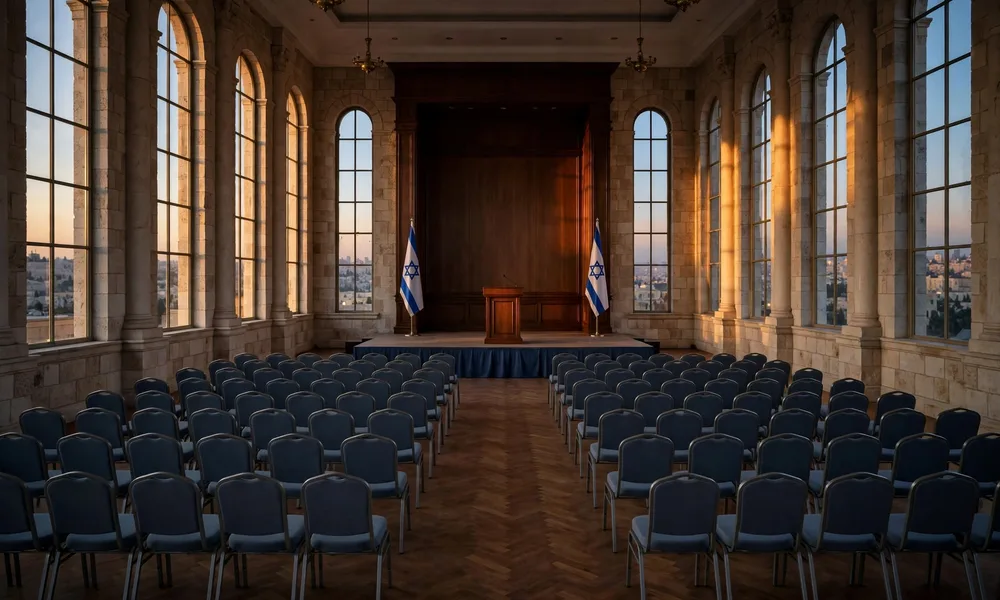
On Sunday, November 8, 2026, Israeli President Isaac Herzog formally handed Gadi Eisenkot the mandate to form Israel’s next government. The handover took place at a ceremony at the President’s Residence in Jerusalem at 5 p.m. local time, and it was covered live by Ynet. The move starts a 28 day period in which Eisenkot must try to build a coalition that can win support in the Knesset. Herzog had announced the decision on Saturday evening, November 7, after consultations with the parties elected on October 27. The ceremony turned that announcement into a formal task with a clear deadline.
| Detail | Fact |
|---|---|
| Date of handover | Sunday, November 8, 2026 |
| Time of ceremony | 5 p.m. local time |
| Place | President’s Residence in Jerusalem |
| President | Isaac Herzog |
| Mandate holder | Gadi Eisenkot, leader of the Yashar party |
| Decision announced | Saturday evening, November 7, 2026 |
| Election date | October 27, 2026 |
| Time to form a government | 28 days, with a possible 14 day extension |
| Recommendations for Eisenkot | 67 of the 120 Knesset members |
| Recommendations for Netanyahu | 46 of the 120 Knesset members |
| Knesset swearing in | Tuesday evening |
| Current prime minister | Benjamin Netanyahu, as caretaker |
What happened at the ceremony
The ceremony on Sunday was short in form but large in meaning. Herzog handed the mandate to Eisenkot at the President’s Residence in Jerusalem, with Ynet covering the event live. The setting mattered because it marked the formal start of the process, not only a statement of intent. From that point, Eisenkot had a set number of days to work, and every meeting would be read against that clock.
Herzog had made the choice known on Saturday evening, after consultations with the parties that won seats in the October 27 election. In those talks the president hears who each group supports, then decides who has the best chance of building a coalition. In this case, the consultations pointed to Eisenkot, and the Sunday ceremony put that decision into action.
Eisenkot is a former military chief of staff and the leader of the Yashar party. That background is now central to the story, because he must move from leading a party to leading talks across many parties. The ceremony gave him the authority to try, and it set the timetable for the attempt. For readers who followed the first step, our earlier report on Herzog’s Saturday announcement sets out how the president reached the decision before the formal handover took place.
Why Eisenkot received the mandate
The main reason Herzog chose Eisenkot was the number of recommendations he received. Factions representing 67 of the 120 Knesset members recommended Eisenkot for the mandate. Factions representing 46 members recommended Prime Minister Benjamin Netanyahu. That gap gave Herzog a clear basis for the choice, even though the election itself did not give any bloc a majority.
The figures also show why the task will be hard. A recommendation is not the same as a promise to join a coalition. A party can recommend a leader for the mandate and still refuse to sit in the government that leader tries to build. Eisenkot therefore starts with broad support for the attempt, but he still has to turn that support into a working coalition. Netanyahu remains caretaker prime minister until a successor takes office.
The numbers left by the October election
The October 27 election left the Knesset split in a way that makes a majority hard to reach. Netanyahu’s bloc won 53 seats. The main opposition grouping won 48 seats. Arab-led parties won 19 seats. The Knesset has 120 seats in total, and a majority needs 61 seats. No bloc reached that number on its own, which is why the mandate and the talks that follow it matter so much.
The numbers explain the shape of the challenge. Eisenkot needs to find 61 seats of support from groups that do not all agree with each other. The opposition grouping, at 48 seats, is the largest single base he can draw on, but it is still 13 seats short of a majority. The Arab-led parties, with 19 seats, are large enough to change the result.
Netanyahu’s bloc, at 53 seats, is also short of a majority, by eight seats. That shortfall is the reason he did not receive the mandate first, despite his long time in office. The election result therefore left both main camps below the line, and it left the smaller groups with real influence over the outcome.
What Eisenkot must do in the next 28 days
Eisenkot now has 28 days to try to form a coalition. Herzog can grant a possible 14 day extension, which would take the total to 42 days if it is used. The first period is the main window, and the extension is a safety net rather than a plan. Eisenkot will need to use the early days to test who is willing to talk, what each party wants, and where the main obstacles lie. Speed matters, because long talks without progress can weaken the sense that a deal is possible.
His diary for the first days is already taking shape. Eisenkot is expected to meet Naftali Bennett on Sunday evening and Avigdor Liberman on Monday to discuss forming a government. Those two meetings are important because Bennett and Liberman lead parties whose support could help Eisenkot reach a majority. The meetings will not settle the whole coalition, but they will show whether the first talks are serious and whether the parties can agree on a common path.
The Joint List position and the speaker question
One of the more notable statements in the first hours after the handover came from the Joint List. The Joint List told broadcaster N12 it was willing to help end Netanyahu’s tenure without demanding a place in government or in the coalition, and said it had yet to be asked to commit its votes. That statement, if it holds, could matter for Eisenkot, because it suggests a path to support that does not require a formal place in the government.
N12 also reported that Eisenkot’s camp was seeking agreement on a candidate for Knesset speaker, and that Likud was preparing a challenge to the election results. Agreement on the speaker would be an early test of cooperation, while a challenge to the results would add doubt to the process.
What happens this week
The next step in the formal process is the swearing in of the new Knesset members, who are due to be sworn in on Tuesday evening. That event will bring the newly elected members into office and set the stage for the work of the new Knesset. Members will take their seats as the first business of the house begins.
The meetings with Bennett and Liberman will come first, on Sunday evening and Monday. Those talks will be watched closely for signs of progress, even though the first statements after such meetings are often short and careful. The swearing in on Tuesday will then mark the formal start of the new Knesset, while the coalition talks continue in parallel.
Leadership questions are also live in Washington, with reports that Chris Van Hollen withholds support for Schumer as Senate leader and that Elissa Slotkin will not rule out challenging Schumer as Senate leader. Those are separate stories, but in Israel the test is now formal, with a mandate, a deadline, and a clear count of seats to win.
Frequently Asked Questions
Who received the mandate to form Israel’s next government?
President Isaac Herzog handed the mandate to Gadi Eisenkot, leader of the Yashar party and a former military chief of staff. The formal handover took place at a ceremony at the President’s Residence in Jerusalem on Sunday, November 8, 2026, at 5 p.m. local time.
How long does Eisenkot have to form a government?
Eisenkot has 28 days to try to form a coalition. President Herzog can grant a possible 14 day extension, which would take the total to 42 days if it is used. The clock started with the formal handover on November 8.
Why did Herzog choose Eisenkot over Netanyahu?
Factions representing 67 of the 120 Knesset members recommended Eisenkot, while factions representing 46 members recommended Prime Minister Benjamin Netanyahu. Herzog announced the decision on Saturday evening, November 7, after consultations with the parties elected on October 27.
What did the October 27 election decide?
The election left no bloc with a majority of 61 seats in the 120 seat Knesset. Netanyahu’s bloc won 53 seats, the main opposition grouping won 48 seats, and Arab-led parties won 19 seats. That split is why Eisenkot must now build a coalition from more than one group.
Sources
Final Thoughts
The handover on November 8 gave Gadi Eisenkot a clear task and a clear deadline. He has 28 days to turn a divided election result into a working government, with a possible 14 day extension if the president grants it. The meetings with Bennett and Liberman, the swearing in on Tuesday evening, and the open questions over the Joint List and the Knesset speaker will show in the coming days whether that task can be done. For now, the mandate is real, the clock is running, and the next government of Israel is still to be built.