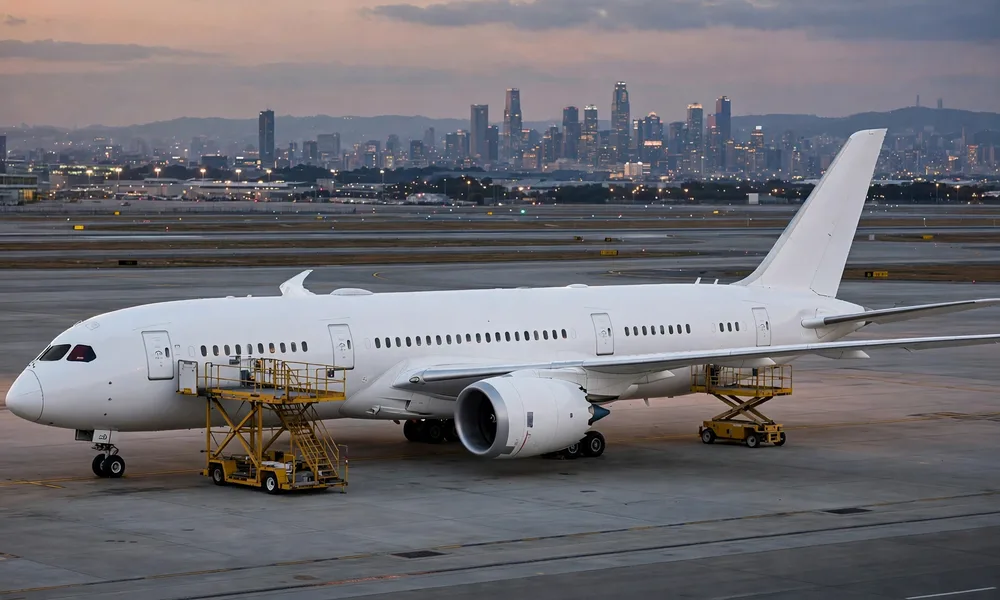
The British Airways Boeing 787 stranded in Pittsburgh has been stuck on the ground at Pittsburgh International Airport for more than 70 days. The aircraft arrived from London Heathrow on August 28, 2026, and it was expected to turn around and fly back to London the same day. Instead, it has not flown since. A ground service vehicle reportedly struck the underside of the aircraft and pierced its fuselage, leaving a hole in the lower cargo area. As of Monday, November 9, 2026, the aircraft is still grounded in Pittsburgh, and British Airways has not given a confirmed date for its return to service.
Quick Facts
| Detail | What happened |
|---|---|
| Aircraft | British Airways Boeing 787-8 Dreamliner |
| Registration | G-ZBJF |
| Airport | Pittsburgh International Airport, Pennsylvania |
| Arrival flight | BA171 from London Heathrow on August 28, 2026 |
| Flight distance | About 3,233 nautical miles, or 5,987 kilometres |
| Reported cause | A mobile baggage belt loader reportedly struck the underside and pierced the fuselage under a bulk cargo door |
| Current status | Still grounded in Pittsburgh after more than 70 days, with no confirmed return date |
| Passengers | No passengers were involved in the ground incident |
| Possible next step | Temporary repair, then a ferry flight to a larger facility |
What Happened to the British Airways Boeing 787 Stranded in Pittsburgh
Flight BA171 left London Heathrow and crossed the Atlantic to Pittsburgh, a journey of roughly 3,233 nautical miles. The 12-year-old aircraft, registered G-ZBJF, landed normally. The problem came after arrival, while the aircraft was on the ground and being prepared for its next flight. According to reports, a ground service vehicle collided with the underside of the Dreamliner. The vehicle was reported to be a mobile baggage belt loader. The impact pierced the fuselage underneath one of the bulk cargo doors and left a hole in the lower cargo section.
British Airways has not publicly confirmed the precise circumstances of the incident, and it has not provided a detailed assessment of the damage. For that reason, the description of the belt loader and the location of the hole should be treated as reported, not as a confirmed statement from the airline. No passengers were involved in the Pittsburgh incident. The aircraft arrived normally, and the damage happened on the ground during handling. In recent days, for example, hoax bomb threats disrupted 18 more flights across Europe, The Pittsburgh case is different: the disruption has stretched on for more than 70 days.
Why the Repair Is Taking So Long
At first, a hole in the lower fuselage might sound like a repair that should take a few days. For the Boeing 787, the work is more complicated than that. The Dreamliner is built largely from composite materials, not from the traditional aluminium skin used on older aircraft. Composite construction also makes repairs more demanding than a conventional metal airframe repair. Composite damage is harder to judge from the outside, and the visible hole may not show the full extent of the problem.
Engineers have to check whether the damage has spread into the layers around the impact point, and whether the structure underneath has been weakened. The location of the damage adds to the challenge. The hole is reported to be underneath a bulk cargo door, in the lower cargo section. A repair there has to restore strength and shape, and it has to fit with the door and the surrounding structure. A permanent composite repair also needs specialist skills, approved repair data, and the right equipment. The slow pace is therefore not proof that nothing is happening. It is a sign of how much has to be checked and approved before a damaged Dreamliner can fly again.
The Reported Landing Gear Complication
A new report on November 8 added another layer to the story. According to that report, a commenter claiming to be a British Airways engineer said technicians had made considerable progress with the repair, but had encountered additional complications involving the aircraft’s landing gear system. That account has not been independently verified, and British Airways has not confirmed any landing gear damage. It should therefore be treated as unverified, not as a confirmed fact about the aircraft.
Even as an unverified claim, the report is worth noting because it may help explain why the timeline has stretched so far. If a repair team finds a second problem while fixing the first one, the work can change in scope. A landing gear issue, if it were confirmed, would be a separate system from the fuselage damage, and it would need its own inspection and fix. It is also possible that the comment is wrong, or that it refers to a minor issue found during routine checks. Without confirmation from British Airways, readers should not assume that the landing gear is damaged, or that it is the main reason for the delay.
What Could Happen Next
Reports suggest that the airline could complete temporary repairs in Pittsburgh and then move the aircraft to a larger facility for a more permanent repair. The suggested destination is Cincinnati Northern Kentucky International Airport, known as CVG, where a larger facility is operated by FEAM Aero. A temporary fix would make the aircraft safe for a single ferry flight, without passengers, to a place better equipped for the full repair. A ferry flight of that kind would need approval from the Federal Aviation Administration through a special flight permit.
The regulator would need to be satisfied that the temporary repair is safe for that one flight, under strict limits on altitude, speed, route, and crew. The aircraft would fly empty, with no passengers and no cargo, and only to the repair base. Earlier reporting suggested a different possibility: a temporary repair could allow the aircraft to fly to Boeing in Seattle for permanent repairs. What is clear is that no single destination has been confirmed, and no date has been set. The airline has not said when the aircraft will leave Pittsburgh, or where it will go for the final repair. For now, the aircraft will stay in Pittsburgh until the temporary repair is ready and approved. In one recent case, a cruise ship was detained in Miami by the Coast Guard, and in another, a cruise ship was arrested in Singapore. Those cases share a basic point: a delay can last far longer than passengers first expect.
Why Losing One Dreamliner Hurts British Airways
British Airways has only 12 Boeing 787-8 aircraft, so every aircraft in that small fleet matters. The 787-8 is the smallest version of the Dreamliner family, but it still plays an important role on long-haul routes. When one of only 12 is out of service for more than 70 days, the airline loses flexibility. When one aircraft is suddenly unavailable, the airline has to find another aircraft to cover its flights, or change the schedule.
That can mean using a larger aircraft on a route, swapping aircraft between routes, or in the worst case, cancelling flights. Over more than ten weeks, those small changes add up to real cost and real disruption for planning teams. The cost of the repair itself is also likely to be high. Composite repairs need specialist labour and approved materials, and the work has to be done to a high standard. The airline has not published a cost figure, so no number should be guessed here. What can be said is that a wide-body aircraft sitting idle for more than two months is expensive, even before the repair bill is counted. One grounded aircraft will not stop a large airline, but the long delay raises questions from travellers.
A Familiar Problem for the Dreamliner on the Ground
The Pittsburgh incident is not the first time a British Airways Dreamliner has been damaged on the ground and kept out of service for a long time. In June 2021, a British Airways Boeing 787-8 registered G-ZBJB suffered a nose gear collapse at London Heathrow. That aircraft took about five months to return to service. A more recent case came in May 2026, when a British Airways Boeing 787-10 was grounded at Heathrow after engineering steps impaled its fuselage before a flight to Chicago.
Passengers watched from a crowded bus as the damage was discovered, and the flight could not go ahead. That incident, like the Pittsburgh case, involved ground equipment striking the fuselage. It was a reminder that the ground is a busy place, with vehicles and equipment moving close to the aircraft on every turn. These cases do not prove a single cause or a single fault. They show a pattern that airlines and airports have to manage every day: large aircraft and heavy ground equipment work in tight spaces, and a small mistake can cause damage that takes months to fix. The Pittsburgh aircraft has now been grounded for more than 70 days, which is about ten weeks.
FAQs
How long has the British Airways Boeing 787 been stranded in Pittsburgh?
The aircraft has been grounded at Pittsburgh International Airport for more than 70 days as of Monday, November 9, 2026. It arrived on August 28, 2026, operating flight BA171, and it is still in Pittsburgh, with no confirmed return date.
What caused the damage to the aircraft?
Reports say a ground service vehicle, reported to be a mobile baggage belt loader, collided with the underside of the aircraft and pierced the fuselage underneath one of its bulk cargo doors. British Airways has not publicly confirmed the precise circumstances, so the cause should be treated as reported, not confirmed.
When will the aircraft fly again?
There is no confirmed return-to-service date. Reports suggest the airline could complete temporary repairs in Pittsburgh and then fly the aircraft, without passengers, to a larger facility for a permanent repair, possibly at Cincinnati Northern Kentucky International Airport, subject to a special flight permit from the Federal Aviation Administration.
Were any passengers hurt in the incident?
No passengers were involved in the Pittsburgh incident. The aircraft arrived normally from London, and the damage happened on the ground during handling.
Sources
Final Thoughts
A single ground collision has kept a British Airways Dreamliner out of service for more than 70 days, and the end of the story is still not in sight. The composite structure and the location of the damage have made a slow job slower. A possible temporary repair and a ferry flight to a larger facility may be the next step, but no date and no final destination have been confirmed. Until then, G-ZBJF will remain parked in Pittsburgh, a reminder that a small impact can have a very long tail.