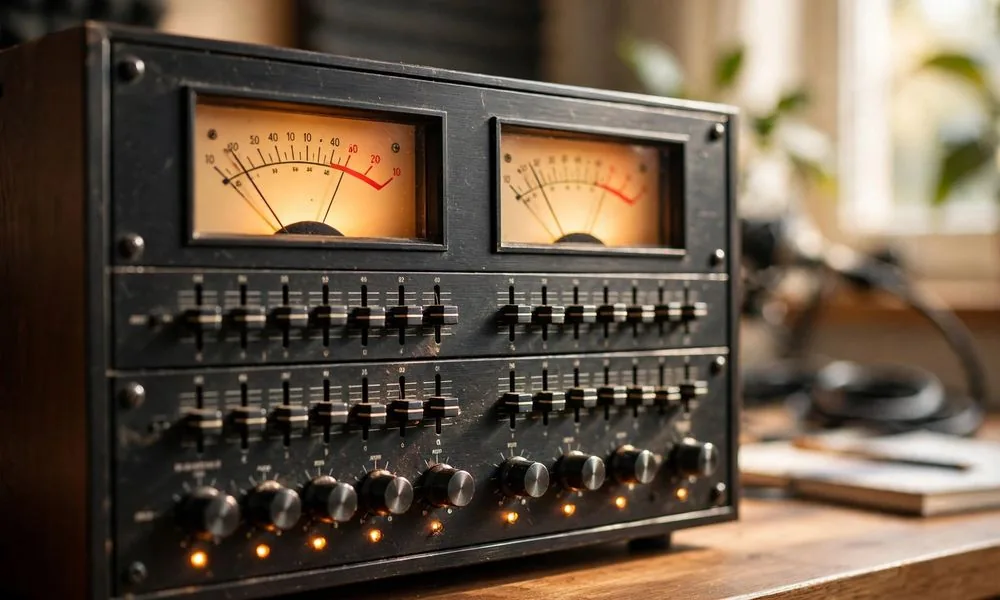
Music can sound flat in one room and full and clear in another. The song is the same, but the speakers, the walls, and even the size of the room change what you hear. That is where a quad equalizer can help. It is a tool that lets you shape sound in a simple and controlled way, so bass does not boom, voices do not get lost, and high notes do not hurt your ears.
If you have ever moved the bass and treble controls on a car stereo, you have already used a basic form of equalization. A quad equalizer goes a step further. The word quad points to four. In some cases it means four sound channels. In other cases it means four bands of sound that you can turn up or turn down. This guide explains both meanings, how the tool works, and how to use it for better audio.
| Quick Facts | Details |
|---|---|
| Name | Quad Equalizer |
| Type | Audio equalizer, also called an EQ |
| What It Is | A tool that boosts or cuts four parts of sound, or that helps balance sound across four audio channels |
| Used For | Improving music, film, and voice sound in home, car, and studio systems |
What Is a Quad Equalizer?
An equalizer, or EQ for short, is a control that changes the loudness of different parts of sound. Sound is made of frequencies. Low frequencies give you bass, like a kick drum or a deep voice. Middle frequencies carry most speech, guitars, and pianos. High frequencies give you treble, like cymbals and the sharp edge of a voice.
A helpful way to picture an EQ is as a set of volume knobs, but each knob works on only one part of the sound. One knob does not make the whole song louder. It makes only the bass louder, or only the treble softer. Audio experts often call EQ controls frequency specific volume knobs, and that simple image is a good one to keep in mind.
The word quad means four, and that is where the name gets a little tricky, because it is used in two related ways. The first meaning comes from quadraphonic sound. That was a system from the early 1970s that used four audio channels, with speakers placed at the four corners of a room. You can read more about that history on the Wikipedia page on quadraphonic sound. In a system like that, equalization helped balance the sound coming from the front left, front right, back left, and back right speakers.
The second meaning is the one most people meet today. Many modern EQs are described by how many bands they have. A band is one slice of the frequency range that you can adjust. A four band EQ gives you four slices to work with. A common setup is low, low middle, high middle, and high. Some home and car units keep it even simpler, with bass, two middle ranges, and treble. When people search for a quad equalizer today, they often mean this four band kind of control.
Both meanings share the same goal. They give you more control than a single volume knob or a simple bass and treble pair. At the same time, four controls are still easy to learn. That balance of power and ease is a big reason the idea has lasted for so long.
Background and How It Works
Equalization started in recording and broadcast work. Engineers used it to fix problems. A microphone might pick up too much low hum. A room might make a voice sound harsh. By cutting the problem part and leaving the rest alone, they could clean up the sound without recording everything again.
Quadraphonic sound added a new problem in the 1970s. Stereo has two channels, left and right. Quadraphonic sound had four. That meant more speakers, more amplifier channels, and more chances for one part of the room to sound too loud or too dull. It was the first surround sound product sold to home listeners, and thousands of records were made for it. Still, it did not become a lasting success at the time. The formats did not all work with each other, the gear cost more, and listeners needed special decoding equipment.
The idea did not die. Home cinema in the 1990s brought multi channel sound back, and old four channel recordings later came out again on newer formats. The lesson from that history still matters. More channels can make sound feel real and wide, but only if each channel is balanced well. Equalization is one of the tools that does that balancing.
So how does a four band EQ work in practice? The audio signal passes through filters. Each filter focuses on its own part of the frequency range. You choose to boost that part, which makes it louder, or cut it, which makes it quieter. A small boost is measured in decibels, often written as dB. A change of just 2 or 3 dB is easy to hear. Big changes are rarely needed.
On many units the low and high bands work as shelf controls. A shelf lifts or lowers everything past a point, like all the bass below a set frequency. The middle bands often work as peak controls. A peak lifts or lowers a bump around one center frequency, and it has less effect far away from that point. You do not need to memorize these terms to use an EQ well. Just know that the end bands shape the broad weight and brightness of sound, while the middle bands help with clarity and tone.
In a true four channel setup, the same idea applies across speakers. If the back speakers sound dull, a gentle high boost can help them match the front ones. If one corner builds up too much bass, a small low cut can calm it. The aim is to make all the speakers work together as one clear whole.
Key Features and Why People Use It
The first key feature is simple control. Four bands are enough to fix the most common problems, but not so many that you get lost. A graphic EQ in a studio may have 15 or 31 bands, and a parametric EQ lets you move each band to an exact frequency. Those tools are powerful, but they take time to learn. Four bands are a friendly middle ground for most listeners.
The second feature is speed. With only four knobs or sliders, you can learn what each one does in a few minutes. Turn the low band and you feel the change at once. Turn the high band and the sound gets brighter or softer right away.
People also use this kind of EQ to match sound to a room. Hard floors and bare walls can make music feel sharp. Soft furniture and carpets can make it feel dull. A small adjustment can bring back balance in either case, without buying new speakers.
It helps with different kinds of content too. Films need clear speech, so the middle bands matter most. Old records or thin streams can feel fuller with a gentle lift at both ends. Podcasts benefit when a small low cut removes rumble. Best of all, four band controls already appear in car stereos, home amps, and phone apps, often in a menu named EQ, Tone, or Sound. You may not need to buy a separate box at all.
Practical Tips for Better Audio
Start flat. Set all four bands to zero before you change anything, then listen to a song you know well for a full minute. A track you know makes changes easy to judge.
Make small moves. Raise or lower one band by 2 or 3 dB, then listen again. Move only one band at a time. If you change everything at once, you will not know which move helped and which one hurt. Most good EQ work is gentle. If a knob ends up turned all the way up, something else is probably wrong, like speaker placement.
Try cutting before boosting. If the bass sounds muddy, cut the low band a little instead of boosting everything else. If a voice sounds harsh, cut the high middle band a little instead of pushing the bass up to hide it. Cutting often sounds cleaner, and it also leaves more headroom, which means the sound is less likely to distort at high volume.
Place your speakers with care before you reach for the EQ. Speakers pushed hard into a corner often boom with bass. Speakers at ear level, with some space from the wall, usually sound clearer. In a four speaker setup, try to sit near the middle, with the speakers spread around you at the four corners, as quadraphonic systems were designed to work.
Check your work with more than one song, and at the volume you use most. A setting that flatters one track may make the next one sound odd. Test a quiet voice track, a song with deep bass, and a song with bright cymbals. If all three sound good, your setting is balanced. Then save it as a preset if your gear allows it, perhaps one for music, one for films, and one for speech.
Frequently Asked Questions (FAQs)
Is a quad equalizer the same as a four band EQ?
Often, yes. Today the name is widely used for an EQ with four adjustable bands, such as low, low middle, high middle, and high. The name also links back to quadraphonic sound, which used four channels. Check the product or app description to see which meaning applies in your case.
Can an equalizer fix bad speakers?
It can help, but it cannot perform magic. An EQ can reduce boom, add some brightness, and make speech clearer. It cannot add deep bass that a small speaker cannot physically make, and it cannot repair damage. Good placement and a gentle EQ setting work best together.
Should I boost the bass for better sound?
Not always. A small bass lift can add warmth, but too much makes drums and bass lines blur together and can muddy voices. Start with a 2 or 3 dB lift at most. If the sound gets muddy, cut it back and try cleaning up the low middle band instead.
Do I need special gear to try this?
No. Many phones, computers, streaming apps, and car stereos already include a four or five band EQ in their settings. Try the one you own first. You can learn the basics for free, and you may find you do not need to buy anything at all.
Final Thoughts
A quad equalizer is a small tool with a clear job. It lets you shape four parts of sound, or balance sound across four channels, so what you hear fits your room, your speakers, and your taste. Its roots go back to the quadraphonic systems of the 1970s, and its simple four band form is still common in cars, homes, and apps today.
You do not need expert ears to use it well. Start flat, move one band at a time, and keep changes small. With a little patience, it can turn flat or harsh sound into audio that feels clear and easy to enjoy.
You may also read: Wendy Ortiz Net Worth: How Much Money Does the Social Media Star Make?


