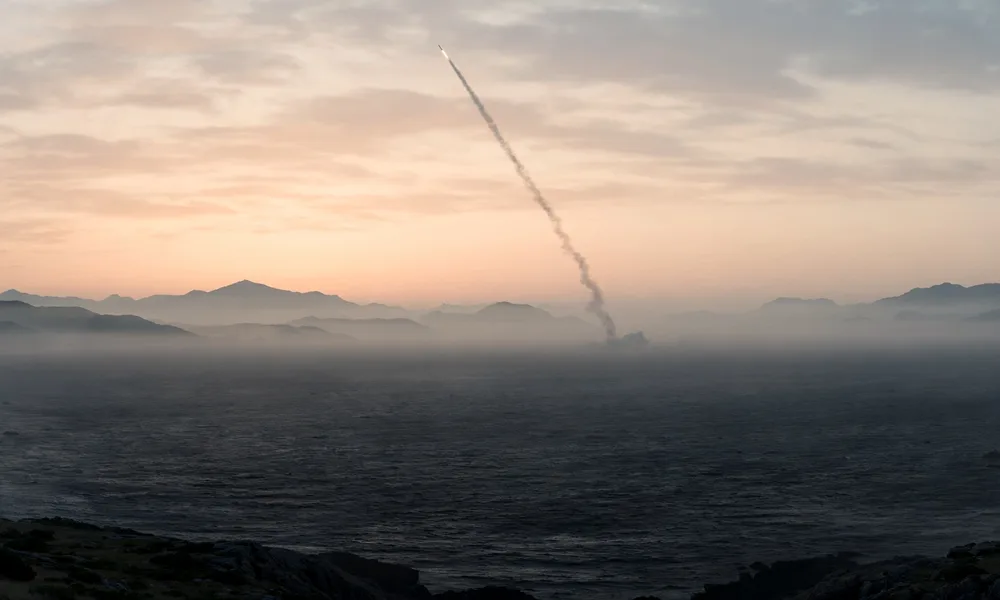
North Korea test-fired a newly designed air-defence missile system and staged a long-range strategic cruise missile strike drill on Wednesday, November 4, 2026. State media KCNA reported both events on Thursday, November 5. KCNA said the air-defence test confirmed the technical specifications and reliability of the missile’s new materials and multiple guidance modes, plus its ability to identify and track targets. A sub-unit of North Korea’s long-range strategic cruise missile unit in the east struck a virtual airport target in the drill.
South Korea’s Joint Chiefs of Staff said on Wednesday that Pyongyang fired multiple missiles toward the sea from the Sondok area on the east coast, flying less than 300 kilometres. The new air-defence missile was first unveiled in November 2025. All detail about what the missiles can do comes from KCNA and South Korean military statements. KCNA claims should be read as state-media claims, not as independently verified facts.
Quick Facts
| Detail | What we know |
|---|---|
| Events tested | Newly designed air-defence missile system and long-range strategic cruise missile strike drill |
| Date of tests | Wednesday, November 4, 2026, reported by KCNA on Thursday, November 5 |
| Air-defence claim | KCNA said test confirmed technical specifications and reliability of new materials and multiple guidance modes, plus ability to identify and track targets |
| Cruise missile drill | Sub-unit in the east struck a virtual airport target |
| South Korea observation | Multiple missiles fired toward the sea from Sondok area on the east coast, flying less than 300 kilometres |
| Frequency | Yonhap called it Pyongyang’s fourth weapons test in a week, Reuters called it the fourth launch in a month |
| First unveiling | New air-defence missile was first unveiled in November 2025 |
| Expert note | Shin Jong-woo said the new missile appears to have a guidance section resembling Russia’s S-400 surface-to-air missile |
| Image note | Images released by Pyongyang appeared to show the cruise missile carrying a cluster warhead |
| Source status | All detail comes from KCNA and South Korean military statements, KCNA claims are not independently verified |
What North Korea Says It Tested
KCNA reported two linked events on the same day. The first was a test firing of a newly designed air-defence missile system. The second was a long-range strategic cruise missile strike drill. An air-defence missile is meant to find, track and hit threats in the sky. A cruise missile is meant to fly a long distance to a target on the ground.
For the air-defence system, KCNA said the test confirmed the technical specifications and reliability of the missile’s new materials and multiple guidance modes, plus its ability to identify and track targets. A state media report can describe a test, but it does not by itself show the full data. It does not show how many missiles were fired, how far they flew, or what kind of target they hit. That is why outside analysts treat the claims as claims, not as settled facts. The cruise missile drill was also a training event. A virtual airport target is not a real airport. It is a planned point used for training.
What South Korea Observed From Sondok
South Korea’s Joint Chiefs of Staff gave the outside view of the same day. They said on Wednesday that Pyongyang fired multiple missiles toward the sea from the Sondok area on the east coast, flying less than 300 kilometres. That statement is short, but it gives three useful facts. It confirms that missiles were fired. It gives a launch area. It gives a flight distance of less than 300 kilometres.
Sondok is on the east coast of North Korea. A launch from that area toward the sea is a common pattern for North Korean tests. Firing toward the sea keeps the missiles away from land and gives a clear flight path for tracking. The distance of less than 300 kilometres does not by itself tell the full story of either system. A drill may use a shorter flight to a virtual target, and an air-defence test may also use a short flight. The South Korean statement confirms that multiple missiles were fired, which matches the KCNA account of two events on the same day. The safe reading is that both sides agree missiles were fired on November 4 from the east coast. South Korean statements confirm a launch took place, but they do not confirm KCNA’s technical claims.
How Often These Tests Have Happened
The timing of this test has drawn attention because it was not a single event in isolation. Yonhap called it Pyongyang’s fourth weapons test in a week. Reuters called it the fourth North Korean weapons launch in a month. The two descriptions use different time frames, so they do not contradict each other. One counts tests in a week. The other counts launches in a month. Both point to the same basic fact: North Korea has been testing weapons often in the recent period.
A run of tests in a short time can mean several things, and it is important not to pick one reason without evidence. It can mean a planned series of tests for different systems, a push to complete checks, or a show of activity at a time of tension. Without a statement from Pyongyang about why the tests were grouped together, any single explanation would be a guess. The frequency also matters for watchers in South Korea, Japan, and the United States. Each test gives new data on launch patterns and timing. A count of tests also depends on how tests are counted. A day with two events can be counted as one test day or as two tests. In the Gulf, a tanker was struck north of Qatar and Iran claimed five tankers on fire, as covered here: Iran says two tankers and a tugboat caught fire in the Strait of Hormuz. That story is separate from North Korea.
What Experts Noticed in the Images
Images released by Pyongyang are often as important as the words in a KCNA report. Outside experts study the shape of a missile, the launcher, the guidance section, and any warhead shown in a photo. In this case, two image notes have been reported. Shin Jong-woo, secretary general of the Korea Defense and Security Forum, said the new missile appears to have a guidance section resembling Russia’s S-400 surface-to-air missile. Images released by Pyongyang also appeared to show the cruise missile carrying a cluster warhead.
The S-400 comparison is a description of appearance, not proof of origin. Shin Jong-woo said the guidance section resembles the Russian system. That means it looks similar in shape or layout. It does not by itself prove that the missile uses Russian parts, Russian design, or Russian help. The cluster warhead note is also based on appearance. Images appeared to show the cruise missile carrying a cluster warhead, a type of warhead that spreads smaller munitions over an area. The word appeared is important here. It means the images suggest that design, but the images alone do not prove the warhead type or its effect. The new air-defence missile was first unveiled in November 2025, so this system is not brand new as an idea.
Why the Timing and the Claims Need Careful Reading
The date pattern in this story is simple and worth keeping straight. The tests took place on Wednesday, November 4, 2026. KCNA reported them on Thursday, November 5. South Korea also spoke on Wednesday about missiles fired from Sondok. The one-day gap between test and KCNA report is normal for North Korean state media. It does not mean the test was hidden or delayed. It is the usual pattern for a KCNA announcement.
The claims about performance also need careful reading. KCNA said the air-defence test confirmed technical specifications and reliability, new materials, multiple guidance modes, and the ability to identify and track targets. Those are strong claims, but they are KCNA claims from the same state that built and tested the system. That does not make them false, but they have not been checked by an outside body. A reader who wants proof should look for outside tracking and for later tests that repeat the result. The cruise missile drill also needs the same care. A virtual airport target is a training target, not a real airport. A drill that hits a virtual target shows that a launch plan worked in a test setting. The wider news picture this week has also included a major legal story in Hong Kong, where Joshua Wong was sentenced to 10 years under national security law, as covered here: Joshua Wong sentenced to 10 years in Hong Kong national security case. Each story needs its own facts.
When did North Korea carry out these tests?
The tests took place on Wednesday, November 4, 2026. KCNA reported them on Thursday, November 5. South Korea’s Joint Chiefs of Staff also spoke on Wednesday about missiles fired from the Sondok area.
What did the air-defence test claim to prove?
KCNA said the test confirmed the technical specifications and reliability of the missile’s new materials and multiple guidance modes, plus its ability to identify and track targets. This is a state-media claim, not an independently verified fact.
How far did the missiles fly?
South Korea’s Joint Chiefs of Staff said the missiles flew less than 300 kilometres toward the sea from the Sondok area on the east coast.
Is this part of a run of tests?
Yes, in terms of frequency. Yonhap called it Pyongyang’s fourth weapons test in a week, and Reuters called it the fourth North Korean weapons launch in a month.
Sources
- WIXX: North Korea test-fires new air-defence missile system, KCNA reports
- Qazinform: North Korea reports test-firing new air-defense system and long-range cruise missile
Final Thoughts
North Korea has shown again that it is testing new systems in public and in quick succession. A new air-defence missile and a long-range cruise missile drill on the same day is a clear sign of an active programme, even if the full technical picture is still unclear. The KCNA report gives the North Korean account in confident terms, and the South Korean observation gives a basic outside check that missiles were fired and flew less than 300 kilometres.
The details that matter most are still open. The S-400 resemblance is a visual note, not proof of origin. The cluster warhead is an appearance in images, not a proven test result. The claims about new materials, guidance modes, and target tracking are state-media claims, not independent findings. Readers should keep those limits in mind and watch for more data before treating any one claim as settled fact.