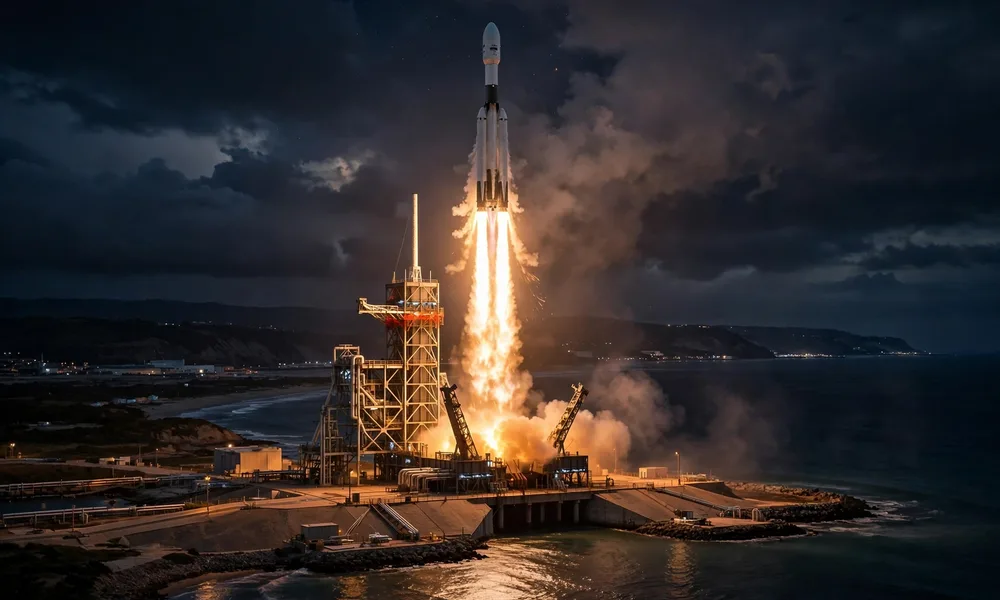
ISRO’s GSLV-F18 Puts NVS-03 Navigation Satellite Into Orbit, Strengthening NavIC

India’s space programme reached another important milestone in the early hours of October 31, 2026. The Indian Space Research Organisation, known as ISRO, launched the NVS-03 navigation satellite aboard the GSLV-F18 rocket, and confirmed the mission a success. For people who rely on navigation in daily life, from drivers and farmers to rescue teams and ships at sea, this launch is about more than a rocket flight. It is about building a stronger, home grown navigation system that India controls itself.
The launch took place at 11:51 PM Indian Standard Time on Friday, October 30, 2026, from the Second Launch Pad at the Satish Dhawan Space Centre in Sriharikota. At 12:23 AM IST on October 31, ISRO confirmed “Mission Success”, with the satellite placed in its intended geosynchronous transfer orbit. That confirmation, coming just over half an hour after liftoff, marked the start of a careful journey that will continue with a series of orbit raising burns before the satellite reaches its final slot.
This article explains in plain English what was launched, why NavIC matters, how the GSLV-F18 flight worked, and what still has to happen before NVS-03 can enter service. We keep the facts to what ISRO confirmed, and we are clear about one important point: the satellite is not yet in operational navigation service.
Quick Facts
| Detail | What happened |
|---|---|
| Rocket and mission | GSLV-F18 carrying the NVS-03 satellite |
| Launch time | 11:51 PM IST on Friday, October 30, 2026 |
| Launch site | Second Launch Pad, Satish Dhawan Space Centre, Sriharikota |
| Success confirmed | 12:23 AM IST on October 31, 2026, with ISRO stating “Mission Success” |
| Orbit reached | Geosynchronous transfer orbit, about 170 km perigee and about 38,000 km apogee |
| Flight number | 20th flight of the GSLV rocket |
| Satellite | NVS-03, the third second-generation NavIC satellite, about 2,232 to 2,250 kg |
| Key technology | Indigenously developed rubidium atomic clock |
| Design life | 12 years |
| Next step | First orbit-raising burn on October 31 succeeded, lasting 2,174.8 seconds; further burns planned |
| Service status | Not yet in operational navigation service |
What Is NavIC and Why Does It Matter
NavIC is India’s own regional navigation satellite system. In simple terms, it is India’s answer to systems like GPS. Navigation satellites send out precise timing signals, and a receiver on the ground, in a phone, a vehicle, or a ship, uses signals from several satellites to work out its position. When a country has its own system, it does not have to depend only on another country’s satellites for this vital service.
That independence matters for everyday life and for safety. Navigation is used for transport, for farming, for mapping, for disaster response, and for many scientific and commercial uses. If signals are disrupted or restricted, a home grown system gives a country a backup and a choice. NavIC is designed to serve India and the region around it, and each new satellite makes the system stronger and more reliable.
NVS-03 is the third satellite in the second generation of NavIC. Second generation satellites bring improved technology, and in this case, that includes an atomic clock developed in India. Atomic clocks are extremely accurate timekeepers, and accurate time is the heart of navigation. Even a tiny error in timing can mean a large error in position, so better clocks mean better navigation for users.
The Launch: GSLV-F18 From Sriharikota
The GSLV, or Geosynchronous Satellite Launch Vehicle, is one of ISRO’s workhorse rockets for placing satellites into higher orbits. The F18 flight was the 20th flight of the GSLV, which shows how much experience ISRO has built up with this vehicle over the years. Each successful flight adds confidence, and each flight also teaches engineers more about how the rocket performs in real conditions.
Sriharikota, home to the Satish Dhawan Space Centre, is India’s main launch site. It sits on the east coast, which is helpful for launches that head east over the sea. The Second Launch Pad used for this mission is one of the pads that regularly handles important national missions. A night launch, at 11:51 PM IST, also gave skywatchers a striking sight, as the rocket rose into the dark sky on a pillar of flame.
The early confirmation of success was important. At 12:23 AM IST on October 31, ISRO announced that the satellite had been placed in its intended geosynchronous transfer orbit. That orbit is a stepping stone, not the final destination, but reaching it accurately is a major part of the mission. It means the rocket did its job, and the satellite is now in the right starting place for the next phase.
Understanding the Orbit in Plain English
It helps to understand the orbit in simple terms. The geosynchronous transfer orbit reached by NVS-03 has a low point, called perigee, of about 170 km, and a high point, called apogee, of about 38,000 km. Imagine an oval path around Earth, where one end is close to the planet and the other end is far away. The satellite travels around that oval, and engineers then use its own engine to gradually reshape the path.
That reshaping happens through orbit raising burns. During a burn, the satellite fires its engine for a set time to change its speed and its orbit. The first orbit raising burn for NVS-03 took place on October 31 and lasted 2,174.8 seconds. It succeeded, which is a good sign, but more burns are planned before the satellite reaches its final slot. This step by step approach is normal for this kind of mission, and it allows engineers to check the satellite at each stage.
Only after those burns are complete, and after testing, can the satellite move toward operational service. That is why it is important to be honest about the current status. A successful launch and a successful first burn are great news, but they are not the same as a satellite already guiding users day to day. The work continues after launch day.
The Rubidium Clock and the 12 Year Design Life
One of the most interesting parts of NVS-03 is its rubidium atomic clock, developed in India. To understand why this matters, think about how navigation works. A receiver works out its distance from a satellite by measuring how long the signal took to arrive. That measurement depends on extremely precise timing. If the clock on the satellite drifts even slightly, the position calculated on the ground will be wrong.
Rubidium atomic clocks use the natural vibrations of rubidium atoms to keep time with great accuracy. Building such a clock at home, rather than importing it, is a sign of growing technological strength. It also reduces dependence on foreign suppliers for a critical part of the navigation system. For a system like NavIC, which is meant to serve the country for many years, that independence is valuable.
The satellite has a design life of 12 years. That does not mean it will stop working exactly after 12 years, but it is the period for which it is designed to operate reliably. A long design life matters because launching satellites is expensive and complex, and operators want each satellite to serve for as long as possible. With a mass of about 2,232 to 2,250 kg, NVS-03 is a substantial spacecraft, carrying the equipment needed for its navigation mission.
What Happens Next, and What to Watch
The next steps are methodical rather than dramatic. Engineers will carry out further orbit raising burns, check the health of the satellite, test its payloads, and gradually move it toward its final position. Each step will be watched closely, because a problem at any stage could delay the mission. So far, the signs are positive, with the launch success and the first burn both confirmed.
People interested in space and technology should watch for updates from ISRO on the remaining burns and on the move to final orbit. Those updates will show whether the mission stays on track. After that, the longer question will be when NVS-03 enters operational navigation service and starts contributing to NavIC signals used by the public and by professional users.
For India, the wider story is about steady progress. Each NavIC satellite adds resilience to the system, and each successful GSLV flight adds experience to the launch programme. The NVS-03 mission fits into that longer story, and it will be judged not just by launch night, but by how well the satellite serves users over its 12 year life.
FAQs
When and where was NVS-03 launched?
NVS-03 was launched aboard GSLV-F18 at 11:51 PM IST on Friday, October 30, 2026, from the Second Launch Pad at the Satish Dhawan Space Centre, Sriharikota. ISRO confirmed “Mission Success” at 12:23 AM IST on October 31.
What orbit did the satellite reach?
The satellite was placed in its intended geosynchronous transfer orbit, with about 170 km perigee and about 38,000 km apogee. Further orbit raising burns are planned to reach its final slot.
What is special about NVS-03?
NVS-03 is the third second-generation NavIC satellite. It weighs about 2,232 to 2,250 kg, carries an indigenously developed rubidium atomic clock, and has a 12 year design life.
Is NVS-03 already providing navigation service?
No. It is not yet in operational navigation service. The first orbit raising burn on October 31 succeeded, lasting 2,174.8 seconds, and further burns are planned before it reaches its final slot and enters service.
Final Thoughts
The GSLV-F18 launch of NVS-03 is a clear success so far, and it deserves to be celebrated as such. A night launch, a precise orbit, a successful first burn, and a new second generation navigation satellite all point to a programme that is moving forward with skill and care.
At the same time, honest reporting means noting what is still to come. The satellite must complete its remaining burns, reach its final slot, and pass its tests before it can serve navigation users. That careful, step by step work is less visible than a launch, but it is just as important.
If that work goes well, NVS-03 will strengthen NavIC for years to come, helping India rely on its own navigation system with greater confidence. That is the real prize behind the bright flame over Sriharikota, and it is worth following as the mission continues.