Hackers Targeted France Blood Banks, Turning Freezer Settings From Minus 30C to 110C
Hackers targeted France national blood service overnight on November 1 to 2, 2026, breaking into refrigeration controls and changing freezer settings from around minus 30 degrees Celsius to 110 degrees Celsius. The attack hit cold rooms run for the French Blood Establishment, known as EFS, through a contractor, and it put blood samples and frozen plasma intended for transfusions at risk. Officials say no blood products were lost, because a technician on duty spotted rising temperatures in time and acted. The France blood banks hack is a warning about a quieter kind of cyberattack, one aimed not at data or money, but at the machines that keep medicine safe.
Quick Facts
| Quick Fact | Detail |
|---|---|
| What happened | Hackers changed blood cold room settings from about minus 30C to 110C |
| When | Overnight, November 1 to 2, 2026 |
| Target | French Blood Establishment (EFS) cold storage rooms |
| Way in | Remote system of Coolworld, a contractor maintaining the cold rooms |
| Sites affected | Three EFS sites, including Bourgogne-Franche-Comte in eastern France |
| What was stored | Donor samples for transfusion safety monitoring, plus frozen plasma for transfusions |
| What 110C means | A controller setpoint entered by attackers, not proof rooms reached 110C |
| Damage | None confirmed: EFS says no blood products lost, no operational disruption |
| How it was caught | On-duty technician noticed rising temperatures overnight |
| First reported by | Le Canard enchaine, French investigative weekly, on November 3 |
| Authorities involved | French Health Ministry and ANSSI, the national cybersecurity agency |
| Wider context | Follows refrigeration attacks on supermarkets across Europe in October and November |
The France Blood Banks Hack: What We Know
The attack was first reported by Le Canard enchaine, a French investigative weekly, on November 3, 2026. According to that report and later coverage by InfoSecurity Magazine, GBHackers, and other cybersecurity outlets, unauthorized actors took control of refrigeration controllers in EFS cold storage rooms during the night from Sunday to Monday. The controllers were maintained by Coolworld, a Dutch temperature control company operating in France, Germany, Ireland, the Netherlands, and the UK, which provides and maintains cold room equipment for EFS.
The attackers changed the target temperature on the controllers from around minus 30 degrees Celsius, the normal storage temperature for these rooms, to 110 degrees Celsius. That is a jump of about 140 degrees, and it would, if left running, destroy the products inside. Fresh frozen plasma generally needs to stay at minus 25 degrees Celsius or below, so prolonged warming makes it unusable. The stakes were therefore very high, even though the attack itself was quiet and remote.
Coolworld confirmed on November 4 that it was aware of a cybersecurity incident involving remote monitoring software used in refrigeration systems. EFS confirmed the attack later that day, saying it affected three of its sites. France Health Ministry said there was “zero operational consequence” because the attack was spotted in time. That phrase has been repeated in almost every report since, because it is the difference between a scary headline and a medical disaster.
Why 110C Needs Careful Reading
One of the most important details in this story is also the easiest to get wrong. The 110 degrees Celsius figure is the temperature entered into the control system, the setpoint the attackers told the machines to aim for. It is not, on the evidence published so far, proof that the rooms, the freezers, or the plasma bags themselves reached 110 degrees.
France Health Ministry itself made that distinction, and cybersecurity outlets have repeated it carefully. Investigators have not disclosed how warm the stored products actually became, or how long they were exposed to rising temperatures. The physical equipment may not even have been able to reach 110 degrees. What matters for safety is the actual temperature of the products and the length of exposure, and neither figure has been published.
That caution does not make the attack less serious. An attacker who can change a setpoint to 110 degrees has control of a safety-critical system, whether or not the machine reaches that temperature. The intent was clearly destructive, and the only reason it failed was human vigilance, not a built-in safety limit. Readers should therefore treat the 110C figure as what attackers tried to do, and the “no blood lost” statement as what actually happened, thanks to fast detection.
How a Technician Saved the Blood Supply
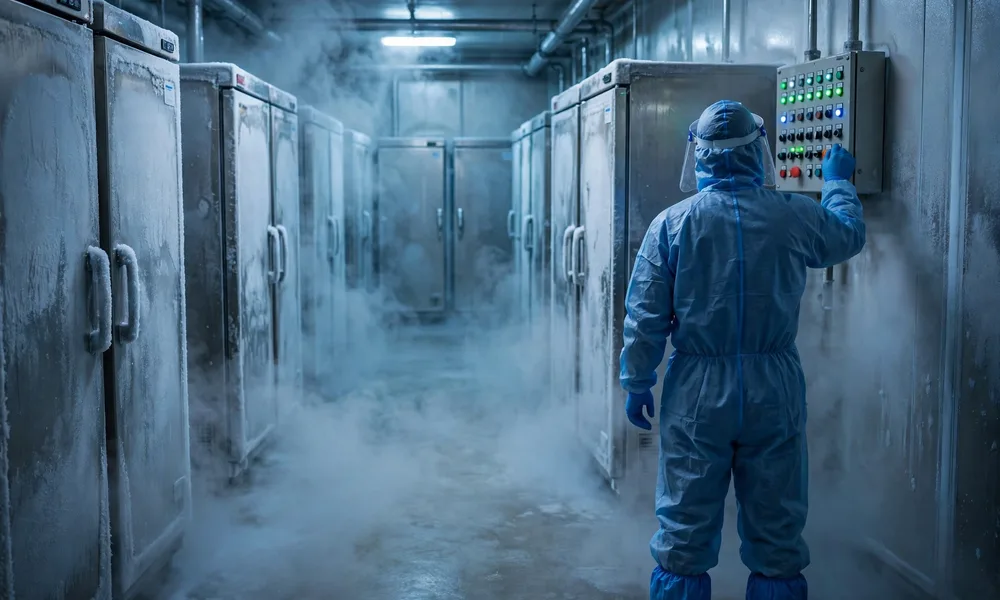
According to EFS, an on-duty technician noticed a rise in temperature in the cold rooms overnight from Sunday to Monday and raised the alarm. That simple act of attention, watching a monitor, noticing a number moving the wrong way, and acting on it, is what stopped this attack from becoming a crisis. Monitoring alarms and precautionary measures put in place at once preserved the safety of blood supplies, the Health Ministry said in a statement cited by Reuters.
EFS president Frederic Pacoud told French television channel BFMTV that while EFS “could have lost samples or bags of plasma intended to treat patients,” the early warning meant “there was no compromise to the safety of blood products.” He confirmed that no blood products were lost as a result of the incident. Collections and deliveries have continued as normal, according to EFS.
That outcome is reassuring, but it also raises a question: what if the technician had been looking elsewhere, or the alarm had been slower? Critical medical storage should not depend on one person noticing a number at 3 a.m. The incident is now being investigated with ANSSI, France national cybersecurity agency, and EFS says its own IT systems were not directly targeted. The attack came through a contractor system, which is a common weak point in modern infrastructure: the main organization may be secure, while a supplier with remote access is not.
What Was Actually in the Cold Rooms
Early EFS statements described the affected containers as holding donor samples used for transfusion safety monitoring. Those samples are kept so that blood safety can be checked over time, and losing them would have damaged monitoring, even if no patient was directly affected. EFS later acknowledged that frozen plasma intended for transfusions was also involved, which raised the stakes considerably.
Plasma is the liquid part of blood, used to treat patients with clotting problems, burns, liver disease, and major blood loss. Frozen plasma must be kept very cold, and once thawed or warmed beyond safe limits, it cannot simply be refrozen and used. Losing a stock of plasma at several sites would not just be a financial loss. It could delay treatment for real patients while replacement stock was found.
That is why the Health Ministry reassurance matters so much. By saying there was no operational consequence and no compromise to blood product safety, officials are telling hospitals and patients that the supply chain held. Blood collection and distribution have continued, and no hospital has reported a shortage linked to this incident. If that assessment changes as the investigation continues, officials will need to say so quickly and clearly.
Part of a Wider Refrigeration Attack Wave
The blood bank attack did not happen in isolation. It followed a wave of refrigeration sabotage across Europe. In October 2026, hackers targeted supermarket refrigeration in France and several other countries, remotely changing freezer settings, causing temperatures to rise, and spoiling large amounts of food. Further incidents were reported across six European countries on November 2, the same weekend as the blood bank attack.
French cybersecurity agency ANSSI had already issued an alert in October, known as CERTFR-2026-ALE-012, about compromises involving certain refrigeration controllers, including Danfoss and Copeland and Dixell systems. No public technical evidence has yet connected the Coolworld incident to those supermarket attacks, and investigators have not published the initial access method, the controller models involved, or the identity of the attackers. But the pattern is hard to ignore: someone, or some group, is systematically testing how much damage can be done by turning up the temperature on Europe cold storage.
That pattern makes the blood bank attack especially worrying. Supermarket food can be replaced. Blood products cannot be manufactured on demand. They depend on donors, testing, and careful storage, and a successful attack on a blood service would be a direct threat to patient care. Cybersecurity experts quoted in coverage have called this a shift from data theft to physical harm, and they argue that operational technology, the connected equipment that controls real-world machines, needs the same protection as computer networks.
More from The Akron Magazine: readers who follow technology and security news may also like our story on Europe supermarket freezer cyberattacks, our report on Google XCPE botnet takedown, and our story on Kentucky measles cases reaching 204.
Frequently Asked Questions
Did hackers destroy blood in France?
No blood products were lost, according to EFS and France Health Ministry. A technician spotted rising temperatures overnight on November 1 to 2, 2026, and acted in time, so there was no operational disruption.
What temperature did hackers set the freezers to?
Attackers changed controller settings from around minus 30 degrees Celsius to 110 degrees Celsius. That 110C figure is the setpoint entered by attackers, not confirmed proof that rooms or plasma reached that temperature.
How did hackers get into the blood bank systems?
Reports say the attack came through the remote management system of Coolworld, a contractor that maintains EFS cold rooms. EFS says its own IT systems were not directly targeted, and investigators have not disclosed the exact access method.
Is the French blood supply safe now?
Officials say yes. EFS says collections and deliveries are continuing as normal, and the Health Ministry says blood product safety was not compromised. The incident is under investigation with ANSSI, France cybersecurity agency.
Sources
InfoSecurity Magazine: France Blood Service Hack Sends Blood Storage Temperatures to 110C
GBHackers: Hackers Target French Blood Service, Reprogram Plasma Storage Freezers
Inside Telecom: France Blood Bank Storage Temperature Hacked
Final Thoughts
The France blood banks hack should be remembered for two things. First, for how close it came to real harm: a remote attacker, working through a contractor, changed the settings on machines that keep life-saving plasma safe, and only fast human action stopped it. Second, for what it reveals about modern infrastructure: the most dangerous cyberattacks may not steal your data or empty your bank account. They may simply turn up the heat on a freezer, and wait.
France blood service did its job in the moment, and officials have been clear about the outcome. The harder job comes next: securing contractor remote access, hardening refrigeration controllers, and making sure that no future attack depends on one technician noticing a number in the middle of the night. Blood donors give something irreplaceable. The systems that store their gift must be protected as if lives depend on them, because they do.