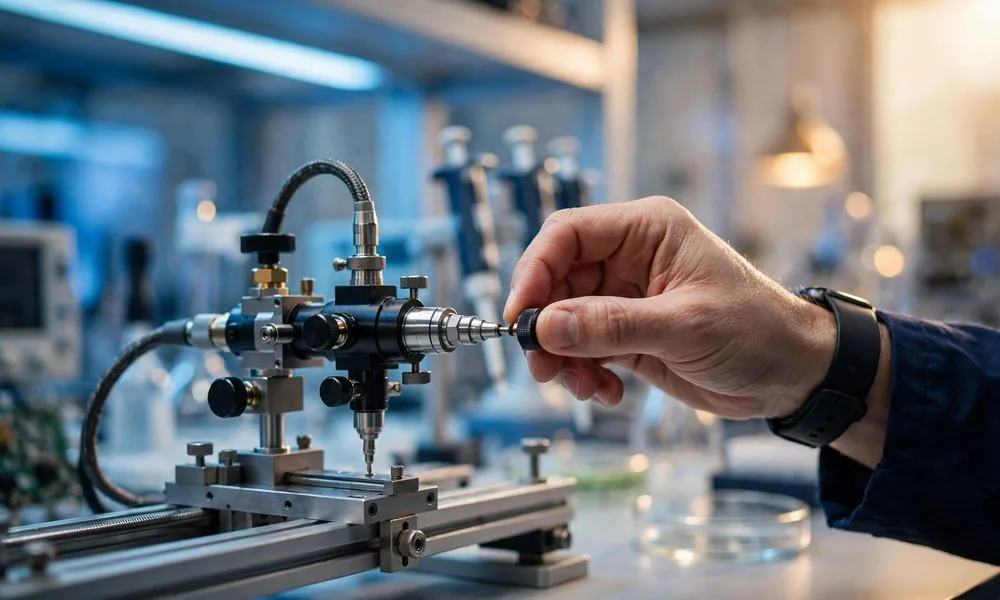
You find the word messonde in a manual, a product list, or a data sheet, and it stops you cold. It looks technical. It looks German. But a quick search gives you messy results, from measuring tools to brand like pages with no clear owner. This guide explains messonde in simple words, starting with its real technical meaning. We cover what a measuring probe is, what kinds exist, where they are used, and why the word looks different online from the form you find in careful German documents.
The short answer is this. The word points to a measuring probe, a device that senses a physical or chemical property and turns it into a signal people can read. The fuller story includes a spelling detail that explains most of the confusion.
| Name | Messonde, closely linked to the German word Messsonde |
|---|---|
| Type | Technical term for a measuring probe or sensor probe |
| What It Is | The part of a measuring system that is placed in or near the material being measured, such as a liquid, gas, surface, or process, and detects a value like temperature, pressure, level, or conductivity |
| Website / Origin | Origin: German technical language. Mess means measurement and Sonde means a probe. The standard German spelling in patents and manuals is Messsonde, with three s letters in a row in the middle |
What Is messonde?
messonde is best understood as a form of the German term Messsonde. That German word joins two parts. Mess comes from messen, to measure. Sonde is a probe, an instrument made to explore or test something it is placed into or against. Put together, the word means measuring probe.
Spelling is the first clue for readers. Careful German technical writing, including European patents, uses Messsonde with three s letters in a row in the middle, because the end of the first part and the start of Sonde both bring the letter s together. English speakers often simplify that hard cluster when they copy, type, or translate the word. The result is the shorter form with one s dropped. That is why a search for the short form gives a mix of real technical pages, machine translations, and low quality pages that repeat the word without understanding it.
A measuring probe is not one single product. It is a role inside a larger measuring system. The probe is the part that meets the real world. It goes into a tank, a pipe, a liquid, a gas flow, a soil sample, or against a surface. It senses something there. The rest of the system, such as a cable, a transmitter, and a display or controller, turns that sensing into a number, a chart, or an alarm that a person can use.
How a Measuring Probe Works
The basic steps are the same across many fields. First, the sensing element reacts to the property being measured. Heat may change its electrical resistance. Pressure may bend a thin part inside it. A liquid may change how it conducts electricity between two points. Light, sound, or radiation may change in a way the element can detect.
Second, that reaction becomes a signal. In modern systems the signal is usually electrical. It may be a small voltage, a change in resistance, or a digital message. Third, the wider system reads the signal, corrects it where needed, and shows a value in units, such as degrees, bars, meters, or percent. Fourth, in a factory or a lab, that value may trigger action. A controller can open a valve, stop a pump, sound an alarm, or simply log the result for later review.
Calibration is a key part of the story. Calibration means checking the probe against a known standard and adjusting the system so the reading is right. Probes drift over time. Heat, dirt, wear, and chemicals can push readings off course. A probe that is never checked can look precise while being wrong. Good manuals therefore give a range, an accuracy figure, a calibration method, and limits for temperature and pressure. If a listing gives none of that, it is not a serious technical document.
Main Types of Measuring Probes
Temperature probes are among the most common. They may use a thermocouple, a resistance thermometer often called an RTD, or a thermistor. You find them in food production, heating systems, engines, labs, and cold storage. A patent example for a fluid measuring probe even describes a separate temperature sensor built as a resistance thermometer, whose resistance changes with the heat inside the equipment.
Level probes answer a simple question. How full is this tank or container? They can work in several ways, including pressure, capacitance, ultrasound, or radar, depending on the design. In German water technology patents, measuring probes appear for fill level alongside flow rate as key values inside vessels, pipelines, and steam equipment. Level readings help prevent overfilling, dry running of pumps, and costly spills.
Pressure probes sense force from a gas or a liquid. Conductivity probes sense how well a liquid carries an electric current, which can reveal salt content or chemical strength. In one European patent, a measuring probe for a fluid is described as detecting physical or chemical properties such as temperature, pressure, and conductivity, plus equipment values such as fill level and flow speed. That single example shows how one probe housing can support more than one kind of sensing.
Water quality work uses a whole family of probes. German patent documents list pH measuring probes, chlorine probes, conductivity probes, and redox probes grouped in one measuring chamber for water treatment. Oxygen probes are common in water, brewing, and biology. Radiation measuring probes are a specialist type, built to detect ionizing radiation and used with a separate measuring instrument. Thickness and distance probes appear in manufacturing, where a part must meet an exact size.
Where Measuring Probes Are Used
Industry is the biggest setting. Factories use probes to watch processes inside pressure vessels, pipelines, tanks, and boilers, so staff can monitor a process and influence it in a targeted way. If a temperature climbs too high or a level drops too low, the system can react before damage is done. That early warning role is a major reason probes are built into equipment rather than used only as hand tools.
Labs use probes for careful tests on small samples. Food and drink makers use them to check heat, acidity, and other values that affect safety and taste. Water plants use them to track quality before, during, and after treatment. Environmental teams use probes in rivers, soil, and weather stations to log change over time. Medical and health technology also uses measuring probes in specialist devices, though those products face strict rules and testing of their own.
Messonde in Modern Online Searches
Online, the word has a second life. Because the simplified spelling is rare and distinctive, it also shows up as a username, a site name, or a brand like label in places that have nothing to do with sensors. Search engines then mix those results with the technical meaning. Some newer pages also claim the word names a new software tool or a communication system. In the sources we checked, those claims had no identifiable developer, no primary documentation, and no product record to back them up.
So treat online claims with a clear test. If a page says this word is a product, it should name the maker, show a model or version, link to official documents, and give specifications. If it only repeats broad praise words with no checkable detail, it is likely content made to catch searches, not a real product guide. The same test works in reverse for technical pages. A real probe listing gives a measuring range, an output type, materials, and mounting details. Those dry details are a sign of a genuine document.
Is It Legit and Safe?
As a technical term, yes, the meaning is legit and well documented in patents and engineering documents. The word names a real class of devices that industry depends on every day. What is not legit is any grand claim built on the word alone. A probe is only as good as its design, its fit for the job, and its calibration record. No single word on a listing can prove quality.
Safety depends on correct use. A probe chosen for the wrong range can give false readings. A false reading in a pressure vessel, a chemical tank, or a food process can lead to real harm. Buyers should check the range, the materials, the pressure and temperature limits, and whether the probe suits hazardous areas if that applies. Electrical parts should be fitted by qualified people, following the manual. Used probes for safety critical work are a poor saving, because wear and drift are hard to see.
Online safety matters too. Do not download manuals or software from a page that merely uses this search term as bait. Go to the makers official site or a trusted supplier, match the model number exactly, and scan any file you download. If a seller cannot give a data sheet, a calibration note, and a clear return policy, buy elsewhere.
Frequently Asked Questions (FAQs)
Is messonde the same as Messsonde?
They point to the same basic idea, a measuring probe. Messsonde is the standard German spelling found in patents and manuals. The shorter form is a simplified spelling that appears often in translations and online text.
Does the word name one exact device?
No. It names a function, not one model. A measuring probe can be built for temperature, pressure, level, pH, conductivity, oxygen, flow, radiation, and other values. The type and model decide what it actually does.
I found the word in my manual. What should I do?
Read the words around it for the measured value and the model number. Then search with the standard German spelling plus that value or model. Look for the makers data sheet, which should list range, accuracy, and fitting steps.
Can I replace a probe with any probe that fits?
No. Fit is only one part. The sensing type, range, output signal, materials, and limits must all match your system. A wrong match can give bad readings or damage equipment. Check the data sheet or ask a qualified technician.
Final Thoughts
messonde is a useful word once its spelling trick is clear. Behind it stands Messsonde, the German term for a measuring probe, the sensing part of a system that watches temperature, level, pressure, and many other values in tanks, pipes, labs, and plants. It is not one machine, not one brand, and, on the evidence available, not a proven new software product.
You may also read: FancyAI Skills: The Future of AI for Marketing Sales and Business Growth


