Ludlow Ogden Smith: All About Katharine Hepburn’s Ex-Husband
 Katharine Hepburn is remembered as one of the greatest screen actresses of all time, a woman who won four Academy Awards and who guarded her independence for her whole life. What many people forget is that she was married once. Her only husband was Ludlow Ogden Smith, a Philadelphia businessman whom friends and family called Luddy.
They married in 1928, before Hepburn was famous, and divorced in 1934, just as her Hollywood career was taking off. Yet the story did not end with the divorce. They stayed friends for the rest of his life, and Hepburn spoke of him with gratitude for decades. This is the full, careful story of the man behind that unusual marriage.
Quick Facts
| Full name | Ludlow Ogden Smith, later used as S. Ogden Ludlow |
|---|---|
| Nickname | Luddy |
| Known for | First and only husband of actress Katharine Hepburn |
| Wedding | December 12, 1928, in Hartford, Connecticut |
| Divorce | Divorced in Merida, Mexico, finalized May 8, 1934 |
| Background | Businessman from a socially prominent Philadelphia family |
| Children with Hepburn | None |
| Died | 1979 |
Who Was Ludlow Ogden Smith?
Ludlow Ogden Smith came from a well-to-do and socially prominent family from the Philadelphia area. A museum account of Hepburn’s wedding dress identifies his parents as Gertrude Clemson Smith and Lewis L. Smith and places the family home in Strafford, Pennsylvania. He was not an actor, a director or a Hollywood figure of any kind. He was a businessman, described in different sources as a socialite-businessman, an insurance broker and a stockbroker from Philadelphia.
The same museum account says he was president of a company called Ogden Ludlow Inc. and credits him as the creator of the Ludlow Formula, described as an early step toward computerized systems in financial institutions. That business detail comes from a single museum source and is not widely repeated in major biographies, so it is best treated as reported rather than fully documented. What the main biographical record does agree on is simpler: he had money, he had a calm and generous nature, and he supported Hepburn when she had very little of either fame or income.
He met Hepburn while she was a student at Bryn Mawr College. The Katharine Hepburn Museum account says they met in 1927, during her senior year. She found him kind, generous and intellectual, according to that account. He was about eight years older than her. When they married on December 12, 1928, she was 21 and he was 29.
A Wedding at Home and an Unusual Name Change
The wedding itself was small and personal. They were married in her parents’ living room at 201 Bloomfield Avenue in Hartford, Connecticut, and the ceremony was performed by her grandfather, the Reverend Sewell Hepburn, according to the museum account. Hepburn wore a dress by the Paris house of Babani. That dress survived, was sold at auction after her death, and was later acquired by the Katharine Hepburn Museum in Connecticut, which is why the details of the day are better recorded than most of Smith’s life.
The marriage came with one famous and telling condition. Smith changed his name at her request. If she kept his name in its normal order, she would be Mrs. Ludlow Ogden Smith, but in everyday life she feared being known as Kate Smith, a name she considered too plain and one that was also linked to a well-known singer. So he rearranged his name to S. Ogden Ludlow. It was an early sign of how the marriage would work. He adjusted. She pursued the life she wanted.
The Hepburn family, by all accounts, liked him at once. The museum account says the family accepted Luddy immediately and that he kept his relationship with them long after the marriage ended. That detail is supported by the wider record. Even after the divorce, Smith remained welcome in the Hepburn family circle, which was not a small thing in a close and strong-minded family.
A Marriage That Could Not Match Her Ambition
Hepburn graduated from Bryn Mawr in 1928 with a degree in history and philosophy, and she wanted the stage. Work was hard to find, and the early years of the marriage were years of small parts, setbacks and travel for auditions and tours. Smith gave her financial and moral support during that period. Hepburn herself never denied it. In her autobiography she was blunt about the imbalance, calling herself, in her own famous phrase, a terrible pig for the way she used his love and support while giving the marriage so little of herself.
Biographers describe a basic mismatch. He was calm and quiet. She was driven, direct and already set on a career that would come first. She never fully committed to the marriage, according to summaries of her life, and she put her work ahead of it. In 1932 she went to Hollywood, and the move made the distance between them permanent in practice, even before it was ended in law.
During that Hollywood period she also began a relationship with her agent, Leland Hayward, while both were still married. That affair is part of the standard biographical record of Hepburn’s life. It underlines the point that the marriage to Smith had effectively ended well before the legal divorce was signed.
The Divorce in Mexico and the Second Divorce
Hepburn traveled to Merida, in Yucatan, Mexico, to obtain a quick divorce. Reference summaries give the filing date as April 30, 1934, with the divorce finalized on May 8, 1934. Mexican divorces of that era were fast, and many American couples used them. But there were doubts about whether such a divorce would be fully recognized in the United States.
Because of those doubts, Smith later obtained a second divorce in the United States before he remarried. Sources differ on the exact year of that second action. Some accounts say he secured a divorce in the United States in 1942 and remarried a few days later. Another account gives a Connecticut divorce date of September 18, 1941. The safe summary is this: a second, American divorce was obtained in the early 1940s, shortly before his remarriage. The exact date is not settled across sources and is marked here as unconfirmed in its detail.
After the divorce, Smith married Elisabeth Albers, whose name is also spelled Elizabeth Albers in some accounts. He raised a family in that second marriage, according to the museum account. Hepburn, by contrast, never married again. Her later long relationships, most famously with Spencer Tracy, never became marriages. Ludlow Ogden Smith remained, for her whole life, her only husband.
Friends for Life After the Divorce
The most remarkable part of this story is what happened next, or rather what did not happen. There was no lasting bitterness in the public record. Hepburn often expressed gratitude to Smith for his support in the early days of her career. They remained friends until his death in 1979, a span of more than four decades after their divorce.
The museum account adds that Hepburn visited him often, especially when he became ill, and that he sustained his ties with the Hepburn family throughout. Some later magazine accounts go further and describe hospital visits and an anniversary remembered during his final illness. Those touching details come from weaker sources and could not be confirmed here from a major biography, so they are noted as unconfirmed rather than presented as fact.
One other claim appears in popular accounts: that Smith helped revive Hepburn’s career around 1939 by financing the stage production of The Philadelphia Story. The play did revive her career, and she later starred in the film version. However, the specific claim that Smith financed the stage production is not part of the main reference summaries reviewed for this article, so it is left here as an unconfirmed report, not as an established fact.
Smith died in 1979. Hepburn lived until 2003, dying at the age of 96, and in her long later life she continued to speak of Luddy with a mix of honesty and affection. She knew the marriage had failed largely because of her own priorities, and she said so in print.
Why Ludlow Ogden Smith Matters
Smith matters because he shows the cost of Hepburn’s famous independence at the start of her life. Before the Oscars, before the trousers became a symbol, before the legend hardened, there was a young actress who accepted the support of a patient husband and then walked toward a career that left no room for the marriage he wanted.
He also matters in his own right as an example of a different kind of strength. He changed his name for her. He supported her when her prospects were uncertain. He let the marriage go without a public fight, remarried, built a family, and still kept a friendship with the woman who had left. History remembers him only because of her, which is unfair to the life he lived outside those six years, but the record he left in her story is a decent and generous one.
FAQs
When did Ludlow Ogden Smith marry Katharine Hepburn?
They married on December 12, 1928, in her parents’ home in Hartford, Connecticut. She was 21 and he was 29. He was the only husband Hepburn ever had.
Why did Ludlow Ogden Smith change his name?
At Hepburn’s request he rearranged his name to S. Ogden Ludlow so that she would not be known as Kate Smith, a name she considered too plain.
When did they divorce?
Their divorce was finalized in Merida, Mexico, on May 8, 1934. Smith later obtained a second divorce in the United States in the early 1940s before remarrying, though sources differ on its exact date.
Did Ludlow Ogden Smith remarry?
Yes. He married Elisabeth Albers and raised a family, according to museum and biographical accounts. He and Hepburn remained friends until his death in 1979.
You may also read: Richard Carleton Meeker: The Full Story of Mary Tyler Moore’s First Husband
Final Thoughts
Ludlow Ogden Smith was a Philadelphia businessman who gave a young, unknown Katharine Hepburn the support she needed and the freedom she demanded, and who paid for that generosity with his marriage. Their union lasted from 1928 to 1934. Their friendship lasted until 1979.
In a century of messy celebrity divorces, theirs stands out for its lack of rancor. Hepburn’s own verdict on herself was the harshest one in the record, and her gratitude to Luddy was real and lasting. That may be the best summary of the man: he was treated, by the most famous witness to his life, as someone who deserved thanks.
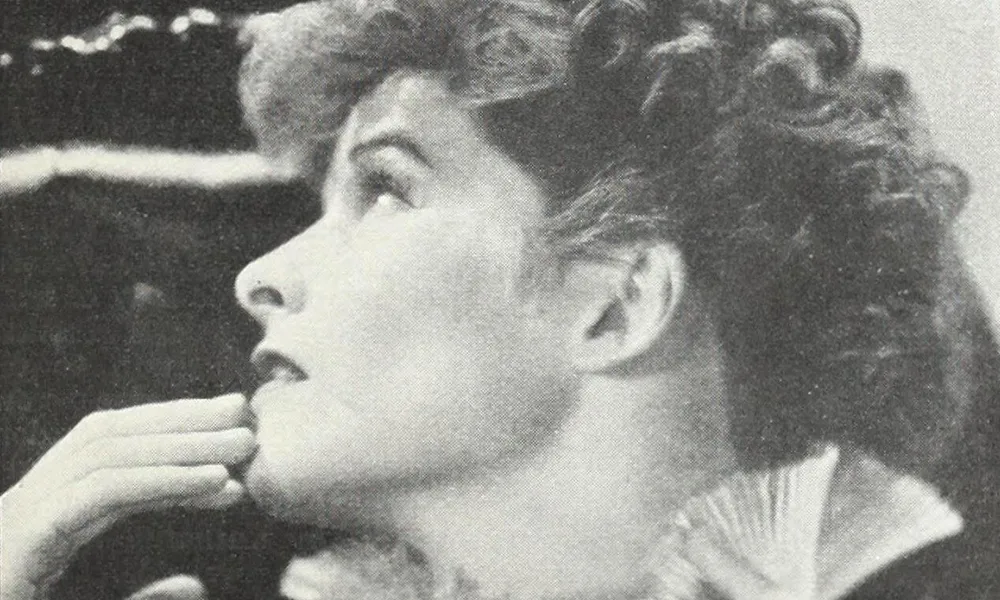
Featured photo: Katharine Hepburn – public domain photo, via Wikimedia Commons