Delhi woke up to thick smog on Monday, November 9, 2026, after a night of Diwali fireworks. At 9 a.m., the city recorded an air quality index, or AQI, of 370. That reading falls in the “very poor” category used by the Central Pollution Control Board, known as the CPCB. Many areas across the city of 20 million people showed readings above 400, which the board places in the “severe” category. The fireworks came after a court order that allowed only certified low-polluting firecrackers during limited hours over the Diwali weekend. Residents said firecrackers were still going off until late in the night, in Delhi and in Mumbai.
Quick Facts
| Detail | Fact |
|---|---|
| Date | Monday, November 9, 2026 |
| AQI at 9 a.m. | 370, “very poor” |
| Areas above 400 | Many areas, “severe” |
| Diwali night AQI | 372 at 1 a.m. |
| Monday 6 a.m. AQI | 366 |
| Nov 8, 4 p.m. AQI | 376 |
| Stations above 400 | 18 to 21, 8 p.m. to midnight |
| “Good” AQI | Up to 50 |
| World rank | Third-most polluted, IQAir |
| Most polluted city | Lahore, AQI 563, hazardous |
| GRAP stage | Stage III, from Nov 6 |
| PM2.5 peak | Above 900 micrograms per cubic meter |
| Stations missing readings | At least 44 of 59 |
| “Good” days in 2026 | One day |
What the Numbers Show on Monday Morning
Pollution was already high before Diwali night, and the fireworks pushed it higher. On November 8 at 4 p.m., the average AQI stood at 376. By 1 a.m. on Diwali night, the average was 372. At 6 a.m. on Monday, it was 366. By 9 a.m., it had risen again to 370.
The Hindu BusinessLine reported that PM2.5 concentrations topped 900 micrograms per cubic meter at several locations, more than 60 times the level recommended by the World Health Organization. PM2.5 means very fine particles, small enough to get deep into the lungs. At least 44 of the CPCB’s 59 stations failed to show particulate-matter readings, so the published averages may not show the full extent of the pollution. IQAir reported AQI readings above 2,000 at multiple locations.
What AQI Numbers Mean in Plain Language
AQI is a single number that sums up how clean or dirty the air is. Lower is better. Higher is worse. The CPCB treats an AQI of up to 50 as “good”, the range where the air is healthy for most people. At 370, Delhi sat in the “very poor” band. That means the air was bad enough to affect healthy people as well as people with breathing problems. Eyes can sting, throats can feel raw, and a normal walk can leave a person short of breath.
Above 400, the label changes to “severe”. That is the band many Delhi areas entered on Monday. In severe air, the guidance is simple. Spend less time outside, keep windows closed where possible, and avoid hard exercise outdoors. Lahore led the IQAir live ranking on Monday morning with an AQI of 563, in the “hazardous” category. Delhi ranked third in the world on the same live list.
Fireworks, Court Orders and a Week of Bad Air
The Supreme Court said earlier this month that only certified low-polluting firecrackers would be allowed during limited hours over the Diwali weekend. In practice, residents in Delhi and in Mumbai said firecrackers were going off until late in the night. Fireworks release a sudden burst of smoke and fine particles. On a cold winter night, with still air and low wind, the smoke stays close to the ground and mixes with the pollution already in the air.
Delhi had seen poor air quality for more than a week before Diwali, so the festival did not create the problem from nothing. It made an existing problem sharper. Many people also spent the weekend out with family and at the cinema, with Ramayana box office day 4 collections drawing wide attention, news that Ramayana crossed 400 crore and entered the top five global grossers adding to the talk, and Sunny Deol praising Ramayana as better than Hollywood making the rounds online.
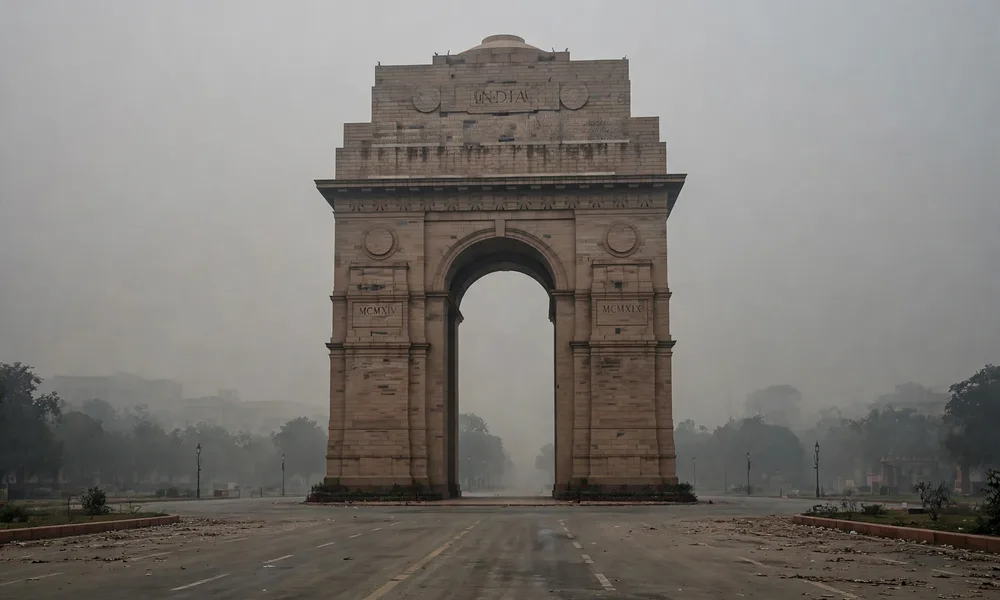
Visuals from Reuters TV showed the result on Monday morning. A layer of smog enveloped India Gate in central Delhi, close to government offices and parliament. People strolled amid thick smog at Kartavya Path on Monday morning, with the haze visible in every direction.
GRAP Stage III Restrictions Now in Force
Delhi imposed restrictions on Friday under the Graded Response Action Plan, known as GRAP. The Commission for Air Quality Management, known as the CAQM, invoked GRAP Stage III on November 6. It cited a daily average AQI of 382 and forecasts of further deterioration. Schools were asked to conduct classes online, and the Delhi Directorate of Education directed all government and private schools to conduct classes up to Class 5 in hybrid mode.
A CAQM order covering November 5 to 20 directs up to 50 percent physical attendance in specified government and private offices in Delhi and five NCR districts. In plain terms, half the staff in those offices can work from home, which cuts traffic and keeps fewer people on the roads during the worst of the pollution.
Parents have urged school holidays from November 10 to 15, but no official order closing all schools has been issued. That distinction matters, and it should be stated honestly. A hybrid direction for young classes is not the same as a full closure. Families should follow the latest notice from their own school and from the Directorate of Education. People with breathing problems should limit outdoor exposure and talk to their own doctor for personal advice.
Smog Over India Gate and the Wider Region
The smog over India Gate was the most visible image of Monday, but the problem reached beyond one landmark. Delhi was the third-most polluted city in the world on Monday morning on IQAir’s live ranking, while Lahore led the list with an AQI of 563, in the hazardous category. Air pollution is an annual concern across northern India during winter. Cold air traps vehicle emissions, construction dust and smoke from crop burning close to the ground. Warm air rises and carries pollution away. Cold, still air acts like a lid, holding the smoke in place.
Fireworks added a sharp burst of pollution around Diwali, on top of that seasonal base. The festival fell in a week when the air was already poor, the weather was turning cold, and the GRAP restrictions had only just been tightened. The smoke had nowhere to go, so it stayed and built up through the night. The missing data from CPCB stations adds another worry, and the gap may have obscured the full extent of the pollution.
Why Winter Makes Delhi Air Worse
Winter in northern India brings conditions that work against clean air. Nights get longer and colder, and the ground cools fast after sunset. A layer of cold air forms near the surface, with warmer air above it. That setup, known as an inversion, stops smoke from rising and spreading. Instead of dispersing, the pollution sits where people live and breathe. Into that trapped layer go the usual winter sources: vehicle exhaust, construction dust, smoke from crop burning in nearby farming areas, and smoke from heating and cooking.
Diwali fireworks fit into this pattern as a sudden shock. A single night of intense fireworks can add as much fine particle pollution in a few hours as several normal days combined. The particles are tiny, and they stay in the air for a long time when there is no wind to move them. That is why the AQI stayed above 360 from 1 a.m. through 9 a.m. on Monday, instead of falling fast after midnight.
FAQs
What was Delhi AQI on Monday morning after Diwali?
At 9 a.m. on Monday, November 9, 2026, Delhi recorded an AQI of 370, “very poor” per the CPCB. The average was 372 at 1 a.m. and 366 at 6 a.m. Many areas showed readings above 400, the “severe” category.
Why did Delhi air get worse after Diwali?
Fireworks added a sharp burst of smoke and fine particles to air that was already poor. The Supreme Court had allowed only certified low-polluting firecrackers during limited hours, but residents said firecrackers went off until late in the night.
What is GRAP Stage III and what does it change?
GRAP is the Graded Response Action Plan, a set of steps that tighten as air quality worsens. Stage III was invoked on November 6 after a daily average AQI of 382. Classes up to Class 5 moved to hybrid mode, and specified offices in Delhi and five NCR districts were directed to keep physical attendance at up to 50 percent from November 5 to 20.
Are schools closed in Delhi from November 10 to 15?
No official order closing all schools has been issued. Parents have urged holidays from November 10 to 15, but the official direction so far is hybrid mode for classes up to Class 5. Families should check the latest notice from their school and the Delhi Directorate of Education.
Sources
Final Thoughts
Delhi AQI 370 on Monday morning is a number that needs no dressing up. It means very poor air across a city of 20 million people, with many areas in the severe range above 400. The fireworks of Diwali night made a bad week worse, and the cold winter air kept the smoke in place through the morning.
The response so far has been the graded one the system is built for. GRAP Stage III is in force, young schoolchildren are learning in hybrid mode, and offices are running at reduced physical attendance. Those steps can limit new pollution and limit exposure, but they cannot clear the sky on their own. That will take a change in the weather, and a change in how the city handles the sources of smoke that return every winter.