Cyclone Murasu Aftermath: Two Dead and 344 Crore Damage as Storm Weakens to a Depression
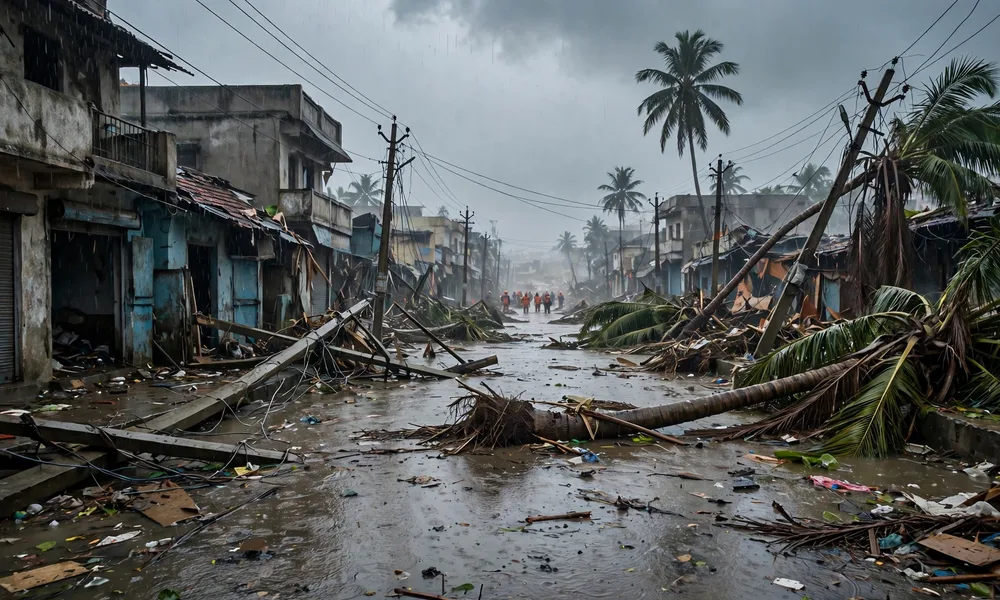
Severe cyclonic storm Murasu, which slammed into the Andhra Pradesh coast early on November 3, 2026, has now weakened to a depression as it moves inland, but the damage it left behind is already large. At least two people have died, tens of thousands of hectares of crops have been damaged, and early official estimates put the total loss at about 344 crore rupees, or roughly 36.3 million dollars.
The storm crossed the coast near Ongole with powerful winds and heavy rain, and it followed close behind another cyclone, Arnab, which had hit the region only about a week earlier. For farmers and coastal communities still recovering from the first storm, Murasu has been a second blow in a very short time.
| Quick Facts | Details |
|---|---|
| Storm | Severe cyclonic storm Murasu |
| Landfall | Near Ongole, Andhra Pradesh, early November 3, 2026 |
| Landfall winds | 100 to 110 kmph, gusting to 120 kmph |
| Status on November 4 | Weakened to a depression over east Telangana and adjoining coastal Andhra Pradesh |
| Position on November 4 | About 30 km south of Khammam, moving north at about 10 km/h |
| Deaths reported | At least 2, both in Bapatla district, from collapsed buildings |
| Crop damage | 52,459 hectares, according to preliminary APSDMA figures |
| Houses damaged | 312 |
| People in relief centres | 12,230 in Guntur, Bapatla and Palnadu |
| Electricity poles down | 2,750 |
| First loss estimate | About 344 crore rupees, about 94 percent farming losses |
| Farmers affected | 69,828 |
How Murasu Made Landfall
Murasu crossed the Andhra Pradesh coast near Ongole in the early hours of November 3 as a severe cyclonic storm. At landfall, sustained winds were reported at 100 to 110 kilometres per hour, with gusts reaching 120 kilometres per hour. Winds at that strength can tear roofs from houses, snap power poles, and flatten standing crops, and the heavy rain that came with the storm added flooding to the list of dangers.
Coastal Andhra Pradesh is no stranger to cyclones, but the timing made this one harder to handle. The storm arrived only about a week after Cyclone Arnab, which had already damaged about 3.52 lakh hectares of crops in the region. Fields that were still waterlogged or partly damaged from the first storm had little time to recover before the second one arrived.
State authorities had opened relief camps and moved people from low-lying and vulnerable areas before landfall, a standard step that likely limited the human toll. Even so, the storm still claimed lives and caused widespread damage to homes, power lines, and farms.
Where the Storm Is Now
By the morning of November 4, Murasu had weakened to a depression over east Telangana and adjoining coastal Andhra Pradesh. Weather officials placed its centre about 30 kilometres south of Khammam, moving north at roughly 10 kilometres per hour. It was expected to weaken further into a well-marked low pressure area.
A weaker storm is still a dangerous storm. The India Meteorological Department, or IMD, warned that heavy to very heavy rain could still fall at isolated places on November 4 in north coastal Andhra Pradesh and east Telangana. Officials also flagged a low to moderate flash flood risk in several coastal districts, which means residents should stay alert even though the worst winds have passed.
Depressions can still dump large amounts of rain over a small area, swelling rivers and drains and flooding low-lying fields and roads. For farmers, that rain can turn damaged crops into a total loss. For relief teams, it can slow the work of restoring power and reaching cut-off villages.
The Human Cost So Far
According to preliminary figures from the Andhra Pradesh State Disaster Management Authority, or APSDMA, at least two people died in the storm. Both deaths were in Bapatla district and were caused by collapsed buildings. Officials have described all figures released so far as preliminary, which means the numbers could change as more reports come in from districts.
The storm also damaged 312 houses and brought down 2,750 electricity poles, leaving many areas without power in the hours after landfall. Repair crews face a large task, especially where roads are flooded or blocked by fallen trees and debris.
About 12,230 people were staying in relief centres in Guntur, Bapatla, and Palnadu districts, and 480 schools were being used as relief camps across the affected region. Schools often serve as shelters during cyclones because they are large, sturdy buildings that can hold many families. For the people inside them, the days after a storm are spent waiting for news about their homes, their crops, and when they can safely return.
Farming Takes the Biggest Hit
The first loss estimate of about 344 crore rupees tells a clear story: roughly 94 percent of the damage is in farming. A total of 69,828 farmers were reported affected, and paddy was the worst-hit crop. The worst-affected districts were named as Bapatla, Krishna, and Guntur, all important farming areas in coastal Andhra Pradesh.
The APSDMA put crop damage at 52,459 hectares in its preliminary figures. Some other counts have mentioned different totals, including a figure of up to 30,661 hectares in some reports, but the official APSDMA figure of 52,459 hectares is the one used here, and officials stress that all estimates at this stage are preliminary. Final assessments usually take longer, as teams visit fields and verify losses village by village.
For farmers, the timing could hardly be worse. Paddy that was close to harvest can be ruined by strong winds and standing water in a matter of hours. When two cyclones strike in quick succession, as Arnab and Murasu have, the losses pile up: the first storm weakens the crop, and the second finishes it. Compensation and relief for affected farmers will now become a major part of the recovery effort.
Two Cyclones in Quick Succession
The back-to-back nature of Arnab and Murasu is one of the most important parts of this story. A single cyclone is hard enough for a coastal farming region to absorb. Two in about a week strain relief systems, damage the same fields twice, and leave less time for repairs between storms.
Power restoration is a good example. Crews that had just begun fixing damage from the first storm had to deal with a fresh round of fallen poles and damaged lines from the second. The same is true for roads, drainage, and housing repairs. Each new storm resets part of the recovery clock.
Relief officials also face a practical challenge: keeping shelters, food supplies, and medical support running for a longer period than a single storm would require. The use of 480 schools as relief camps shows the scale of the sheltering effort, and it also means those schools cannot return to normal classes until families have somewhere safe to go.
What Officials Are Warning About Next
Even as Murasu weakens, the IMD warning for November 4 deserves attention. Heavy to very heavy rain at isolated places can cause local flooding, especially in areas where drains and rivers are already full from the storm. The low to moderate flash flood risk in several coastal districts means that people in flood-prone spots should stay cautious and follow local advisories.
Residents returning home should watch for damaged power lines, weakened buildings, and flooded roads. Standing water can hide open drains and debris, and buildings damaged by wind and rain may be unsafe until they are checked. Local authorities typically advise people not to touch fallen power lines and to report them to the power department.
For the wider region, the focus now shifts from tracking the storm to counting the damage and starting repairs. District teams will continue field surveys, power crews will work through the list of fallen poles, and farming officials will verify crop losses so that relief can be assessed fairly.
Frequently Asked Questions
What is Cyclone Murasu and where did it hit?
Murasu was a severe cyclonic storm that crossed the Andhra Pradesh coast near Ongole early on November 3, 2026, with winds of 100 to 110 kmph gusting to 120 kmph. By November 4 it had weakened to a depression over east Telangana and adjoining coastal Andhra Pradesh.
How many people died and how much damage was caused?
At least two people died, both in Bapatla district, after buildings collapsed. The first loss estimate is about 344 crore rupees, with about 94 percent of it in farming. Preliminary figures list 52,459 hectares of crops damaged, 312 houses damaged, and 69,828 farmers affected. All figures are preliminary and may be revised.
Is the danger over now that Murasu has weakened?
Not entirely. The IMD still warns of heavy to very heavy rain at isolated places on November 4 in north coastal Andhra Pradesh and east Telangana, with a low to moderate flash flood risk in several coastal districts. Residents should keep following local advisories until the system weakens further.
How does Murasu compare with Cyclone Arnab?
Arnab struck about a week earlier and damaged about 3.52 lakh hectares of crops. Murasu has added a second round of damage to many of the same areas, which makes recovery harder for farmers and relief teams alike.
Final Thoughts
Cyclone Murasu may be fading into a depression, but its impact on coastal Andhra Pradesh will last far longer than the storm itself. Two lives lost, thousands of farmers affected, and hundreds of crores in damage, most of it in farming, add up to a serious setback for communities that were already dealing with Cyclone Arnab a week earlier.
The next phase is less dramatic than landfall but just as important: restoring power, verifying crop losses, helping displaced families return home safely, and making sure relief reaches the farmers and households that need it most. As the official figures are updated, the full scale of the damage will become clearer. For now, the priority remains safety, shelter, and a fair and speedy recovery.
Read more on The Akron Magazine. For official weather updates, see the India Meteorological Department.