Remembrance Sunday 2026 fell on Sunday, November 8, when King Charles III led the National Service of Remembrance at the Cenotaph in Whitehall, London. At 11am, Big Ben struck and Whitehall fell silent for two minutes. The King then laid the first wreath at the Cenotaph in honour of members of the armed forces who lost their lives in conflicts. Prince William laid a wreath after his father, and other senior royals also laid wreaths. Around 10,000 veterans then took part in a march-past. Prince Harry did not attend the London ceremony. He attended a separate Remembrance Sunday service in Brackley, Northamptonshire, on the same day.
Table of Contents
Quick Facts
| Detail | Fact |
|---|---|
| Date | Sunday, November 8, 2026 |
| Main ceremony | National Service of Remembrance at the Cenotaph, Whitehall, London |
| Led by | King Charles III |
| Two minutes silence | 11am, marked by Big Ben and gunfire from the King’s Troop Royal Horse Artillery on Horse Guards Parade |
| First wreath | Laid by King Charles III, with the handwritten message “In everlasting remembrance” |
| Wreath design | 41 paper poppy petals mounted on black leaves, closely resembling a wreath produced for King George VI |
| Prince William | Laid a wreath after his father, in the uniform of a Lieutenant Colonel of the Household Cavalry |
| Watching from the balcony | Queen Camilla and Catherine, Princess of Wales, from the Foreign, Commonwealth and Development Office |
| March-past | Around 10,000 armed forces veterans |
| Broadcast | BBC, ITV and Sky News |
| Festival of Remembrance | Saturday evening concert at the Royal Albert Hall |
| Prince Harry | Separate service in Brackley, Northamptonshire |
| Remembrance Sunday | The Sunday closest to November 11, Armistice Day |
The Two Minutes of Silence at Eleven
The heart of the service was the silence. At 11am, Big Ben struck, and Whitehall fell silent for two minutes. The quiet was marked by gunfire from the King’s Troop Royal Horse Artillery on Horse Guards Parade. For those two minutes, the crowds, the veterans, the serving personnel, and the royal party stood still together.
That silence is the centre of Remembrance Sunday every year. It gives people a shared moment to think about those who served and those who did not come home. Everything before the silence builds toward it, and everything after it flows from it.
The service remembered those who served in both world wars and in later conflicts involving British and Commonwealth forces. For the people who stood in Whitehall, the silence was also personal. Many will have been thinking of a relative, a friend, or a name on a local memorial.
The Wreath That Honoured a King Before Him
After the silence, the King laid the first wreath at the Cenotaph. He wore a field marshal uniform with greatcoat, cap and sword, and he saluted after laying his wreath. The moment was simple and formal at the same time. There was no rush, and no extra display. The act of laying the wreath, stepping back, and saluting said what needed to be said.
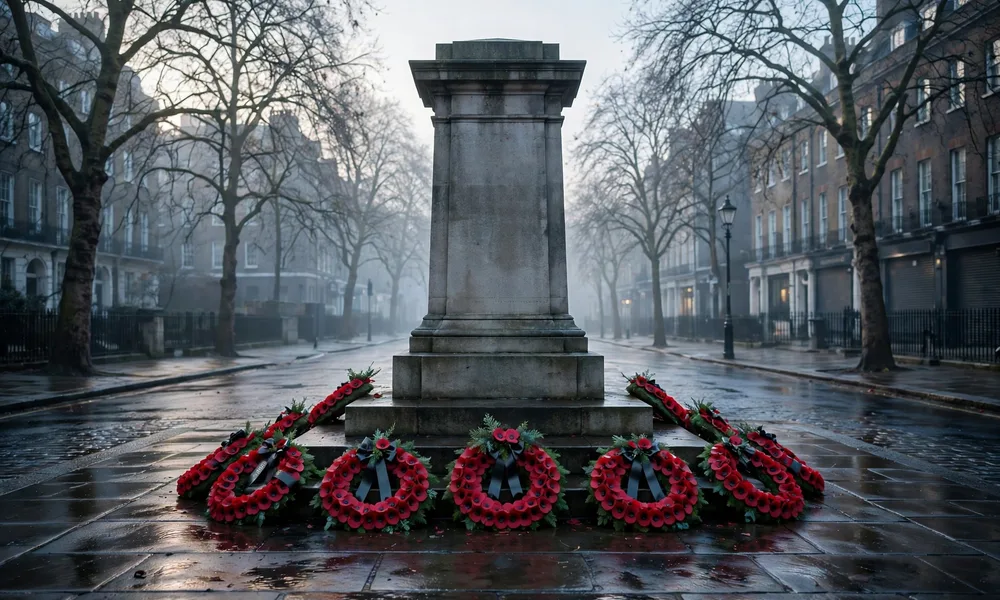
The wreath itself carried a link to the past. It closely resembled one produced for King George VI, with 41 paper poppy petals mounted on an arrangement of black leaves. It carried a handwritten message from the King: “In everlasting remembrance”. Those four words were short, but they were chosen with care. They spoke of memory that does not fade with time, and of a promise to keep remembering.
The choice of a wreath that recalls King George VI showed how Remembrance Sunday connects one generation to the next. The Cenotaph itself is a plain stone memorial, without a name and without grand decoration. Its strength lies in its simplicity.
Prince William and the Royal Family at the Cenotaph
Prince William, the Prince of Wales, laid a wreath after his father. He wore the uniform of a Lieutenant Colonel of the Household Cavalry with black cloak and sword, and he saluted after laying his wreath. His place in the order was clear. The King laid the first wreath, and his son and heir followed him.
Prince William brings his own service to the day. He completed seven and a half years of full-time military service after being commissioned as an officer in 2006. That service gives his part in the ceremony a personal meaning. He is not only taking part as a royal. He is taking part as someone who served, and who understands what the day means to those who served beside him.
The Duke of Edinburgh and the Princess Royal also laid wreaths, each laid with the same care and followed by a salute. Queen Camilla’s wreath was laid on her behalf by her equerry, Major Rob Treasure. Queen Camilla and Catherine, Princess of Wales, watched from the central balcony of the Foreign, Commonwealth and Development Office overlooking the Cenotaph. The service was broadcast by BBC, ITV and Sky News, so people who could not be in Whitehall could still follow it from home.
Ten Thousand Veterans March Past the Cenotaph
After the service, the march-past began. Around 10,000 armed forces veterans took part, walking past the Cenotaph in turn. It is one of the most moving parts of the day. The veterans march in groups, many wearing medals, many walking with friends they served with, and many remembering those who cannot march beside them.
Some march with ease. Others march slowly, or with help, and the crowd respects every step. People along Whitehall applaud as the groups pass. The applause is warm, but it is also quiet and respectful, in keeping with the day.
The commemorations had begun on Saturday evening with the Festival of Remembrance concert at the Royal Albert Hall. It uses music, readings, and stories to remember service and sacrifice. Many veterans and families travel long distances to London for the weekend, and recent disruption to travel in Europe has shown how quickly plans can change, as reported in this account of hoax bomb threats that disrupted flights across Europe.
Prince Harry Pays His Respects in Brackley
Prince Harry attended a separate Remembrance Sunday service in Brackley, Northamptonshire, on November 8, while the main ceremony took place in London. Photographs showed him chatting with locals in a dark suit with military medals. His choice to attend a local service meant that he marked the day in a quieter setting, among the people of a town, rather than at the national ceremony in Whitehall.
A local service has its own value. In towns across the country, people gather at war memorials, in churches, and in town squares. They hear the names of the fallen, they lay wreaths, and they stand in silence. Those services are the backbone of Remembrance Sunday. The national service in London is the focal point, but the day is kept alive in hundreds of local services just like the one in Brackley.
Prince Harry has been the subject of much royal news in recent months, including reports about Prince Harry and Meghan Markle and a first UK Christmas in eight years with Doria Ragland. His family has also been in the news for other reasons, including the report that Thomas Markle was arrested in Florida on a child pornography charge on November 6. On Remembrance Sunday, however, the focus in Brackley was on the service itself, and on the people who gathered to remember.
Why Remembrance Sunday 2026 Still Matters
Remembrance Sunday falls on the Sunday closest to November 11, Armistice Day, which marks the end of the First World War. That link to 1918 gives the day its roots, but its meaning has grown over time. It now remembers those who served in both world wars and in later conflicts involving British and Commonwealth forces. Each generation adds its own names to the act of remembrance.
The day matters because it asks people to pause. In a busy year, with news moving fast, a shared silence at 11am is a rare thing. It asks people to stop, to think, and to remember that freedom and safety have a cost. It also asks people to think about those who serve today, and about the families who support them.
As the years pass, fewer people remain who remember the world wars first hand. Remembrance Sunday is one of the ways that memory is passed on, as children stand beside parents and grandparents at memorials and veterans tell their stories. The 2026 service showed that this tradition is still strong.
FAQs
What happened at the Cenotaph on Remembrance Sunday 2026?
King Charles III led the National Service of Remembrance at the Cenotaph in Whitehall, London, on Sunday, November 8, 2026. At 11am, Big Ben struck and Whitehall fell silent for two minutes, marked by gunfire from the King’s Troop Royal Horse Artillery. The King then laid the first wreath, followed by Prince William, the Duke of Edinburgh, and the Princess Royal.
What did the King’s wreath look like?
The King’s wreath closely resembled one produced for King George VI. It had 41 paper poppy petals mounted on an arrangement of black leaves. It carried a handwritten message from the King: “In everlasting remembrance”. The King wore a field marshal uniform with greatcoat, cap and sword, and saluted after laying the wreath.
Where was Prince Harry on Remembrance Sunday 2026?
Prince Harry attended a separate Remembrance Sunday service in Brackley, Northamptonshire, on November 8, while the main ceremony took place in London. Photographs showed him chatting with locals in a dark suit with military medals.
How many veterans took part in the march-past?
Around 10,000 armed forces veterans took part in the march-past after the service. The service was broadcast by BBC, ITV and Sky News, and the commemorations had begun on Saturday evening with the Festival of Remembrance concert at the Royal Albert Hall.
Sources
Final Thoughts
Remembrance Sunday 2026 was a day of quiet dignity. The King led the nation at the Cenotaph, the silence at 11am held Whitehall still, and the wreaths were laid with care and respect. Around 10,000 veterans marched past the memorial they honour. Prince Harry’s service in Brackley was a reminder that remembrance is not confined to London. Wherever the day was marked, the purpose was the same. We remember those who served, we honour those who did not come home, and we promise to keep their memory alive.