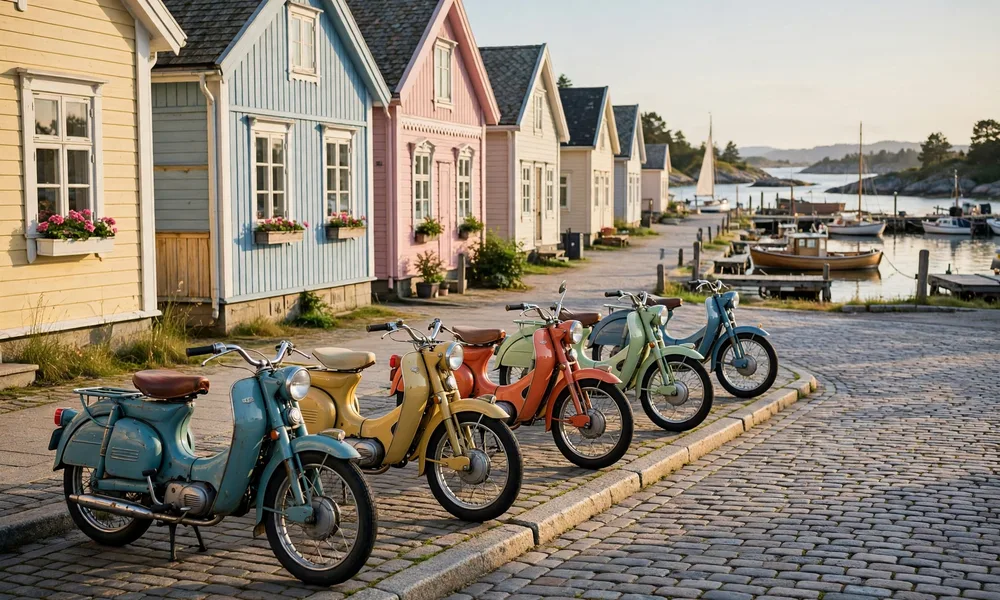
Mopedum: A Look Back at Sweden’s Vintage Moped History
Mopedum, also known as Svenska Nostalgimuseet, the Swedish Nostalgia Museum, was a small museum in the harbour town of Nynashamn, south of Stockholm, built around one beloved machine. The Swedish moped. Inside, visitors could follow the moped’s development from 1952 to 1979, the years the museum itself called the moped’s golden age.
But Mopedum was never only about mopeds. Its displays walked visitors through everyday Swedish life across three decades, from a 1952 country shop to the famous switch to right hand traffic and the styles of the 1970s. This article looks back at the museum, the golden age it celebrated, and the simple 1952 law that started the whole story.
| Quick Facts | |
|---|---|
| Full name | Mopedum, Svenska Nostalgimuseet (the Swedish Nostalgia Museum) |
| Location | Vikingavagen 39, Nynashamn, Sweden |
| Theme | Swedish mopeds and everyday Swedish life |
| Period covered | 1952 to 1979, described by the museum as the moped’s golden age |
| Known for | Telling the moped’s story through period rooms, shops and street scenes |
| Signature event | Mopedrundan, a moped rally held on the second Saturday in September, run with the Nynas Shell moppers. The 2019 rally was the sixth |
| Website | mopedum.se, as listed in museum directories |
| Current status | Travel listing sites have reported the museum as permanently closed. Its present day status is unconfirmed in official sources |
What Was Mopedum?
Mopedum stood at Vikingavagen 39 in Nynashamn, a ferry and harbour town at the southern end of the Stockholm region. Museum directories listed it under its Swedish name, Mopedum Svenska Nostalgimuseet, and its own description invited visitors to make a journey through time. The trip began at a country store from 1952, passed the change to right hand traffic, and ended among the prog music and velour of the 1970s, with the moped as the common thread running through the whole museum.
That thread was a deliberate choice. In Sweden, the moped is not a minor vehicle. For generations of teenagers, it was the first taste of freedom, and for many workers in the 1950s it was the first motor transport the family could afford. A museum built around it could tell the story of ordinary life in a way that a hall of rare cars never could. Visitors and reviewers described a quirky, carefully built set of period scenes, packed with everyday objects, following the life of a couple across three decades as the country changed around them.
The museum also had a cafe filled with nostalgic set pieces, and it stayed connected to living moped culture rather than treating the machines as dead exhibits. Together with a local rider group, the Nynas Shell moppers, Mopedum arranged Mopedrundan, a moped rally held on the second Saturday in September. By 2019 the rally had been run six times, which shows the museum was still active in the local scene at the end of that decade.
1952: The Law That Started It All
Every golden age needs a starting gun, and for the Swedish moped it fired on 1 July 1952. On that date, a new Swedish law gave the bicycle with an auxiliary engine, as it was first called, a special place on the road. The word moped itself blends the Swedish words for motor and pedals. Under the 1952 rules, a moped rider needed no registration, no driving licence and no insurance, and paid no vehicle tax. The legal age was set at 15, a year younger than for a light motorcycle, which caused debate at the time.
The law also set strict technical limits. The engine could be no more than 50 cc, with power around 0.8 horsepower and a design speed of 30 km/h. The machine had to look like a bicycle and had to have pedals, and it was meant to be driven mainly by human power with the engine as a helper. Lawmakers imagined a practical tool for working men travelling to their jobs, not a pleasure machine for the young.
Reality had other plans. Mopeds spread fast through Swedish homes, and within a few years they looked less and less like bicycles, keeping only the compulsory pedals. Teenagers adopted them as vehicles of freedom. In 1961 the state accepted the change, and a new law allowed mopeds a more motorcycle like shape, with no need for pedals at all, while keeping the 50 cc engine and 30 km/h limit. The fun machine the lawmakers had not planned for had won.
The Golden Age, 1952 to 1979
Mopedum chose 1979 as the end of its story, and the choice makes sense. Between 1952 and the end of the 1970s, the moped sat at the centre of Swedish youth life and small town transport. It carried teenagers to school, to work and to the dance hall. It was cheap to buy, cheap to run, and at 15 it arrived a full year before any other licence free step up in the world. Whole friendships, romances and summer memories were built on two small wheels and a 50 cc engine.
The period also tracks the great changes in Swedish society that the museum built into its rooms. The 1950s country shop gives way to the confident Sweden of the 1960s. On 3 September 1967, the country famously switched from driving on the left to driving on the right in a single morning, one of the largest traffic changes ever attempted, and the museum’s journey passed that moment too. Then came the 1970s, with prog rock, velour and a new youth culture, and the moped still rolling through all of it.
By the end of the 1970s, rising wealth, cheaper small cars and changing rules slowly moved the moped from the centre of life toward the edges. That is why museums frame these years as a golden age. It was the one period when a whole nation’s coming of age story could be told through a single small machine.
The Brands Sweden Remembers
The golden age was built by Swedish factories, and their names still stir strong feelings among collectors. When the 1952 law arrived, bicycle makers such as Monark, Crescent and Husqvarna rushed to build their first mopeds. Monark’s early Monarped looked much like a small motorcycle, with its fuel tank in the motorcycle position and telescopic front suspension, and Monark machines used engines from makers such as Ilo, NSU and Husqvarna.
Crescent came from the Nyman works in Uppsala, which built its first moped, the Autoped, in 1952 and moved to Sachs engines from 1954. From 1955 the firm’s mopeds carried the Crescent name. In the early 1960s the big Swedish makers drew together into one group, MCB, Monark Crescent AB, which combined Monark, Crescent and the bicycle and moped side of Husqvarna. Through the middle 1960s, most models from the group used Husqvarna’s E-type engine, giving Swedish mopeds of the period a shared mechanical heart under different badges.
These are the machines that filled museums like Mopedum, and that still fill rally fields and garage workshops today. Names like Monark, Crescent and Husqvarna carry the same weight for Swedish riders that classic car badges carry elsewhere. Each restored moped at a rally is a small piece of industrial history that someone has kept alive by hand.
Inside the Museum: More Than Mopeds
What set Mopedum apart from a simple vehicle collection was its method. Instead of rows of machines on stands, it built a story. Visitors followed the changing life of ordinary people across the decades, with the moped’s development as the thread, and the rooms around the machines filled with the shops, objects and styles of each period. Reviewers who visited in its active years praised the attention to detail and the way the museum reached beyond transport into social history.
That approach explains its second name, the Swedish Nostalgia Museum. The country store from 1952, the traffic change displays and the 1970s rooms were not decoration around the mopeds. They were the point. The museum argued, in the friendliest possible way, that you cannot understand why the moped mattered until you see the world it carried people through.
Travel listing pages for the museum carry a sadder note. In recent years they have reported the location as permanently closed, and we could not confirm from an official source whether Mopedum still opens in any form. Readers planning a trip should check the museum’s own channels before travelling, and treat old listings with care. What is certain is that its collection and its rally belonged to a living Swedish tradition, and traditions like that rarely vanish completely. Machines, knowledge and riders tend to find a new home.
FAQs
Where was Mopedum located?
Mopedum, the Swedish Nostalgia Museum, was at Vikingavagen 39 in Nynashamn, a harbour town south of Stockholm, Sweden. Its website was listed in museum directories as mopedum.se.
Is Mopedum still open?
That is unconfirmed. Travel listing sites have reported the museum as permanently closed, and we found no official source confirming current opening hours. Anyone hoping to visit should check for recent news from the museum’s own pages or local Nynashamn sources first.
Why does the museum’s story run from 1952 to 1979?
Those years are the period the museum itself called the moped’s golden age. The Swedish moped was created by a new law on 1 July 1952, and by the end of the 1970s its central place in Swedish life was fading as cars became more common.
What was Mopedrundan?
Mopedrundan was a moped rally arranged by Mopedum together with the Nynas Shell moppers, held on the second Saturday in September. Museum listings record that the 2019 rally was the sixth time it had been run.
You may also read: Cassie Pérez: Everything to Know About Chris Pérez’s Daughter
Final Thoughts
Mopedum understood something important about history. The objects that change everyday life are rarely the grandest ones. A 50 cc moped with bicycle pedals, freed by a smart law in 1952, gave Swedish workers cheap transport and Swedish teenagers their first freedom, and it carried a generation through three decades of change.
Whether or not its doors open again in Nynashamn, the golden age Mopedum celebrated is safe in the hands of the riders who still restore Monarks, Crescents and Husqvarnas and gather for autumn rallies. The little museum by the harbour simply said out loud what they already knew. In Sweden, the moped was never just a machine. It was a way of growing up.


