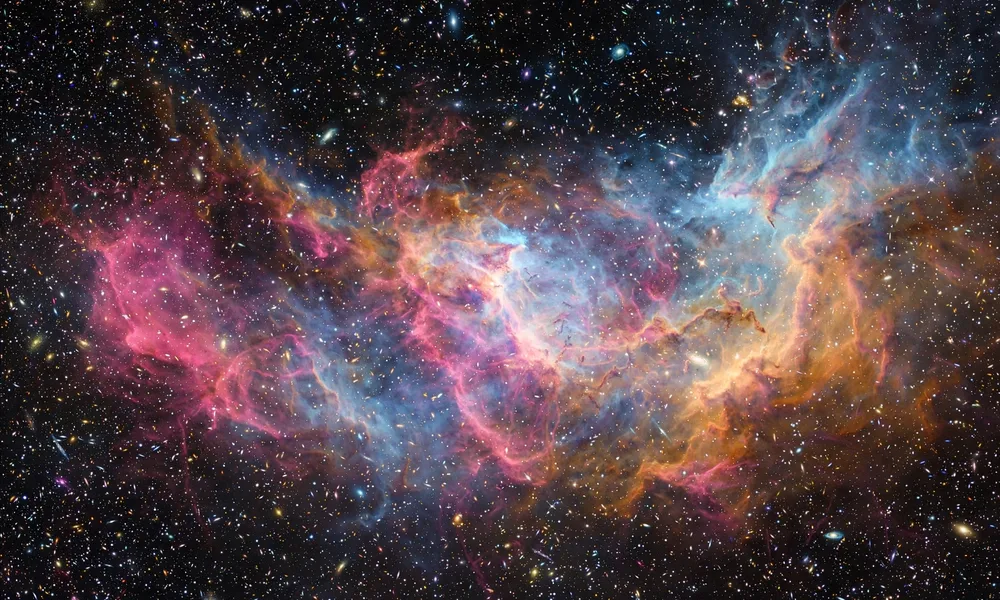
Helonium: The Tiny Ion That Changed Our View of Space
Helonium may be the most important molecule that most people have never heard of. It is the common name for the helium hydride ion, written by scientists as HeH+. This tiny particle, made of just one helium atom and one hydrogen atom, is believed to be the first compound that ever formed in the universe after the Big Bang.
Scientists made helonium in a laboratory as long ago as 1925, yet they could not find it in space for almost a century. That changed in April 2019, when a flying telescope finally detected it in a nebula about 3,000 light years away. This article explains what helonium is, why it mattered at the dawn of time, and why the 2019 discovery made headlines around the world.
| Quick Facts | |
|---|---|
| Common name | Helonium |
| Scientific names | Helium hydride ion, hydridohelium(1+) ion |
| Chemical formula | HeH+ |
| Type | Cation, a positively charged ion |
| Made of | One helium atom bonded to one hydrogen atom, with one electron removed |
| Molar mass | 5.01054 g/mol |
| First made in a laboratory | 1925, by T. R. Hogness and E. G. Lunn |
| First detected in space | April 2019, in the planetary nebula NGC 7027 |
| Detected by | The SOFIA airborne telescope, using the GREAT instrument |
| Special claim | Believed to be the first compound formed in the universe, and the strongest known acid |
What Is Helonium?
Helonium is a cation, which means it is a particle with a positive electric charge. It forms when a helium atom bonds with a hydrogen atom and one electron is removed from the pair. Another way to picture it is as protonated helium, which is a helium atom holding an extra proton. With a formula of HeH+, it is the lightest heteronuclear ion known, meaning it is the lightest charged particle built from two different elements.
The bond between the two atoms is short and strong for something so small. Scientists measure its length at about 0.772 angstroms. Most of the electron charge sits closer to the helium nucleus than to the hydrogen nucleus. Unlike the similar dihydrogen ion, helonium has a permanent dipole moment, which is a separation of charge across the particle. That dipole is very useful, because it makes the ion easier to study through its spectrum, the pattern of light it gives off and absorbs.
Helonium also has a famous claim in chemistry. It is described as the strongest known acid, stronger even than fluoroantimonic acid, with a proton affinity of 177.8 kJ/mol. In simple terms, it gives up its proton to almost anything it touches. That extreme reactivity is a large part of its story, both in the laboratory and in space.
The First Molecule in the Universe
To understand why helonium matters, it helps to go back to the beginning. In the first moments after the Big Bang, the universe was too hot for atoms to exist. As it expanded and cooled, the first simple atoms formed, mainly hydrogen and helium, the two lightest elements. These were almost the only building materials the young universe had.
Scientists believe that around 100,000 years after the Big Bang, neutral helium atoms began to combine with positively charged hydrogen ions. The result was helonium, the first molecular bond in cosmic history. From that first step, chemistry slowly grew more complex. Helonium reacted onward and helped open the path toward molecular hydrogen, and from there, over billions of years, toward stars, planets and eventually life itself.
This is why researchers call helonium the first molecule, even though it is technically an ion. It marks the moment the universe stopped being only loose atoms and started building connected structures. Its strong dipole moment also makes it important in models of the first stars, because it affected how the early gas cooled and collapsed.
Made in a Laboratory in 1925, Missing in Space
The strange thing about helonium is that humans met it on Earth long before they found it in the sky. In 1925, researchers T. R. Hogness and E. G. Lunn detected it indirectly while firing protons into a thin mixture of hydrogen and helium gas. Later work, including mass spectrometry studies in the 1930s, confirmed its identity and helped scientists measure its properties with care.
Through the middle of the twentieth century, theory ran ahead of observation. In 1956, M. Cantwell predicted that the vibration spectrum of the ion should be visible in infrared light. In 1979, D. Tolliver and others recorded its spectrum in the laboratory for the first time, and in 1982 further infrared lines were measured. Chemists also learned to create it through the decay of tritium, a method developed from work by F. Cacace in Rome in the 1960s, which allowed them to study how this fiercely reactive ion attacks other molecules.
From the 1970s onwards, astronomers suspected helonium must exist in the interstellar medium, the thin gas between the stars. Models of the early universe depended on it. Yet decade after decade, no telescope could confirm it in space. One problem was that one of its strongest spectral lines, at 149.14 micrometres, sits almost exactly on top of lines from another particle, the methylidyne radical. The signal scientists wanted was hiding in a crowd.
The 2019 Breakthrough in NGC 7027
The long search ended in April 2019. A team led by Rolf Gusten of the Max Planck Institute for Radio Astronomy published the first clear detection of helonium in space in the journal Nature. The ion was found in NGC 7027, a planetary nebula about 3,000 light years away in the direction of the constellation Cygnus. A planetary nebula is the glowing shell of gas cast off by a dying star much like our Sun, and NGC 7027 has the hot, harsh conditions that allow this fragile ion to form today.
The instrument that made the discovery was SOFIA, the Stratospheric Observatory for Infrared Astronomy, a telescope carried high into the sky aboard a modified Boeing 747 aircraft. Flying above most of the water vapour in Earth’s atmosphere, SOFIA could pick up far infrared signals that ground telescopes struggle to see. On board, the high resolution GREAT spectrometer separated the helonium fingerprint from the confusing lines around it, at a frequency of about 2,010 gigahertz.
NASA and the research team were clear about what the result meant. The helonium in NGC 7027 is not a leftover from the Big Bang itself. It formed recently, inside that nebula. But finding it at all proved that the ion can exist in space, exactly as the models of early universe chemistry had long predicted. A missing piece of the cosmic puzzle had finally been seen with real instruments.
Why Helonium Is So Hard to Hold On To
If helonium is so basic, why is it almost never found on Earth? The answer is its reactivity. Helonium reacts with every substance it meets. It cannot be stored in any container, because it would attack the container itself. Scientists must create it in place, study it quickly, and accept that it exists in bulk nowhere in everyday life.
When helonium meets other molecules, it hands over its proton and often breaks its target apart. It has been shown to protonate oxygen, ammonia, water, carbon dioxide and many other common substances. This is the behaviour of the strongest known acid, and it explains why a molecule so important to the universe leaves almost no trace in a normal laboratory or in the air around us.
In space, the rules are different. The gas between stars is incredibly thin, so a helonium ion may travel a long way before it touches anything. In places with intense ultraviolet light, such as the inner regions of a planetary nebula or the shocked gas behind a supernova blast, new helonium can also keep forming. Thin gas plus harsh energy is the recipe that lets this tiny ion survive long enough to be seen.
What Helonium Tells Scientists Today
The 2019 detection did more than close an old file. It gave astronomers a tested tool. Because helonium emissions can reveal shocks in dense interstellar clouds, such as those driven by stellar winds and supernovae, the ion can act as a tracer, showing scientists where violent energy is reshaping gas. It is also thought to play a part in the atmospheres of helium rich white dwarf stars, where it changes how the gas holds heat and how slowly the star cools.
Just as important, the discovery strengthened confidence in models of the early universe. The chemistry that led from simple atoms to the first stars began, as far as science can tell, with this one small ion. Knowing that helonium really does form in space makes the whole chain of reasoning that follows it firmer ground.
Helonium will never be a household substance. It has no use in the home, no role in medicine and no place on a shelf. Its importance is written on the largest possible scale. It is the first page of the story of chemistry itself, and in 2019, after a search lasting decades, humanity finally read that page in the sky.
FAQs
Is helonium the same as the helium hydride ion?
Yes. Helonium is the shorter common name for the helium hydride ion, also called hydridohelium(1+). All three names describe the same particle, with the formula HeH+.
Can helonium be found on Earth?
Only in laboratories, and only for moments at a time. It is far too reactive to exist naturally in everyday conditions or to be stored. Scientists create it in place during experiments, for example in gas mixtures or through tritium decay methods.
Why did it take so long to find helonium in space?
Its key spectral lines are in the far infrared, which Earth’s atmosphere blocks, and one main line overlaps with lines from another radical, which confused the signal. The problem was solved by flying the SOFIA telescope above most of the atmosphere with a very high resolution instrument.
Is the helonium found in NGC 7027 really from the Big Bang?
No. The ion detected in 2019 formed recently inside that nebula. Its importance is that it is the same type of particle that scientists believe formed first in the early universe, so finding it in space confirmed a key part of that theory.
You may also read: TheTechyx.com: What Is It and How Does It Work?
Final Thoughts
Helonium is a lesson in how much weight a tiny thing can carry. Two atoms, one missing electron, and a charge are all it is. Yet this small ion is believed to be the first compound the universe ever made, the strongest known acid, and a particle scientists had to chase for nearly a century before they could see it beyond Earth.
The detection in NGC 7027 in April 2019 did not just answer an old question. It confirmed that our basic picture of how chemistry began is right, and it handed astronomers a new tracer for studying some of the most energetic places in space. For a particle that cannot survive a meeting with almost anything, helonium has had an extraordinary reach across time.


