Trump Declares Oval Office and Cabinet Room National Monuments to Block Future Changes
Trump declares Oval Office: President Donald Trump signed a proclamation on Thursday, November 5, 2026, that creates the Trump Oval Office national monument, covering the Oval Office and Cabinet Room, under the Antiquities Act. The move is meant to protect the two famous West Wing rooms from major changes by future presidents. Trump said the proclamation is the first step toward making the spaces a national monument, and it will be sent to Congress to be ratified. He made clear that no major change should happen without the approval of Congress.
Table of Contents
At the same time, the proclamation does not lock the rooms exactly as they look today. The text says nothing in it shall restrict the president’s authority to redecorate, select furnishings, or make ordinary operational and security changes. That means a future president could still remove the gold trim and paintings Trump added, even though the shape and structure of the rooms would gain new protection.
Quick Facts
| Detail | What We Know |
|---|---|
| What happened | Trump signed a proclamation designating the Oval Office and Cabinet Room as a national monument |
| Date signed | Thursday, November 5, 2026 |
| Rooms covered | The Oval Office and the Cabinet Room in the West Wing |
| Law used | The Antiquities Act |
| Next step | The proclamation will be sent to Congress to be ratified |
| What it blocks | Major modifications without approval from Congress |
| What it does not block | Redecorating, furnishings, and ordinary operational and security changes |
| Management plan | Interior Secretary Doug Burgum was directed to create a preservation plan |
| Timing | Two days after Democrats took control of Congress in the midterm election on November 3, 2026 |
| Trump’s age | 80 |
Trump Declares Oval Office: What He Signed and Said
Trump declares Oval Office a national monument: Trump signed the proclamation in the Oval Office on Thursday, November 5, 2026. The document names the Oval Office and the Cabinet Room as a national monument, a step that puts two of the most famous rooms in American government under a new layer of protection. Trump said the goal was simple: to make sure no future president could tear the rooms down or remake them in a major way.
During the signing, Trump explained the idea in plain terms. He said that if a future president wanted to say there should be no Oval Office anymore, and wanted to make the room square instead, that president would have to go back to Congress first. That line captured the heart of the plan. The shape of the Oval Office, which gives the room its name and its place in history, would no longer be a matter for one president alone to decide.
Trump declares Oval Office a national monument, and he also said the proclamation is the first step toward declaring the spaces a national monument, and that it will be sent to Congress to be ratified. That detail matters, because a proclamation alone is an executive action. Trump himself said that making the rooms a landmark will, in theory, make it impossible to knock them down or change them in any meaningful way. A red hat that said VETO sat on his desk during the ceremony, a clear sign of the political moment. The proclamation also directs Interior Secretary Doug Burgum to create a management plan to preserve the rooms.
What the Proclamation Does and Does Not Do
After Trump declares Oval Office a national monument, the most important part of this story is the line between what the proclamation protects and what it leaves open. On one side, it aims to stop major structural changes. A future president would not be able to knock down the Oval Office, change its shape, or rebuild the Cabinet Room in a major way without going through Congress. That is the protection Trump talked about when he signed the document.
On the other side, the proclamation does not freeze the rooms in place. The text says nothing shall restrict the president’s authority to redecorate, select furnishings, or make ordinary operational and security modifications. In plain words, a future president can still change the look of the rooms. New paint, new curtains, new furniture, and new art are all still allowed. The gold trim and paintings that Trump added could be taken down by a successor.
There is also a legal question that will follow the proclamation. As an executive action, it could be overturned by a successor. That is why sending it to Congress matters so much. If Congress ratifies the designation, it would gain a stronger legal base and be much harder to undo. Until that happens, the protection rests on a presidential signature, not on a law passed by Congress.
Why the Timing Matters After the Midterms
The timing of the signing was hard to miss. It came on Thursday, November 5, 2026, just two days after Democrats took control of the House and Senate in the midterm election on Tuesday, November 3. The election changed the political map in Washington, and Trump acted quickly after the result became clear.
With Democrats now in control of both chambers of Congress, Trump faces a very different Washington than the one he worked with before the election. Asking a Congress controlled by the other party to ratify the proclamation could be a hard sell. Readers who want the full picture of the election that set this moment in motion can read our report on the 2026 midterm results and the Democratic win in Congress. The same week also brought big personnel news, as the head of the Justice Department civil rights division stepped down after the Democratic midterm sweep, a story we covered in our report on Harmeet Dhillon resigning as DOJ civil rights chief.
The Changes Trump Has Already Made
To understand why Trump moved to protect the Oval Office now, it helps to look at what he has already changed since returning to the White House in January 2025. Trump is 80, and he has used his time back in office to reshape the White House in a way no recent president has attempted. The changes go far beyond a fresh coat of paint.
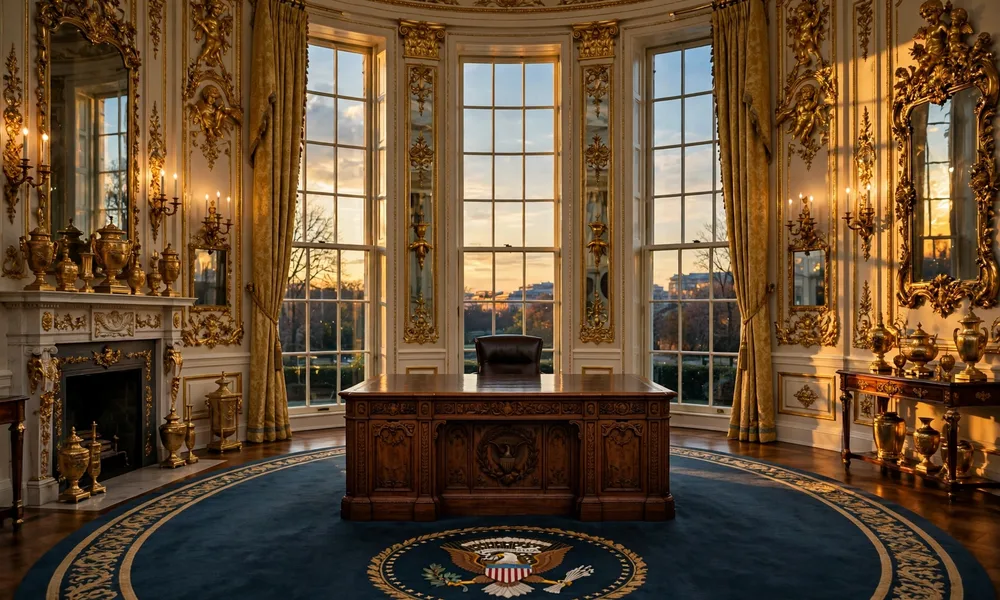
Inside the Oval Office, Trump has added gold accents throughout the room. Gold vermeil figurines, gilded mirrors, gold eagles, and cherubs now fill spaces that were once far more plain. The look is bold, bright, and unmistakably his own. Visitors to the room notice the change at once. The Oval Office today looks very different from the room that greeted presidents before him.
Outside the Oval Office, the changes are even larger. Trump paved over the Rose Garden, one of the most famous outdoor spaces at the White House. He tore down the East Wing to build a ballroom, a project that removed a whole wing of the building. He also resurfaced the Lincoln Memorial Reflecting Pool, another high-profile change to a landmark site in Washington.
These projects help explain both the support and the criticism around the new proclamation. Supporters say Trump has improved historic spaces. Critics say he has already made sweeping changes to historic places, and that it is strange for a president who tore down the East Wing to now argue that the Oval Office must never be changed. The White House has also been busy with other business in the same week, as First Lady Melania Trump hosted delegations from Russia and Ukraine there. You can read more in our coverage of Melania Trump hosting Russian and Ukrainian delegations at the White House.
What Happens Next
After Trump declares Oval Office a national monument, the next step is Congress. Trump said the proclamation will be sent to Congress to be ratified, and that step will decide whether the designation gains lasting power. If Congress approves it, the protection would be much stronger. If Congress refuses or simply never acts, the proclamation would remain an executive action that a future president could reverse.
Interior Secretary Doug Burgum also has a job to do. The proclamation directs him to create a management plan to preserve the rooms. That plan will set out how the Oval Office and Cabinet Room should be maintained, what counts as a major change, and how the rooms should be cared for over time. The details of that plan will matter, because they will shape how the rules work in practice.
Future presidents will face a clear choice when they take office. They will be free to redecorate, change the furniture, and update the security and operations of the rooms. They will not be free, under the proclamation, to knock the rooms down or remake them in a major way without going to Congress. That split is likely to be tested at some point, and the first time a future president wants to make a big change, the courts or Congress may have to settle what the proclamation really allows.
Frequently Asked Questions
Did Trump make the Oval Office a national monument?
Yes. Trump declares Oval Office a national monument in a proclamation signed Thursday, November 5, 2026, covering the Oval Office and Cabinet Room under the Antiquities Act. He said it is the first step toward making the spaces a national monument, and it will be sent to Congress to be ratified.
Can a future president still redecorate the Oval Office?
Yes. The proclamation says nothing shall restrict the president’s authority to redecorate, select furnishings, or make ordinary operational and security modifications. A future president could still remove the gold trim and paintings Trump added.
Can a future president undo the proclamation?
Yes, it is possible. As an executive action, the proclamation could be overturned by a successor. Trump himself said making the rooms a landmark will, in theory, make it impossible to knock them down or change them in any meaningful way. The protection would become much stronger if Congress ratifies it.
Why did Trump sign the proclamation now?
Trump declares Oval Office a national monument in a signing that came two days after Democrats took control of the House and Senate in the midterm election on Tuesday, November 3, 2026. It was also Trump’s third event of the week related to his White House construction or renovation projects. Trump said the goal was to protect the two West Wing spaces from major modifications by future presidents.
Sources
- Reuters: Trump takes action to make sure Oval Office stays oval
- CNN: Trump Oval Office and Cabinet Room landmarks
- USA Today: Trump Oval Office and Cabinet Room national monument after midterm election
- People: Trump declares Oval Office national monument so nobody can destroy it
Final Thoughts
Trump declares Oval Office and the Cabinet Room national monuments in a proclamation that turns two of the most famous rooms in America into a test case for how history should be protected. The Oval Office and the Cabinet Room are more than workspaces. They are places where decisions that shaped the nation were made, and where the world has watched presidents at work for generations. Protecting them makes sense to many people, no matter their politics.
At the same time, the gold, the art, and the style that Trump brought to the Oval Office can still be changed by the next president. The structure is protected, but the look is not. If Congress ratifies the designation, it could last. If Congress does not act, a future president could undo it with a stroke of a pen. What is clear today is that the Oval Office will stay oval, at least for now.