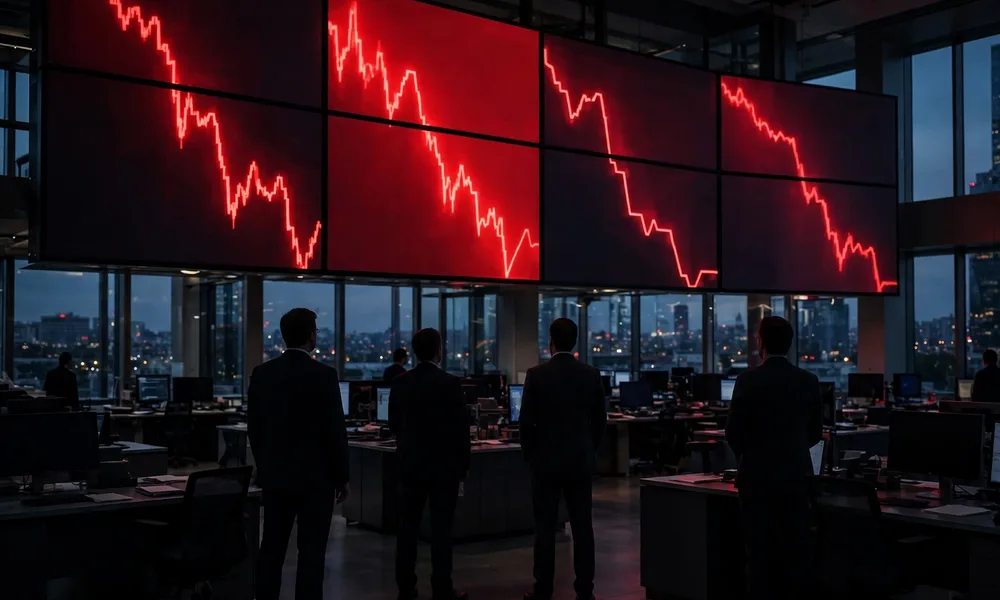
Yes, the Nasdaq entered correction territory on Thursday, November 5, 2026, after a brutal closing bell sell-off that erased the entire post-midterm rally and then some. The Nasdaq Composite fell 5.52 percent to 24,315.00, which put it 11.9 percent below its October 6 record close of 27,599.89. The Dow Jones Industrial Average plunged 1,833.06 points, or 3.44 percent, to 51,523.06. The S and P 500 dropped 4.36 percent to 7,353.73, its worst single day since April 2025. In one session, S and P 500 companies lost 2.9 trillion dollars in market value and Nasdaq companies lost 2.5 trillion dollars, both single-day records.
Quick Facts
| Fact | Detail |
|---|---|
| Date | Thursday, November 5, 2026 |
| Dow Jones | Down 1,833.06 points, 3.44 percent, to 51,523.06 |
| S and P 500 | Down 334.89 points, 4.36 percent, to 7,353.73 |
| Nasdaq Composite | Down 1,421.52 points, 5.52 percent, to 24,315.00 |
| Nasdaq vs record | 11.9 percent below October 6 record close of 27,599.89 |
| Nasdaq 100 | Down 6.36 percent to 26,629.81 |
| Russell 2000 | Down 4.45 percent |
| PHLX Semiconductor Index | Down 12.25 percent to 9,011.14 |
| VIX fear gauge | Up about 69.7 percent to 28.18 |
| Market value lost | S and P 500 companies lost 2.9 trillion dollars, Nasdaq companies lost 2.5 trillion dollars |
| Biggest stock moves | Micron fell 17 percent, Nvidia fell 9 percent |
| Oil | Brent up 3.67 dollars, crude about 90.79 dollars, up about 3 percent |
| Next key event | US October jobs report due Friday |
What Happened at the Close
Thursday started with worry and ended with a rout. Stocks opened lower, sold off through the session, and closed near the worst levels of the day. There was no late rescue, no bounce into the close, and no sector that managed to hold its ground in a meaningful way. The selling was broad, fast, and heavy, and it hit the biggest names hardest.
The Dow gave back everything it gained on Wednesday and more. On Wednesday, the Dow had jumped 1,569.40 points in its best post-midterm session since 1982. One day later, it fell 1,833.06 points. That swing tells the story of the week in a single number. Traders who bought the midterm result on Wednesday sold it hard on Thursday, and the mood flipped from celebration to fear in less than 24 hours.
The scale of the losses set records of its own. S and P 500 companies shed 2.9 trillion dollars in market value in one day. Nasdaq companies lost 2.5 trillion dollars in the same session. Both figures were single-day records, according to the reports on the close. Those numbers are hard to picture, but they show how much wealth was wiped from public markets in a few hours of trading.
For readers who followed the day as it unfolded, the intraday picture was already ugly by mid-afternoon. Our earlier coverage tracked that live slide in detail. You can read the intraday account here: tech stocks sell off on November 5 as Nasdaq and QQQ fall. This article covers what the close confirmed: final numbers, the Nasdaq correction, and the record losses.
Why the Nasdaq Correction Matters
A correction is not an official label from an exchange. It is a market term for a fall of 10 percent or more from a recent peak. The Nasdaq closed 11.9 percent below its October 6 record close of 27,599.89, so it crossed that line with room to spare. This is the second Nasdaq correction of the year, which makes Thursday more than a one-day event. It is the second time in 2026 that the index has fallen far enough from its high to earn that label.
Corrections matter because they change how investors behave. After a long run higher, a 10 percent fall forces fund managers to ask whether the trend has changed. Some buyers step in and look for value. Others sell first and ask questions later. Pension funds, index funds, and retail investors all watch the same line, and crossing it can trigger selling from funds that follow strict rules.
The October 6 record of 27,599.89 now stands as the high point that traders will measure the recovery against. To get back to that level, the Nasdaq would need a strong and steady climb. That does not mean it will take months, and it does not mean it will happen at all in the near term. It simply means the gap is now large enough that no single good day will close it.
AI Stocks Led the Sell-Off
The sharpest pain was in chips and AI infrastructure. The PHLX Semiconductor Index fell 12.25 percent to 9,011.14, a fall that dwarfs the broader market decline. When the chip index falls by more than 12 percent in one day, it signals that investors are questioning the whole AI spending story, not just one company.
Micron fell 17 percent in the session. Nvidia fell 9 percent. Those are two of the most important names in the AI trade, and both fell far more than the market average. Micron makes memory chips that sit at the heart of AI systems. Nvidia makes the processors that power AI training and inference. When both fall this hard on the same day, the message is that the market is repricing the AI build-out itself.
The reported drivers were fears of a Democrat-led clampdown on AI and worries about a moratorium on data centers. After the midterm results, traders began to price in tougher rules for AI and for the huge data centers that support it. A moratorium, even a feared one, would slow the pipeline of new centers. Slower centers would mean slower orders for chips, servers, power equipment, and construction. That chain of worry ran straight through the market on Thursday.
The contrast with Wednesday could not be sharper. On Wednesday, the Dow surged 1,569.40 points in its best post-midterm day since 1982. You can revisit that rally here: Dow surges 1,569 points in best post-midterm day since 1982. Thursday took all of that back and added a fresh loss on top. The two days together show a market that is reacting to politics first and to earnings second.
Fear Gauge Spikes as Investors Rush for Safety
The VIX fear gauge jumped about 69.7 percent to 28.18. The VIX measures how much volatility traders expect in the near term, and a jump of nearly 70 percent in one day is rare. A reading of 28.18 is well above the calm levels seen during much of the recent rally. It tells us that traders are now paying much more for protection against further falls.
When the VIX jumps like this, it usually means options traders are buying puts in large numbers. Puts are contracts that pay off if stocks fall, so heavy put buying is a sign that many investors expect more downside or at least want insurance against it. The size of the jump suggests the move caught many traders by surprise.
The broad nature of the fall added to the fear. The Russell 2000 fell 4.45 percent, so small companies fell almost as hard as the big technology names. When small caps, large caps, and chips all fall together, there are few places to hide inside the stock market. That kind of uniform selling is what pushes fear gauges higher.
Oil moved in the opposite direction. Brent rose 3.67 dollars, with crude at about 90.79 dollars, up about 3 percent. The rise followed reports of tankers hit near the Strait of Hormuz. Oil often rises when traders worry about supply in that region, and Thursday was no exception. Higher oil can add to inflation worries, which makes the stock sell-off harder to read. Investors were dealing with falling stocks and rising oil at the same time.
What Comes Next for Markets
The next big test arrives on Friday with the US October jobs report. Jobs data shapes what the Federal Reserve might do next, and it also shapes how confident consumers and businesses feel. A strong report could calm some nerves. A weak report could add to the worry. Either way, traders will be watching it closely after a day like Thursday.
The political angle will also stay in focus. The global reaction to the midterm outcome was already visible before the US close, with stocks sliding in other markets on the same fears about AI and data centers. Our coverage of that wider slide is here: global stocks slide on Democratic sweep and AI data center fears. The US close confirmed that the worry was not limited to one region.
For long-term investors, the key question is whether Thursday was a reset or the start of something deeper. A correction can be a healthy pause after a long rally. It can also be the first step in a longer decline. No single day answers that question. What Thursday did answer is that the market is now willing to sell AI leaders hard on policy fears, and that the record highs of October are now a long way above current prices.
One thing is clear from the numbers alone. The Dow lost 1,833.06 points. The S and P 500 had its worst day since April 2025. The Nasdaq entered its second correction of the year. And two stock markets lost a combined 5.4 trillion dollars in value in a single session. That is the scale of Thursday, and it is why this close will be remembered even if Friday brings a calmer day.
Frequently Asked Questions
How much did the Dow fall on November 5, 2026?
The Dow fell 1,833.06 points, or 3.44 percent, to 51,523.06. That wiped out Wednesday gain of 1,569.40 points and left the index lower than where it started the week rally.
Is the Nasdaq officially in a correction?
Yes. The Nasdaq closed at 24,315.00, which is 11.9 percent below its October 6 record close of 27,599.89. A fall of 10 percent or more from a recent peak is called a correction, and this is the second Nasdaq correction of 2026.
How much market value was lost in one day?
S and P 500 companies shed 2.9 trillion dollars in market value and Nasdaq companies lost 2.5 trillion dollars in one day. Both were single-day records.
Why did AI stocks fall so sharply?
Reports pointed to fears of a Democrat-led clampdown on AI and worries about a moratorium on data centers. Chip stocks led the fall, with the PHLX Semiconductor Index down 12.25 percent, Micron down 17 percent, and Nvidia down 9 percent.
Sources
Final Thoughts
Thursday, November 5, 2026, was one of those days that resets the market conversation. The Dow fell 1,833.06 points. The S and P 500 had its worst day since April 2025. The Nasdaq entered correction territory for the second time this year. And the market lost a record amount of value in a single session. The drivers were clear in the reporting: policy fears around AI and data centers hit the stocks that had led the rally hardest. Whether Friday jobs report steadies the market or adds to the slide, Thursday close will stand as the day the post-midterm rally ended and the correction began.