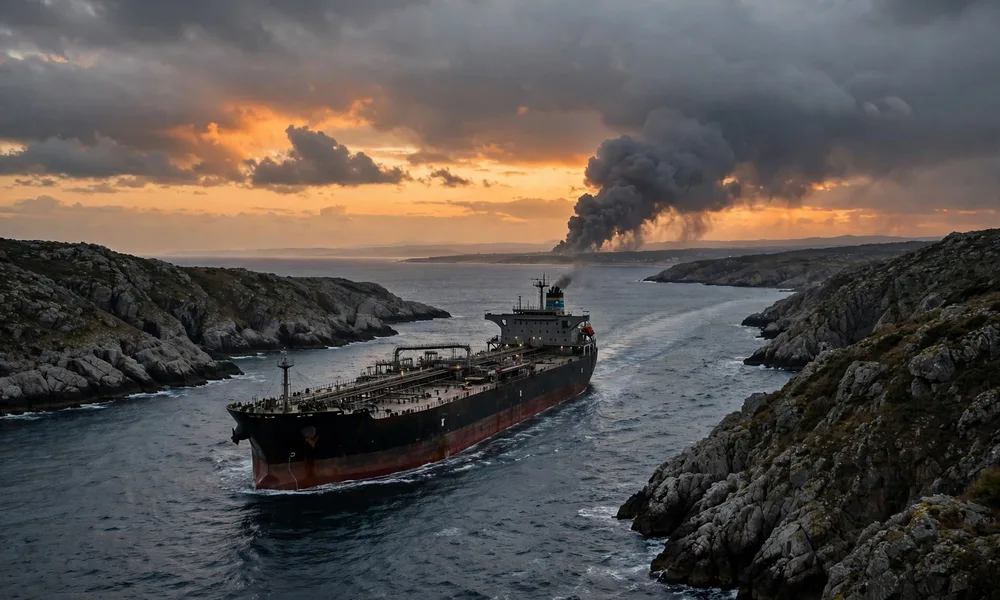
Two oil tankers and a tugboat caught fire in the Strait of Hormuz on Thursday, November 5, 2026, according to Iran’s Islamic Revolutionary Guard Corps. The IRGC said the fires happened in separate incidents after the vessels attempted to use unauthorised routes. One tanker struck a mine while crossing a passage south of the strait and caught fire and stopped. A second vessel, described as a supertanker, caught fire while leaving a designated route in the eastern part of the waterway. A tugboat that approached the supertanker to help put out the flames also caught fire. The claims could not be independently verified, and the IRGC gave no details on casualties, damage or the identities of the vessels.
Quick Facts
| Date of the fires | Thursday, November 5, 2026 |
| Location | Strait of Hormuz |
| Vessels on fire | Two oil tankers and one tugboat |
| Source of the report | Iran’s Islamic Revolutionary Guard Corps (IRGC) |
| First tanker | Struck a mine while crossing a passage south of the strait, caught fire and stopped |
| Second vessel | A supertanker that caught fire while leaving a designated route in the eastern part of the waterway |
| Tugboat | Caught fire after approaching the supertanker to help put out the flames |
| Reason given by the IRGC | The vessels attempted to use unauthorised routes |
| Casualties, damage and vessel identities | No details given by the IRGC |
| Independent verification | The claims could not be independently verified |
| Previous day’s claim | On November 4, the IRGC claimed four oil tankers were destroyed after striking naval mines |
| Oil price reaction | WTI dropped more than 8 percent to 88.12 dollars; Brent crude fell below 94 dollars a barrel |
| US position | US President Donald Trump said the US currently has no plans for military action |
| Mediation | Qatar has stepped up mediation |
What Happened on November 5
Iran’s Islamic Revolutionary Guard Corps said on November 5, 2026 that two oil tankers and a tugboat caught fire in the Strait of Hormuz. The three fires happened in separate incidents, but they were all reported on the same day and in the same waterway. The IRGC linked the incidents to the use of unauthorised routes.
The second vessel was described as a supertanker. It caught fire while leaving a designated route in the eastern part of the waterway. A tugboat then approached the supertanker to help put out the flames, and the tugboat also caught fire. That detail shows how fast the situation developed, with a rescue attempt itself turning into a third fire.
The IRGC gave no details on casualties, damage or the identities of the vessels. The claims could not be independently verified. That is an important point for readers, because the only source for the November 5 fires in the reports so far is the IRGC itself. The lack of names, casualty figures and damage details means the full picture is still unclear.
The November 4 Claim That Came Before
The November 5 fires came a day after another claim from the IRGC. On November 4, the IRGC claimed that four oil tankers were destroyed after striking naval mines on a prohibited route south of the strait. It also said two other vessels were seized.
Taken together, the two days of claims describe a fast moving and serious situation in the Strait of Hormuz. On November 4, four tankers were said to have been destroyed and two vessels seized. On November 5, two more tankers and a tugboat were said to have caught fire. That is a large number of vessels to be involved in incidents in such a short period.
The November 4 claim also used the language of mines and prohibited routes. The November 5 claim used similar language, with one tanker striking a mine and the vessels described as attempting to use unauthorised routes. The pattern in the IRGC statements is clear, even if the details have not been independently verified.
Readers who have been following the wider story will know that tensions around Iran and the Strait of Hormuz have been building. For background on the earlier claims in this same waterway, see our report on Iran claims four tankers destroyed in Strait of Hormuz mines. That report covers the November 4 claim in detail.
A Separate Incident Reported by UK Maritime Trade Operations
The UK Maritime Trade Operations centre reported an incident of a vessel struck by unknown projectiles northeast of Lima, Oman, on Wednesday. That report is separate from the IRGC claims about the Strait of Hormuz, but it adds to the sense that the wider area has seen more than one maritime incident this week.
The UK Maritime Trade Operations centre is a body that tracks incidents at sea and shares information with shipping. Its report of a vessel struck by unknown projectiles northeast of Lima, Oman, does not name the vessel or give details of damage in the facts provided. It does, however, show that maritime operators in the region are reporting problems beyond the Strait of Hormuz itself.
Lima is in Oman, and the area northeast of Lima is close to the entrance to the Strait of Hormuz. That geography matters, because incidents in that area can affect shipping moving in and out of the Persian Gulf. The report of unknown projectiles is different from the IRGC account of mines, but both point to a dangerous period for shipping in the region.
Why the Strait of Hormuz Matters
The Strait of Hormuz is a crucial chokepoint for global oil and gas exports from the Persian Gulf. That is why any incident there draws worldwide attention, even before the details are fully confirmed. A large share of the oil and gas that leaves the Persian Gulf by sea passes through this narrow waterway.
When vessels catch fire or strike mines in the strait, the immediate concern is for the crews and the ships. The wider concern is for the flow of oil and gas through the strait. If shipping is disrupted, delayed or rerouted, the effects can be felt in energy markets far from the Gulf.
The strait is narrow, and the shipping lanes through it are defined. That is why the IRGC statements put so much weight on designated routes and unauthorised routes. The claim is that the vessels left the routes they were meant to follow, and that is when they ran into trouble. Whether that account is confirmed or not, the geography of the strait means that any incident there has the potential to affect global trade.
The importance of the strait is also why oil prices react so sharply to news from the area. Traders watch the strait closely, and reports of fires, mines or seizures can move prices within hours.
Oil Prices Fall Sharply
Oil prices fell sharply on November 5. WTI dropped more than 8 percent to 88.12 dollars. Brent crude fell below 94 dollars a barrel. Those are large moves for a single day, and they show how sensitive the oil market is to news from the Strait of Hormuz.
US President Donald Trump said the US currently has no plans for military action. That statement may have helped to calm fears of an immediate military escalation. Qatar has stepped up mediation, which also points to efforts to manage the situation through talks rather than through force.
The combination of the IRGC claims, the oil price fall, the US statement and the Qatari mediation shows that the story has several parts. There is the maritime incident itself, there is the market reaction, and there is the diplomatic effort to keep the situation from getting worse. For more on the diplomatic side of this story, see our report on Iran Hormuz US reply unconvincing and Trump Qeshm strikes.
What Is Still Unclear
A lot about the November 5 fires is still unclear. The IRGC gave no details on casualties, damage or the identities of the vessels. Without those details, it is not possible to say how serious the fires were, whether anyone was hurt, or which tankers were involved.
The claims could not be independently verified. That means no other source has yet confirmed the IRGC account of the three fires. Independent verification matters in a case like this, because the claims come from one side and the details are limited. Until other sources confirm the incidents, the reports should be read with that limit in mind.
The wider political picture is also still developing. US President Donald Trump said the US currently has no plans for military action, and Qatar has stepped up mediation. Those are the two clearest signs of how the situation is being handled at a diplomatic level. For a look at how the Iran issue is playing out in US politics, see our report on JD Vance on Iran war reason Republicans lost midterms.
Frequently Asked Questions
How many vessels caught fire in the Strait of Hormuz on November 5, 2026?
Three vessels caught fire, according to Iran’s Islamic Revolutionary Guard Corps. They were two oil tankers and a tugboat. The fires happened in separate incidents in the Strait of Hormuz on Thursday, November 5, 2026.
What caused the tankers to catch fire?
The IRGC said one tanker struck a mine while crossing a passage south of the strait and caught fire and stopped. A second vessel, described as a supertanker, caught fire while leaving a designated route in the eastern part of the waterway. A tugboat that approached the supertanker to help put out the flames also caught fire. The IRGC said the vessels attempted to use unauthorised routes.
What happened the day before, on November 4?
On November 4, the IRGC claimed that four oil tankers were destroyed after striking naval mines on a prohibited route south of the strait, with two other vessels seized. The November 5 fires came a day after that claim.
How did oil prices react?
Oil prices fell sharply. WTI dropped more than 8 percent to 88.12 dollars, and Brent crude fell below 94 dollars a barrel. US President Donald Trump said the US currently has no plans for military action, and Qatar has stepped up mediation.
Sources
This article is based on reporting from Reuters, AnewZ and The Chronicle. The Reuters report is available at Reuters, the AnewZ report is available at AnewZ, and The Chronicle report is available at The Chronicle.
Final Thoughts
The fires reported on November 5, 2026 add another serious chapter to a tense week in the Strait of Hormuz. Two oil tankers and a tugboat caught fire in separate incidents, a day after the IRGC claimed four tankers were destroyed and two vessels seized. The details are still limited, the identities of the vessels are unknown, and the claims could not be independently verified. At the same time, the market reaction was clear, with WTI down more than 8 percent to 88.12 dollars and Brent crude below 94 dollars a barrel. The statements from US President Donald Trump, who said the US currently has no plans for military action, and the stepped up mediation from Qatar, suggest that diplomatic efforts are under way.