What Is AICOT? OMRON’s Solar Safety Technology Explained
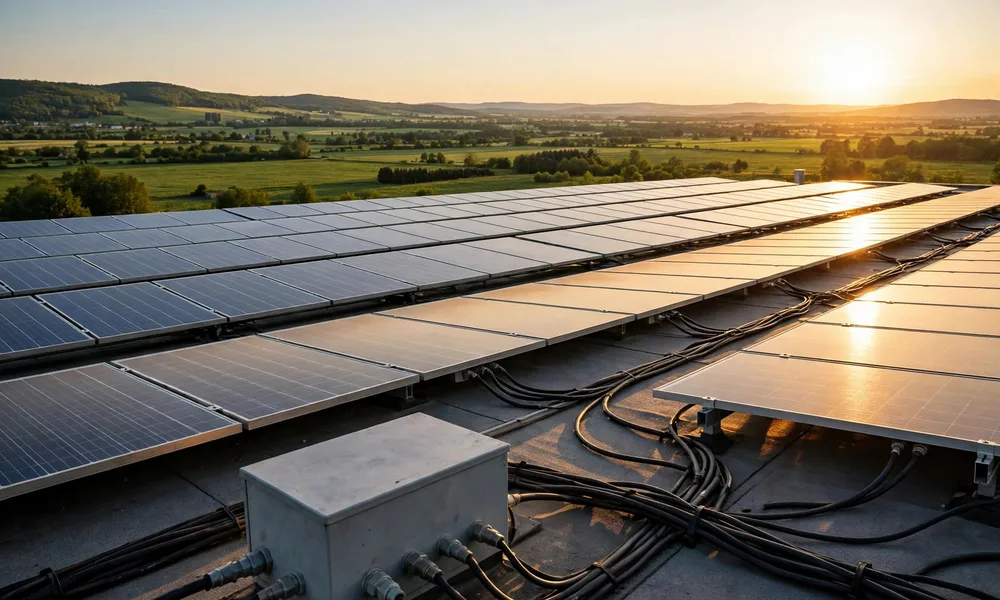
Aicot is a short name for a technology that solves a dangerous problem most solar owners have never heard of. When the power grid fails, a home solar system can keep feeding electricity into local lines that workers believe are dead. That hidden danger has a name, islanding, and stopping it fast is the whole job of OMRON’s AICOT.
In this explainer we answer what is aicot in simple words: what it stands for, why islanding is risky, how OMRON’s method detects a failure in a fraction of a second, and why the company gave the technology away to the whole industry.
| Full Name | AICOT: Anti-Islanding Control Technology |
|---|---|
| Developer | OMRON Corporation, Japan |
| Purpose | Detect grid failure and stop a solar system feeding power into dead lines |
| Detection Method | Watching for changes in frequency, with small reactive power steps |
| Detection Speed | Islanding detected in about 0.2 seconds, according to OMRON |
| First Product | PV inverter equipped with AICOT launched in 2011 |
| Development Time | About eight years, according to OMRON |
| Standards Link | Became a Japanese standard approach for grid connection; linked to JET certification and IEC 62116 testing in industry reports |
The Problem: What Is Islanding?
To understand AICOT, you first need the problem it solves. A normal rooftop solar system sends power in two directions in daily life: into the home, and out into the local grid when the panels make more than the home uses. The grid is always there, steady and strong, holding the local voltage and frequency in place.
Now imagine a storm, a crash or a fault cuts power to a street. The grid side goes silent. But the sun is still shining, so the solar panels on that street keep making power. If their inverters keep feeding that power into the local wires, the cut off section of the network stays live on its own, like a small island of power in a dead sea. That is islanding, or more precisely, unintentional islanding.
Islanding is dangerous for two clear reasons. The first is human life. Repair crews arrive expecting the lines on that street to be dead so they can work safely. A line secretly fed by rooftop solar can give a worker a severe or fatal shock. The second is equipment. When the main grid is reconnected, power from the island can be out of step with power from the grid. That clash can damage appliances, inverters and transformers. For both reasons, solar inverters are required to spot a grid failure and shut down very fast.
Why Older Methods Struggled on Busy Streets
Early anti islanding methods were mostly passive. The inverter watched the voltage and frequency of the grid and shut down if they moved outside safe limits. For a single solar home on a street, that works fairly well. The grid failing makes a clear change, and the inverter sees it.
The problem grew as solar spread. On a street where many homes have solar, many inverters are watching and reacting at once, and their small effects can cancel each other out. The change caused by a real outage can be masked, and passive detection can become slow or fail in the exact crowded conditions where safety matters most. As OMRON tells the story, this multi unit problem was known in the industry, and it had a practical effect: in some places, limits were placed on how many systems could be installed close together.
Japan in the 2000s was pushing hard to spread home solar power, including whole model neighbourhoods with solar on many houses. A safety method that only worked when systems were spread out was holding that vision back. OMRON, a Japanese company with deep roots in sensing and control, took on the problem through research linked to a national energy program, working under a project structure involving NEDO and Kandenko, according to its own account.
How AICOT Works, in Simple Words
AICOT stands for Anti-Islanding Control Technology. Its core idea is active, not passive. Instead of only watching and waiting, a power conditioner with AICOT keeps checking the health of the grid by introducing very small, controlled changes in reactive power and watching how the frequency responds.
Think of it like gently pushing a large, steady ship. While the huge grid is connected, it absorbs those tiny pushes with almost no visible movement, because the grid is so strong and stable. The frequency barely changes. But if the grid fails, the steadying force vanishes. The same tiny push now produces a clear, fast shift in frequency on the isolated section, because there is nothing big holding it steady. The inverter sees that shift at once and knows the grid is gone.
Speed is the famous part of the story. OMRON says AICOT can detect islanding in 0.2 seconds by watching those frequency variations. Industry reporting on OMRON inverters adds that the full system can shut the inverter down within the time required by grid codes, described as under five seconds. That combination, fast detection even with many units side by side, and little interference between them, was the breakthrough. OMRON describes itself as the first in the industry to develop anti islanding control technology that works when several systems are installed close together.
From Eight Years of Work to an Open Patent
AICOT was not a quick invention. OMRON says the technology took eight years to develop. In 2011, the company launched a PV inverter equipped with the new technology. For homeowners and installers, the practical effect was freedom: because the method worked with many systems together and caused little interference, the old restrictions on installation were no longer needed. Solar could be installed throughout an entire community, house after house, rather than in careful, spaced out pockets.
Then OMRON did something unusual. To help solar power spread further, the company released the patent for AICOT to the public. A technology that took eight years to build was opened up so that other manufacturers could use it in their own PV inverters, and OMRON notes that a variety of manufacturers do use it today. That choice turned a company advantage into an industry wide safety gain.
The technology also became part of the rules of the game. Industry coverage describes AICOT as adopted as a Japanese standard approach, needed in connection with JET certification, which is required for grid connection in Japan, and notes OMRON inverters meeting the international islanding test standard IEC 62116. In simple terms, what began as one company’s research project became part of how safe solar connections are judged.
A final clarification helps readers searching this topic today. Some newer web pages use the letters AICOT or AI and OT for unrelated ideas about artificial intelligence and operational technology security. Those are different subjects sharing similar letters. The original, documented AICOT in the solar field is OMRON’s Anti-Islanding Control Technology described here. If a page does not mention OMRON, inverters or islanding, it is almost certainly talking about something else.
Why It Still Matters for Solar Owners Today
Most solar owners will never think about islanding, and thanks to technologies like AICOT, they do not need to. The safety check runs in the background, in the inverter, every second the sun shines. But its importance grows every year, because the original problem grows every year: more roofs, more systems side by side, more streets where a grid failure would otherwise leave hidden live islands behind.
For buyers, the lesson is not to shop for the AICOT name on a box. It is to buy certified inverters from reputable makers, installed by qualified installers who follow local grid codes. Anti islanding protection is a required safety function, tested against standards. OMRON’s contribution was to make that function fast and reliable in crowded, real world conditions, and then to share it so the whole market could meet the same bar.
For anyone who cares about clean energy, the story is also encouraging. One of the quiet blockers to community wide solar was not panel cost or sunshine, but a safety puzzle in the electronics. Solving it took patient engineering over eight years. That is often how energy progress really happens: not only in big visible panels, but in small, clever controls that make the big visible change safe.
You may also read: Annaliese Witschak: The Full Story of George Soros’ Ex-Wife
FAQs
What does AICOT stand for?
AICOT stands for Anti-Islanding Control Technology. It is a safety technology developed by OMRON for solar power systems. It detects when the main grid has failed and stops the solar inverter feeding power into lines that should be dead.
How fast can AICOT detect a grid failure?
OMRON says AICOT can detect islanding in 0.2 seconds, by spotting changes in frequency after small reactive power steps. Industry reports add that the inverter then shuts down within the time limit set by grid codes.
Why is islanding dangerous?
If solar systems keep powering a cut off section of the network, repair workers can be shocked by lines they expect to be dead. Out of step power from the island can also damage appliances, inverters and transformers when the main grid is reconnected.
Do all solar inverters use AICOT?
OMRON released the patent publicly, and says a variety of manufacturers use the technology in their PV inverters. Not every inverter in the world uses this exact method, but all grid connected inverters must have tested anti islanding protection that meets local standards.
Final Thoughts
Aicot answers a question that sits at the heart of the solar age: how do thousands of small home power stations share one grid without endangering the people who repair it? OMRON’s answer was active detection, watching frequency respond to tiny controlled pushes, spotting a failure in 0.2 seconds, and working even when many systems stand side by side.
Launched in a product in 2011 after eight years of work, and then opened to the whole industry, AICOT helped remove limits on community solar in Japan and raised the safety bar for everyone. It is invisible, technical and easy to overlook, which is exactly why it deserves an explainer. The safest technologies are usually the ones you never notice at work.


