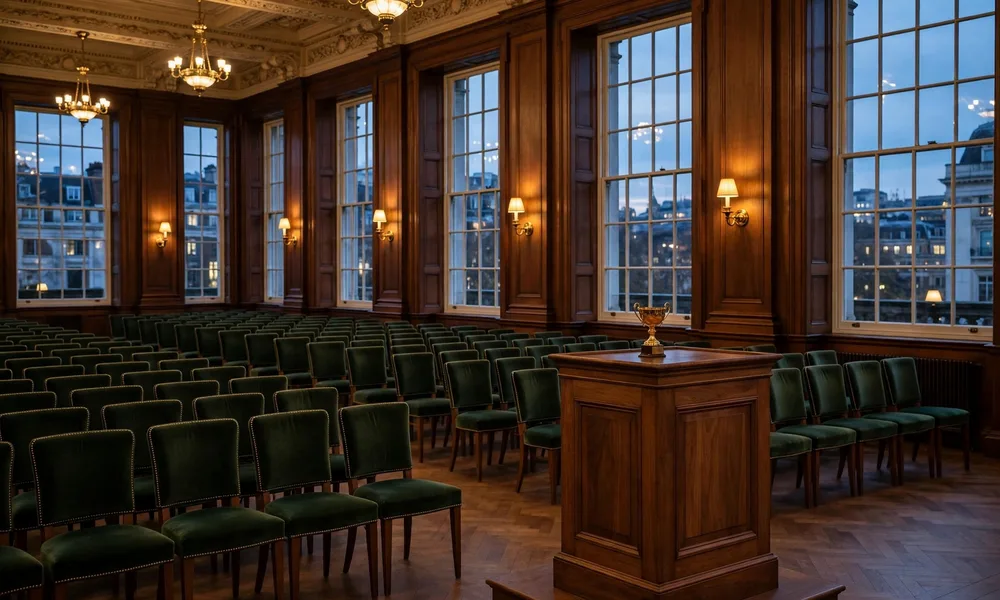
British author M. John Harrison has won the 2026 Booker Prize for his novel The End of Everything, becoming the oldest winner in the history of the prize. Harrison, 81, received the award at a ceremony at Old Billingsgate in London on Monday, November 9, 2026. He passes Margaret Atwood, who was 79 when she jointly won in 2019 for The Testaments. The win is his first Booker nomination and his first Booker win, after a writing career that spans six decades.
Quick Facts
| Fact | Detail |
|---|---|
| Winner | M. John Harrison, age 81 |
| Winning book | The End of Everything |
| Prize | 50,000 pounds, about 67,000 dollars |
| Ceremony | Old Billingsgate, London, Monday November 9, 2026 |
| Judges chair | Historian Mary Beard |
| Trophy presented by | David Szalay, the 2025 winner |
| Book length | 198 pages, the shortest on the shortlist |
| Setting | Near-future Kent coast, fictional town of Dalston-on-Sea |
| Publisher | Serpent’s Tail, an imprint of Profile Books |
| Submissions | 163 books entered, six finalists |
A Historic Night in London
The ceremony at Old Billingsgate brought together writers, publishers, and judges for one of the biggest nights in the literary calendar. When Harrison’s name was announced, the room marked a moment that had been decades in the making. The judges chose his novel unanimously, a rare show of agreement on a panel that had spent months reading through 163 submitted books.
The prize comes with 50,000 pounds, about 67,000 dollars, and a trophy presented by David Szalay, who won the Booker Prize the previous year. For Harrison, the money and the trophy matter, but the history matters more. No writer this old has ever won the Booker Prize before. Margaret Atwood held the previous record at 79, when she shared the 2019 prize for The Testaments. Harrison, at 81, now stands alone at the top of that list.
He is also the first Booker winner to come from the world of science fiction. That background shaped the novel that won him the prize, and it shaped the way he writes about the future. His career began in the 1960s, and he has published across genres for more than sixty years, building a readership that spans literary fiction and speculative fiction alike.
The Book That Won
The End of Everything is a dystopian satire of 198 pages, the shortest book on the shortlist. It is Harrison’s 13th novel. The story is set on the near-future Kent coast, in the fictional town of Dalston-on-Sea, after social order has broken down. It follows Phillip Tennent and his elderly aunt Marnie as they try to live through a world that no longer works the way it used to.
Into that broken world come mysterious shapeshifting entities called the iGhetti. They are strange, unsettling, and hard to pin down, and they give the novel its eerie pull. The book mixes dark humor with a bleak picture of a society coming apart, and it does so in under 200 pages. Readers and critics have praised it for saying a great deal in very little space, a skill that takes a lifetime to learn.
The short length is part of the story of this win. In a year when the shortlist included big, sprawling novels, the judges picked the smallest book on the list. That choice says something about what they valued: sharp writing, a clear vision, and a story that does not waste a single page.
The Judges and Their Decision
The judging panel was chaired by historian Mary Beard, and it brought together a striking mix of voices. Poet Raymond Antrobus, musician Jarvis Cocker, the frontman of Pulp, critic Rebecca Liu, and novelist Patricia Lockwood served alongside her. It was an unusual panel, and it reached an unusual result: a unanimous decision.
Beard made one point clearly after the announcement. This was not a lifetime achievement award. The judges picked the book, not the career behind it. That matters, because Harrison’s long career could easily have invited that reading. He has been writing for six decades. He has fans across the literary world. But the judges insisted that The End of Everything won on its own strength, as a novel published in 2026, judged against the other books of the year.
The unanimous vote adds weight to that claim. Panels rarely agree so fully, and when they do, it signals that one book stood apart in the room. Harrison’s win, then, is both a surprise and a clear statement about the quality of the book itself.
Harrison knows the judging process from the other side. He served as a Booker judge in 2022, reading and weighing other writers’ books. That experience gives him a rare view of the prize. He has sat in the room where the decision gets made, and now he has won the prize that room awards. Few writers can say that.
A Career of Six Decades
Harrison’s career spans six decades, and it has never stayed in one lane. He began writing in the 1960s and built his name in science fiction before moving across literary fiction, fantasy, and criticism. He is the first Booker winner to come from the science-fiction world, a fact that will be noted every time this win is discussed.
Outside writing, he was a rock climber and a fell runner, pursuits that demand patience, nerve, and a comfort with lonely landscapes. Those qualities show up in his fiction, which often places its characters in strange, open spaces where the rules are unclear. The Kent coast of The End of Everything is one of those spaces: familiar and English, yet changed beyond recognition.
The win also marks a first for his publisher. Serpent’s Tail, an imprint of Profile Books, had never won the Booker Prize before. For a smaller literary imprint, a Booker win changes everything. It brings attention, sales, and a place in the history of the prize that no amount of marketing can buy.
The Shortlist He Beat
The path to the prize ran through 163 submissions, narrowed to a 13-book longlist and then to six finalists announced in September. The shortlist was one of the strongest in recent years, and it included two former winners. Marlon James and Douglas Stuart had both won the Booker before, and both were in contention again. Elizabeth Strout, Rebecca Perry, and Luke Kennard completed the list of six.
Beating two former winners is no small feat. It is also a sign of how open the prize remains. Past winners do not carry an advantage, and a first-time nominee can still take the top prize. Harrison’s win proves that the Booker can still surprise, and that a writer in his ninth decade can still produce the best novel of the year.
The announcement lands at a busy moment for the arts world, where major prizes and ceremonies arrive in quick succession. Recent coverage of Johnny Depp at the Ebenezer London premiere showed how crowded the season has become, while the Apple TV comedy starring Julia Louis-Dreyfus and Cecily Strong reminded readers that screen and stage are competing for the same attention. Even the honorary Oscars ceremony honoring Ridley Scott filled the same week with star power. Against that noise, a quiet literary prize for a 198-page dystopian satire still managed to make headlines around the world.
What This Win Means for Readers
For readers, the win is a simple invitation: pick up a short book by a writer you may not know, and see what the fuss is about. At 198 pages, The End of Everything is a book that can be read in a weekend, and it offers a complete world in that short span. The Booker Prize stamp will put it in bookshops and libraries where it might otherwise have been missed, and it will introduce Harrison to readers who have never read his work.
For the literary world, the win raises a question that will be debated for months. If a writer from science fiction can win the Booker, what else has the prize been missing? The boundary between literary fiction and genre fiction has been blurring for years, and Harrison’s win pushes it further. His career, built across genres, now stands as proof that the best novel of the year can come from anywhere.
The age record matters too. At 81, Harrison shows that a writer’s best work does not have to come early. His 13th novel won the biggest prize in English-language fiction. That is a message for every writer who worries that their time has passed, and for every reader who assumes that the newest voice is always the sharpest one.
FAQs
Who won the 2026 Booker Prize?
M. John Harrison won the 2026 Booker Prize for his novel The End of Everything. The award was announced at a ceremony at Old Billingsgate in London on Monday, November 9, 2026.
Why is this win historic?
Harrison, at 81, is the oldest winner in Booker Prize history. He passes Margaret Atwood, who was 79 when she jointly won in 2019 for The Testaments. He is also the first winner to come from the science-fiction world, and the first winner for his publisher, Serpent’s Tail.
What is The End of Everything about?
The novel is a dystopian satire set on the near-future Kent coast, in the fictional town of Dalston-on-Sea, after social order breaks down. It follows Phillip Tennent and his elderly aunt Marnie amid mysterious shapeshifting entities called the iGhetti.
How much is the Booker Prize worth?
The Booker Prize is worth 50,000 pounds, about 67,000 dollars. The winner also receives a trophy, which in 2026 was presented by David Szalay, the previous year’s winner.
SOURCES
Final Thoughts
M. John Harrison waited six decades for this moment, and when it came, it came for the right reason: a short, sharp novel that the judges chose unanimously. The age record will lead the headlines, and it deserves to. But the book itself is the real story. The End of Everything is a dystopian satire that fits a whole broken world into 198 pages, and it won against a shortlist that included two former winners. For readers, that is the best kind of prize result: a book worth reading, by a writer worth discovering, at an age that proves great writing has no deadline.