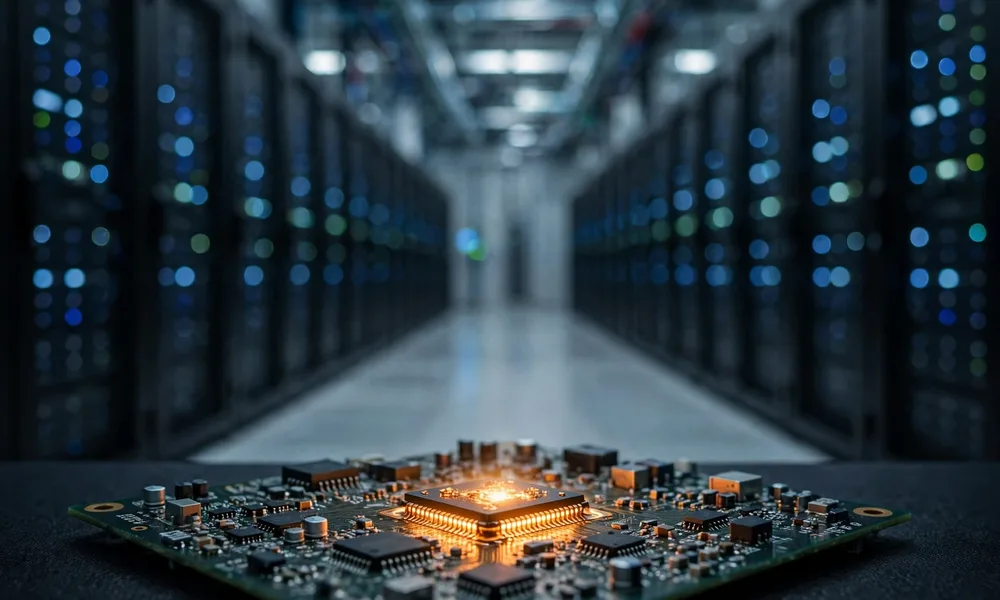
Google unveiled two new AI chip systems, TPU 8tx and TPU 8i Max, on Monday, November 9, 2026. They are the third and fourth TPU systems Google has introduced in a single year, and the move is a direct challenge to Nvidia in cloud AI hardware. TPU 8tx is built for secure and confidential inference for banks, governments, and other regulated organisations. TPU 8i Max is built for very large context windows and long-context work. Neither system uses new silicon. Both are reconfigurations of chips Google already announced. Google gave no price, no general-availability date, and no regions for either system. Amin Vahdat told Bloomberg the systems will be available next year, meaning 2027.
Quick Facts
| Detail | What we know |
|---|---|
| Announcement date | Monday, November 9, 2026 |
| New systems | TPU 8tx and TPU 8i Max |
| Announced by | Amin Vahdat, Senior Vice President and Chief Technologist for AI and Infrastructure at Google |
| TPU 8tx purpose | Secure and confidential inference, and small-scale training |
| TPU 8i Max purpose | Very large context windows, long-context work, and multi-agent inference |
| TPUs launched in 2026 | Four in total, a first for Google |
| Availability | Next year, meaning 2027, according to Vahdat speaking to Bloomberg |
| Price and regions | Not announced |
| Independent benchmarks | None published so far |
| TPU customers | Nearly 100, according to Google, with none named |
What Google Announced on November 9
Google made the announcement in a blog post by Amin Vahdat, Senior Vice President and Chief Technologist for AI and Infrastructure at Google. The post introduced TPU 8tx and TPU 8i Max on the same day, and it placed both systems in the wider story of Google building its own AI hardware for Google Cloud.
The timing matters. The announcement lands as Nvidia faces a board probe into chief executive Jensen Huang and its shares slumped on Monday, November 9, while the wider market rallied. Google is positioning its in-house chips as an alternative to Nvidia hardware for cloud AI work, and the launch gives that message a clear and timely focus.
Neither system uses new silicon. Both are reconfigurations of chips Google already announced, now aimed at different kinds of AI work, from private workloads to very long and complex tasks.
Google also open-sourced TPU Sync in the same announcement, and it made Cloud Pathways and GKE dynamic slicing generally available.
For the market context around the launch, see Nvidia slumps as Wall Street rallies on Monday, November 9.
TPU 8tx: Confidential AI for Regulated Work
TPU 8tx is built for secure and confidential inference. It is also suited to small-scale training. In simple terms, inference means running a trained AI model to get answers, while training means teaching a model in the first place. TPU 8tx is aimed mainly at the first job, with some ability to handle the second at a smaller scale.
The system uses the same silicon as the TPU 8t training chip, paired with 5th Generation AMD EPYC CPU hosts and the Boardfly network from TPU 8i. It keeps sensitive data and model weights protected and isolated even while in active use.
Google is targeting banks, governments, and other regulated organisations that want to run AI models on their most sensitive data.
Google claims up to 2x lower latency than TPU 8t. Latency is the delay before a model answers, so lower latency means faster responses. That claim comes from Google alone, and no independent benchmark of TPU 8tx has been published.
That protection is the point for the customers Google names. A bank or a government body cannot treat its most sensitive records like ordinary web data. It needs to know that the data and the model weights stay isolated while the model is running, not only when the data is stored. TPU 8tx is Google’s answer to that need.
TPU 8i Max: Built for Long Context and the Memory Wall
TPU 8i Max is built for very large context windows and what Google calls the memory wall. A context window is the amount of information a model can hold in mind at one time, and the memory wall is the slowdown when a model needs more memory than the hardware can easily supply.
TPU 8i Max puts two TPU 8i chips in one package. According to Google, that delivers double the compute, double the on-chip SRAM, and double the HBM bandwidth of TPU 8i, in the same rack footprint. A rack footprint is the physical space the hardware takes up in a data centre, so Google is saying customers get twice the power without needing twice the space.
TechTarget, citing Google, puts those figures at 768MB of SRAM and 17.2TB/s of HBM bandwidth.
The system is aimed at long-context work and multi-agent inference, for example dozens of AI agents working across an entire codebase or hours of video at once.
The same rack footprint is a practical point as well as a technical one. A data centre has limited space, power, and cooling, so a system that doubles compute, SRAM, and HBM bandwidth without taking more rack space lets a customer do far larger jobs in the space it already has. For long-context work, where a model must hold a huge amount of information at once, that extra memory and bandwidth is what keeps the work moving.
Like TPU 8tx, TPU 8i Max has no independent benchmark published so far. Every performance claim so far is Google’s own.
Four TPUs in One Year: What Changed
With these two systems, Google has introduced four TPU systems in a single year for the first time. The first two were TPU 8t for large-scale training and TPU 8i for real-time reasoning. Both were introduced at Google Cloud Next in April 2026. Now TPU 8tx and TPU 8i Max join them.
Vahdat wrote: “This is the first time we have introduced four TPU systems in a single year.”
Four systems in one year is a sharp change of pace. Google is building a full family of chips, each aimed at a different job: large-scale training, real-time reasoning, confidential work, and very long context.
Demand for AI computing is high, and cloud customers want choice. For years, Nvidia hardware has been the default for much of AI training and inference. Google is trying to give customers a real alternative inside Google Cloud.
Google’s wider chip ambitions are not limited to TPUs for data centres. The company is also working on space-based computing, as covered in Google TPU orbit and Project Suncatcher.
What This Means for Nvidia and for Cloud Customers
Google wants a bigger share of the AI hardware market and wants to reduce how much the industry depends on one supplier. Nvidia still leads, but Google now has a growing range of its own systems to offer through Google Cloud.
The timing adds to the story. The announcement came on the same day Nvidia shares slumped while the wider market rallied, and as Nvidia faces a board probe into Jensen Huang. The probe and the share move are separate stories, but they sit in the same news cycle as the Google launch. Readers who want that background can read Jensen Huang admits affair as Nvidia board opens spy probe.
Google says TPUs now serve nearly 100 customers, including frontier labs, trading firms, retailers, and universities, but it named none of them.
Google gave no price, no general-availability date, and no regions for either new system. Amin Vahdat told Bloomberg the systems will be available next year, meaning 2027, but that is the only timing detail available so far.
Every performance claim so far is Google’s own, and no outside test has been published. The headline figures should be treated as claims to test, not as proven results.
For now, readers should wait for the missing pieces. Price will decide who can use these systems. A general-availability date and a list of regions will decide when and where the work can run. Independent benchmarks will decide whether the doubled figures and the latency claim hold up outside Google’s own tests.
FAQs
What are TPU 8tx and TPU 8i Max?
They are two new AI chip systems unveiled by Google on Monday, November 9, 2026. TPU 8tx is built for secure and confidential inference and small-scale training. TPU 8i Max is built for very large context windows and long-context work, including multi-agent inference.
Are TPU 8tx and TPU 8i Max brand new chips?
No. Neither new system is new silicon. Both are reconfigurations of chips Google already announced. TPU 8tx uses the same silicon as the TPU 8t training chip, paired with 5th Generation AMD EPYC CPU hosts and the Boardfly network from TPU 8i. TPU 8i Max puts two TPU 8i chips in one package.
When will TPU 8tx and TPU 8i Max be available, and how much will they cost?
Google gave no price, no general-availability date, and no regions for either system. Amin Vahdat told Bloomberg the systems will be available next year, meaning 2027. No other timing or pricing detail has been shared so far.
Why is Google launching these chips now?
Google has introduced four TPU systems in a single year for the first time. The launch positions its in-house chips as an alternative to Nvidia hardware, at a time when Nvidia faces a board probe into its chief executive and its shares slumped on Monday, November 9, while the wider market rallied.
Sources
Final Thoughts
Google unveiled TPU 8tx and TPU 8i Max on November 9, 2026. Four TPU systems in a single year is a first for Google, and it shows a company moving fast to build a full alternative to Nvidia hardware inside its own cloud. TPU 8tx is for organisations that need to run AI on sensitive data with protection in place. TPU 8i Max is for work that needs very large context windows and many agents working together. Both are reconfigurations of existing chips, not new silicon. Still, the gaps matter. There is no price, no general-availability date, and no regions. There are no independent benchmarks, and every performance claim so far is Google’s own. The real test will come in 2027, when the systems reach customers and outside testing can show whether the claims hold up in real work.