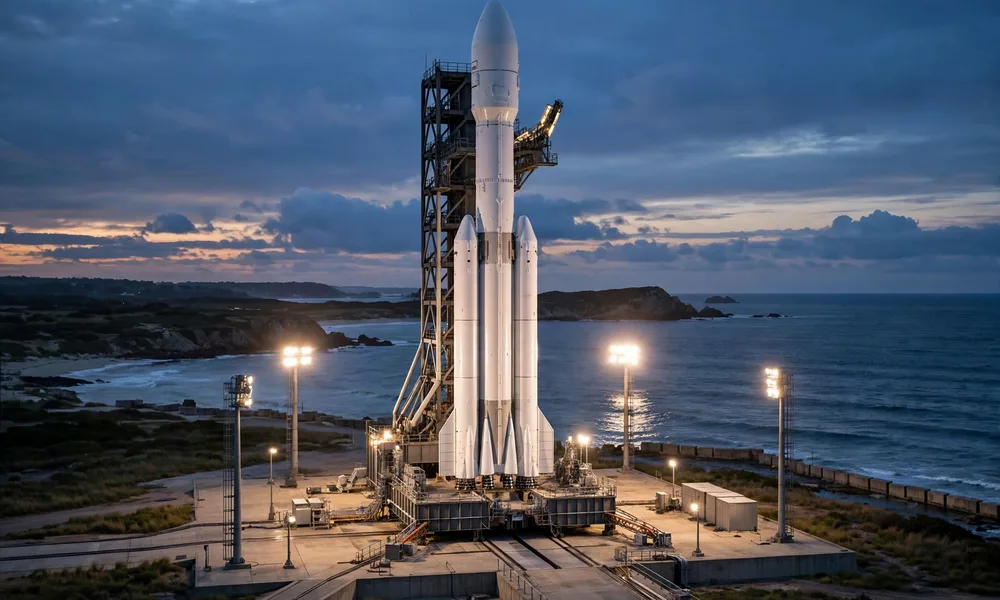
Blue Origin has pushed the return to flight of its New Glenn heavy lift rocket to January 2027. Chief executive Dave Limp told staff the new target in an internal memo, according to Reuters, which saw the memo and spoke to two people familiar with the matter. The Financial Times first reported the news on Thursday, November 5, 2026. The rocket has been grounded since a major explosion during a test on May 28, 2026, destroyed the vehicle and badly damaged its only launch pad. Blue Origin had hoped to fly again before the end of 2026. That plan is now gone, and no exact date in January has been announced.
Quick Facts
| Item | Detail |
|---|---|
| Rocket | New Glenn, a 322 foot tall heavy lift rocket |
| New return target | January 2027, with no exact date announced |
| Previous target | December 2026, described by founder Jeff Bezos on October 7, 2026 |
| Grounded since | May 28, 2026, after an explosion during an integrated hot fire test |
| Test site | Launch Complex 36, Cape Canaveral Space Force Station, Florida |
| Cause found | A main oxygen valve on the BE-4 engines, confirmed in August 2026 |
| Flights before the explosion | Three launches since the 2025 debut |
| New hardware shown November 5 | Northstar booster engine and GS3 third stage |
| GS3 first mission target | 2028 |
| Customers affected | Amazon Project Kuiper, NASA Artemis Blue Moon missions, AST SpaceMobile, and other commercial customers |
What Changed and When
Blue Origin moved its return to flight from December 2026 to January 2027. It is a shift of weeks, not a full year, but it matters because the company had already lost months to the May explosion and the long rebuild that followed.
As recently as October 7, founder Jeff Bezos told Fox News that the company was targeting December 2026. Then the internal message from Dave Limp reset expectations. He said, “This small adjustment doesn’t diminish what we’ve accomplished or the importance of the work still ahead.”
The May 28 Explosion That Grounded New Glenn
New Glenn has not flown since May 28, 2026. On that day, the rocket was taking part in an integrated hot fire test at Launch Complex 36 at Cape Canaveral Space Force Station in Florida. A hot fire test is a full dress rehearsal for launch. The engines light, the systems run together, and engineers watch how the whole vehicle behaves under real power.
This test ended in a major explosion. The rocket was destroyed, and the launch pad was badly damaged. The damage mattered even more because Launch Complex 36 is Blue Origin’s only operational New Glenn launch site. There was no second pad ready to take over while the first one was repaired.
The timing made the loss worse. The test happened days before the rocket was set to carry Amazon internet satellites into orbit. Those satellites were part of Project Kuiper, the low Earth orbit constellation that Amazon is building to provide internet service. New Glenn stands 322 feet tall, about the height of a 30 storey building. It had lifted off three times since its debut in 2025 before the May explosion.
What Blue Origin Found and What It Has Repaired
In an update published in August 2026, Blue Origin said it had traced the explosion to a main oxygen valve on the BE-4 engines. The BE-4 is the engine that powers the first stage of New Glenn. A valve failure in that system can release oxygen in a way that leads to fire and a rapid loss of the vehicle.
Finding a cause is only the first part of a return to flight. The second part is fixing the hardware, checking the design, and rebuilding the ground systems that were damaged. That work has taken months, and weather added to the delay. Limp told employees that summer weather had slowed the rebuild, a normal problem in Florida, where heat, rain, and storms can stop outdoor work at a launch site.
Even so, the company reports real progress. Limp said Blue Origin had repaired and restacked the Vehicle Access Tower and restored the launch bridge as part of efforts to return New Glenn to flight. The tower is the tall structure that lets crews reach the rocket for work and loading. The launch bridge is part of the ground path that supports the vehicle before liftoff. Restoring both is a visible sign that the pad is coming back to life. Blue Origin has not announced an exact January date. Any specific January day circulating online should be treated as unconfirmed.
Two New Upgrades Unveiled on the Same Day
On November 5, at the UP.Summit conference at the Shuttle Landing Facility in Florida, Blue Origin unveiled two major New Glenn upgrades. The first is Northstar, a methane fueled booster engine built with additive manufacturing. Additive manufacturing builds parts layer by layer, which can reduce the number of separate pieces in a complex engine. Blue Origin says Northstar cuts parts count by about 50 percent and targets roughly 25 percent of the production cost of the BE-4 engine it supplements. That cost figure is a company goal, not a demonstrated number, so readers should treat it as a target rather than a proven saving. Northstar has no confirmed operational introduction date. For a look at how big technology bets are being judged right now, see our report on the Anthropic IPO valuation risk and our report on OpenAI 11 billion funding.
The second upgrade is GS3, a hydrogen fueled third stage powered by a single BE-7 engine. Blue Origin built GS3 around what the company says will be the first composite liquid hydrogen tank to fly in space. A composite tank uses light, strong materials instead of metal alone, which can save weight and improve performance. Blue Origin is targeting 2028 for the first mission of GS3, and the company says it has already secured a government customer for a cislunar mission, a mission in the region between Earth and the Moon.
What the Delay Means for Kuiper, Artemis, and Other Customers
Amazon Project Kuiper is one of the most affected programs. Kuiper is building a constellation of satellites in low Earth orbit to provide internet service. It needs many launches to place enough satellites in orbit, and each missed launch window pushes the schedule back. The May test was set to carry Kuiper satellites just days after the explosion. Since then, Amazon has had to rely on other launch providers while it waits for New Glenn to return.
NASA Artemis missions are also affected through Blue Origin’s Blue Moon lunar lander. Blue Moon is part of the Artemis program, which aims to return astronauts to the Moon and build a lasting presence there. A lander needs a heavy lift rocket to reach lunar orbit, and delays in the rocket program can affect testing, cargo flights, and mission planning.
Why January 2027 Matters for the Heavy Lift Race
The heavy lift market is now a race between a small number of large rockets. SpaceX flies Falcon Heavy and is testing Starship. United Launch Alliance flies Vulcan Centaur. Blue Origin flies New Glenn. The winner is not decided by one launch, but by who can fly often, safely, and at a price customers can accept.
New Glenn entered that race in 2025 with a strong debut and three flights before the May explosion. The grounding stopped its momentum. While New Glenn sat on the ground, other rockets kept flying, kept learning, and kept signing new customers. January 2027 is therefore more than a return date. It is a chance for Blue Origin to show that the pause was a repair period, not the start of a longer decline.
The return flight will also be a test of the fixes made after the May explosion. Engineers will watch the BE-4 engines, the oxygen valve system, and the rebuilt pad with care. A smooth flight would prove that the cause was found and fixed. A problem on the pad or in flight would force another review and another delay, which would be far more damaging than the current slip. For recent remarks on space policy, see our report on Trump Kennedy Space Center remarks.
Frequently Asked Questions
When will New Glenn fly again?
Blue Origin has pushed the return to flight to January 2027. Chief executive Dave Limp told staff the new target in an internal memo reported on November 5, 2026. The company has not announced an exact date in January. Any specific January day circulating online should be treated as unconfirmed until Blue Origin confirms it.
Why was New Glenn grounded?
New Glenn has been grounded since May 28, 2026, when a major explosion during an integrated hot fire test at Launch Complex 36 destroyed the rocket and badly damaged the launch pad. Blue Origin later traced the explosion to a main oxygen valve on the BE-4 engines. The pad is the company’s only operational New Glenn launch site, so the damage forced a long rebuild.
What is Northstar and what is GS3?
Northstar is a methane fueled booster engine built with additive manufacturing. Blue Origin says it cuts parts count by about 50 percent and targets roughly 25 percent of the production cost of the BE-4 engine it supplements. That cost figure is a company goal, not a demonstrated number, and Northstar has no confirmed operational introduction date. GS3 is a hydrogen fueled third stage powered by a single BE-7 engine. Blue Origin is targeting 2028 for its first mission and says it has already secured a government customer for a cislunar mission.
How does the delay affect Amazon Kuiper and NASA Artemis?
The delay affects Amazon Project Kuiper, which needs many New Glenn launches to build its low Earth orbit satellite constellation, and Blue Origin’s Blue Moon lunar lander missions under NASA’s Artemis program. It also affects AST SpaceMobile and other commercial customers. Each customer must now plan around a January 2027 return, and any further slip would add more pressure to schedules that are already tight.
Sources
Final Thoughts
Blue Origin has chosen honesty over speed. It could have held to a December target that no longer fit the work, but it moved the date to January 2027 and told staff why. That choice is better than a rushed launch, and it is better than silence. Rockets are unforgiving machines, and a pad explosion is a reminder that testing is where problems must be found. The tower is restacked, the bridge is restored, and the valve cause is known. If New Glenn flies cleanly, the delay will look like a short pause. Until an exact January date is announced, January 2027 is a target, not a guarantee.
Featured image: AI-generated editorial illustration for this story.